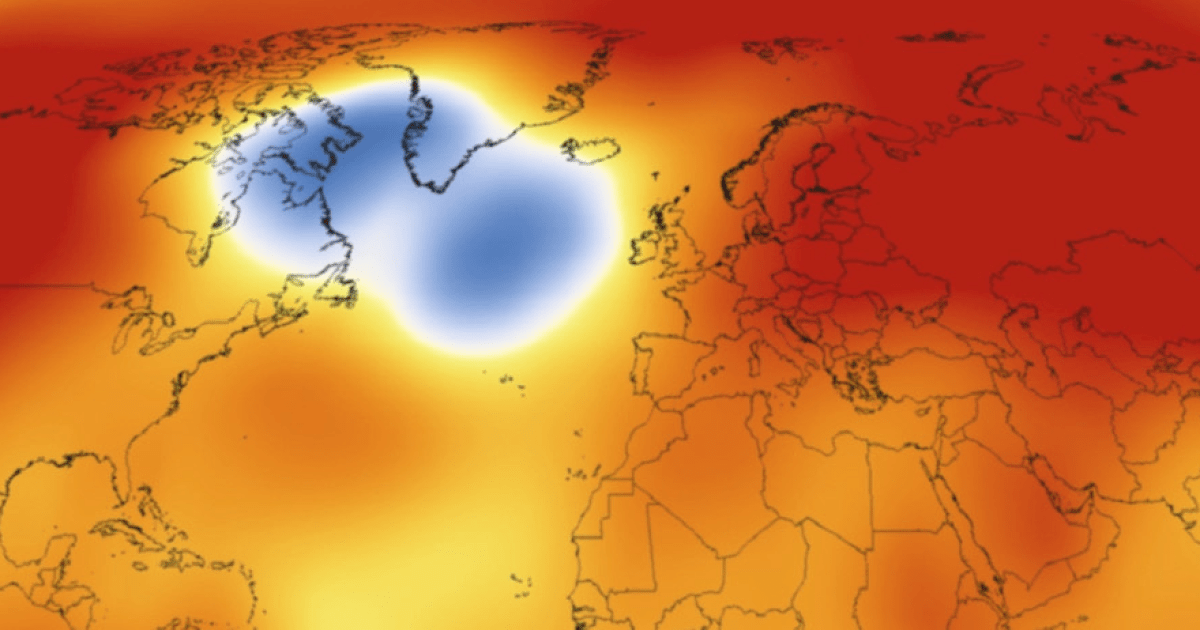
The science of climate change is complex, but the overall effect is pretty simple – the planet is getting warmer.Except, however, for a cool ‘blob’ just southeast of Greenland that no one has ever been able to properly explain.The blob, also called the ‘warming hole’, is a large patch of the North Atlantic that has cooled by as much as 1°C over the last few decades.
Now scientists think they know what’s behind the blob: the Atlantic Meridional Overturning Circulation (AMOC), a tangle of currents.AMOC (pronounced: AY-mock) carries warm, salty surface waters from the tropics into the North Atlantic, where they cool and sink into the ocean.This oceanic conveyor belt has a massive influence on the weather as the currents transfer heat around the planet, so any changes in it would have cascading effects for large parts of the planet.
And quite a big change is happening now, according to a study published in Geophysical Research Letters: AMOC is weakening.AMOC slowing isn’t a discovery – but scientists have never been able to agree on why it’s happening.As Atlantic currents are powered by wind, salinity and heat, some suggest that the blob is caused by strong winds that could be forcing more evaporation, sucking heat from the ocean.
With more water in the air, more clouds are forming above, blocking out the sun above the oceans below Greenland.Yet University of California, Riverside, climate scientist Wei Liu, who led the study, found that the cold blob is 1,000 metres deep, suggesting the ocean is the biggest factor.‘People have been asking why this cold spot exists.
We found the most likely answer is a weakening AMOC,’ she said.Her team only had about 20 years of data to work with but managed to dive further back by looking over weather observations made by boats and satellites, called a climate reanalysis.Follow Metro on WhatsApp to be the first to get all the latest news Metro’s on Whatsapp! Join our community for breaking news and juicy stories.
Her team found that heat loss from the ocean surface has decreased in the blob since 1955.Stefan Rahmstorf at the Potsdam Institute for Climate Impact Research in Germany, who was also involved in the study, said wind and clouds only explain a ‘modest fraction of the warming hole’.What does AMOC weakening mean for us? While the blob covers some of Greenland, the rest is not so lucky.
Cold water from the country’s melting ice sheets is flowing down to the Atlantic.All this chilly water sloshing around is diluting the tropical waters brought by one of AMOC’s warm currents, the Gulf Stream, so less water is sinking south of Greenland.When one part of the AMOC slows down, this could grind the system to a halt – scientists believe that it will weaken by at least 20% by 2100, possibly shut down altogether.
For one, less tropical heat would make its way into the northern reaches of the Atlantic, making the UK and the Nordic countries colder, Jim NR Dale, a climate expert not involved in the study, told Metro.Dale, a meteorologist with the British Weather Services, said AMOC is ‘without a doubt’ one of climate change’s biggest ‘tipping points’, or rapid and hard-to-reverse changes in the environment.‘The result is the future potential for a disruption of the AMOC and life as we know it in north west Europe: winters akin to Canada, deep snow and frigid, long-lasting freezing temperatures,’ Dale said.
‘It’s not happened as yet, but it is one of the major consequences of anthropogenic global warming.’ By ‘anthropogenic’, Dale means the view widely accepted by scientists that climate change is the result of humans burning fossil fuels.Outside of Europe, scientists predict the loss of AMOC could cause the sea level to rise rapidly in North America, while the Sahel in Africa and the monsoon regions of Asia would most likely get less rain.Researchers admit that the data isn’t conclusive, so alternative explanations can’t be ruled out.
Trending Now Kebab firm fined £500,000 because of what was actually in a 'lamb' doner UK 1 hour ago By Barney Davis Entrepreneur stabbed to death in luxury London high-rise Donald Trump storms out of interview and rants at 'crooked, one-sided press' Holiday cottages illegally built on £1,000,000 ancient woodland to be demolished AMOC might not even be weakening, with some suggesting that the system’s Norwegian current may be strengthening and hoovering up heat.Agreeing with the findings, Dale added that the cold blob has long ‘stood out like a sore thumb’ compared to the rest of the world.‘It’s almost certainly caused by melting ice [freshwater] off the Greenland ice sheet, seeping into the ocean,’ he said.
‘The colder temperatures create what is known as an Atmospheric Loop with less evaporation taking place at the surface, it simply gets colder still over time.’ Get in touch with our news team by emailing us at [email protected] more stories like this, check our news page.MORE: A mysterious radio signal has been pinging in space every 1.4 hours – now we know why MORE: Trump has eyes on new territory after plans to take over Greenland stall MORE: Trump claims ‘Mexicans love him’ in bizarre video of him parachuting Comments Add as preferred source News Updates Stay on top of the headlines with daily email updates.
This site is protected by reCAPTCHA and the Google Privacy Policy and Terms of Service apply.Your information will be used in line with our Privacy Policy HomeNewsTech Related topics Climate ChangeGreenlandWeatherWeird news
Read More