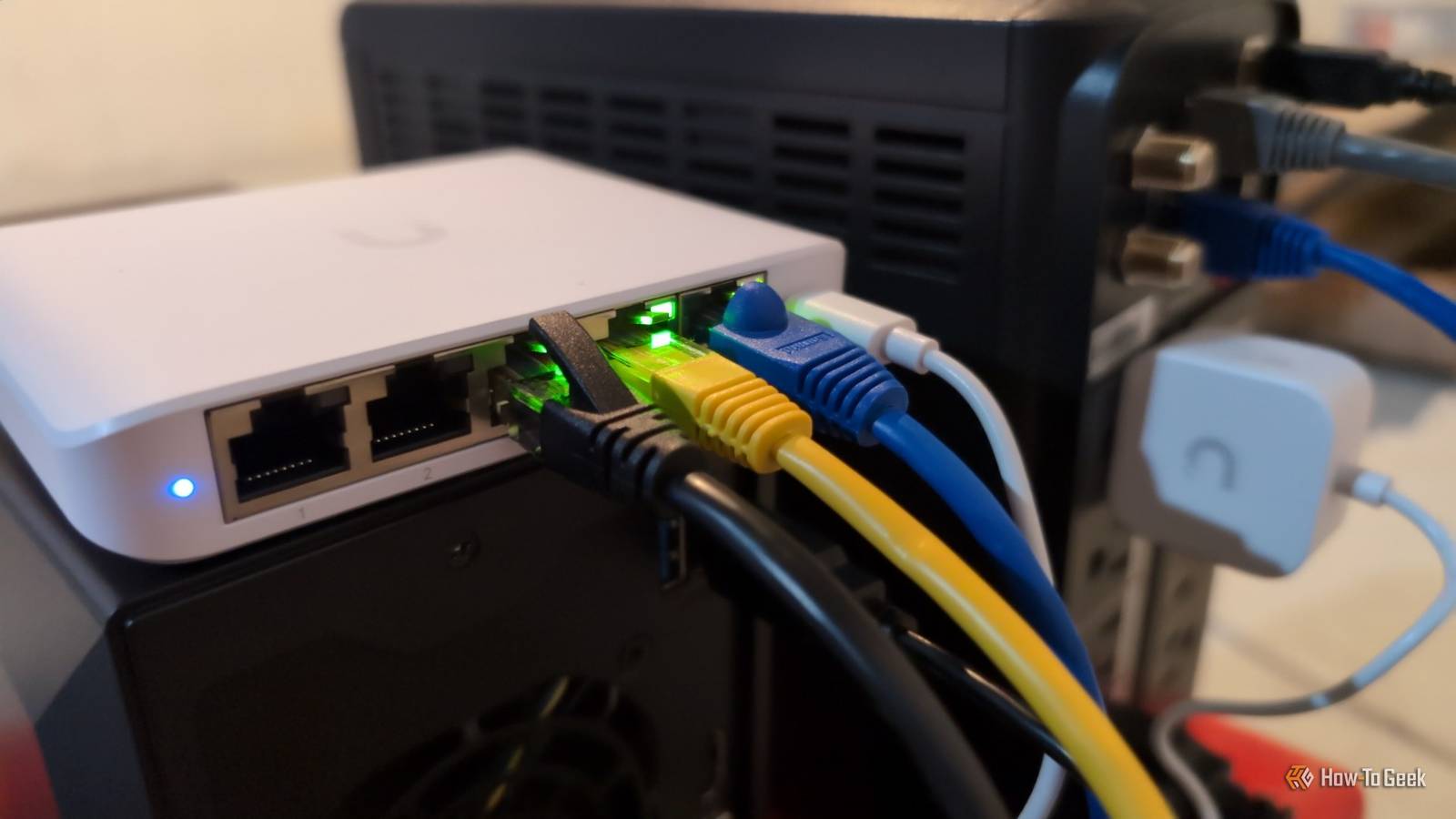
Too many people treat Ethernet cables like an afterthought.You use whatever cable is included with your router, or you buy a random Ethernet cable off of Amazon without verifying whether it actually suits your needs.The thing is, what actually separates budget cables from premium ones isn't obvious from the outside.
If you test a premium cable against one that is super cheap, you'll end up with a pretty different experience, but you woundn't know that from just looking at them.Cheap cables look the same but are built completely differently The different numbers actually have meaning Close I honestly believed that the price of my Ethernet cable did not matter, and wanted to figure out once and for all whether shelling out extra for a fancy network cable actually does anything in the real world.So I set up a head-to-head test between cheap commodity cables and the high-end stuff.
I have plenty of cheap Ethernet cables; I used to make them in school for IT class.My cables were Cat6 and Cat7; they were not high-end.Many of them were free and came with my router from my service provider.
I bought my first premium Ethernet cable from Amazon, and it was flat.The next time I bought one, it was round, but the differences were clear on both ends.Better cables tend to use more advanced shielding, like screened and foiled twisted pair designs where each pair gets its own foil wrap and then the whole thing sits under a braided outer shield.
So not many people understand the differences between the numbers, but they matter a lot.Cat5 is the old reliable, rated for 100 MHz and speeds up to 1Gbps.Cat6 bumps that to 250 MHz and can do 10Gbps up to 55 meters if conditions are good.
But since standard cat5 and Cat6 are unshielded, signal loss and noise really hurt them over longer runs.Cat7 goes to 600MHz and adds shielding around each pair.Cat8 is the top of the copper Ethernet world, tested at 2 GHz to push 25 or 40Gbps over short 30-meter links.
That would tell me whether normal people actually get anything out of high-frequency shielding and fancy connectors, or if plain unshielded budget cables are still fine for everyday stuff.Most people will never notice a difference The lag only comes to those who need the better cable For most people just doing normal stuff like browsing and watching regular streams, there's not going to be much difference between a cat5 and Cat6 cable and an expensive Cat8 cable.A 4K stream is using less than50 Mbps, and a VoIP call barely touches 90 to 156kbps.
Even if you're paying for a full 1Gbps fiber plan, swapping a perfectly fine unshielded cat5 for a double-shielded, gold-plated Cat7 or Cat8 isn't going to magically give you more speed or lower latency.At gigabit speeds or below, plain unshielded twisted pair cabling has way more than enough tolerance to stop high-frequency signal loss.In those easy conditions, paying a ton extra for high-end cables basically just means buying specs your networking gear and daily internet habits can't even use.
You need better cables when you're pushing that cable through long runs, high-EMI environments, and multi-gigabit connections.When cable runs get close to the maximum channel limits, like the standard 100-meter horizontal cabling limit, that's when insertion loss and near-end crosstalk hit the unshielded budget cables hard.I could never put up with a wired connection that was using anything less than a Cat7 today.
I have multiple browsers, sometimes a server running, and a few other things that need a stable connection.I'm not here playing first-person shooters, but the days of turning on a computer to play a flash game are long gone.It comes down to whether you're actually pushing your setup hard enough to need it.
Your grandma likely does not need anything more than an unshielded Cat5 cable.But you're going to get noticeable lag if you try the same setup as a tech enthusiast.You might be paying for fast internet.
However, if your cable can't deliver that to your computer, then you're capping yourself over what could be a one-time $20 purchase.I found my speeds barely exceeded 203Mbps with my yellow free Ethernet cable while my premium black one went up above 600Mbps, and that is usually much higher.The second test used didn't give a similar number despite being the same cords, but either way, it shows the difference.
It may have been from me using the speed tests so much, but it's hard to deny the results.Related My flat Ethernet cable was silently cutting my speeds in half A damaged Ethernet cable dropped my speeds to 100 Mbps, and here's how I found it Posts 30 By Ismar Hrnjicevic How to pick the right cable for your home Cheap cables will hold back your future upgrades I've spent way too much of my life staring at cable specs and pulling wire through walls, but that's given me strong opinions.A few years back, I helped my mother wire up her new apartment, and the amount of garbage advice I had to wade through was unreal.
Standard unshielded copper patch cords are totally fine for everyday use.I hate seeing people drop serious cash on fancy cables when their router can't even push past a gigabit.But if your network has high-bandwidth upgrades like a multi-gigabit ISP connection or a NAS server doing 10-Gigabit transfers, then spending more on high-quality cabling actually makes sense.
You can use a good Cat6a cable as the sweet spot if you're not going all out every day, but tend to do more than just browse the internet.That means local file transfers and 4K or 8K streaming can run without choking your networking hardware.My first three cables were all Cat6, and they worked just fine.
Today I use a Cat8, and I definitely do not need it.However, it does not hurt to go overboard, and I recommend it for future proofing.Just don't assume that cables don't matter, because if you plan network upgrades over the next few years, they really do.
Cheap unshielded cables are usually made with cost-cutting compromises, so they could have thinner conductor gauges or copper-clad aluminum instead of pure copper.That increases electrical resistance and insertion loss while also causing big voltage drops.You don't always need the best cable Remember that most people are fine with budget cables, and there's no point spending $40 on Cat8 if your router tops out at a gigabit and your heaviest use is streaming video.
However, if you're planning to upgrade your connection or add something like a NAS to your setup, getting the cabling right now costs a lot less than pulling it all out later.I run Cat8 myself and don't need it, but I also don't regret it.If you're somewhere in the middle, Cat6 is your best bet.
UGREEN Cat 8 Ethernet Cable Brand UGREEN This high-speed Cat8 cable supports transfer speeds up to 40 Gbps and a bandwidth of 2000 MHz.Features shielded twisted pairs (F/FTP), pure copper, gold-plated connectors for anti-interference.Durable cotton-braided jacket withstands 10,000+ bends.
PoE-supported (except 65ft).$10 at Amazon Expand Collapse
Read More