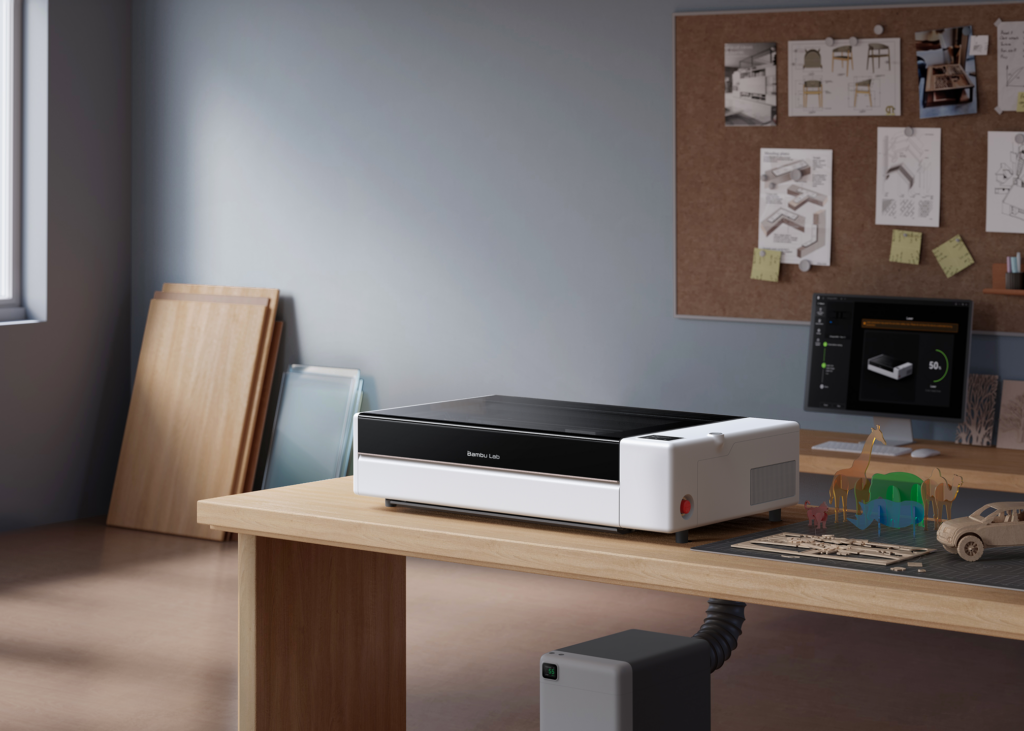
Bambu Lab has gone from one X1 printer, which did very well, to entry-level A1 systems, mid-market P2S systems, and larger H3D’s and more.They’ve also made systems that couple laser cutting and engraving with 3D printing.The company now has eight 3D printers and will add a dedicated laser cutter.
The R1 has a 55W CO2 laser.The laser cutter and engraver are meant to work on plywood, wood veneer, wood, acrylic, leather, fabric, and paper.Because it has a CO2 laser, the company believes it can cut and engrave transparent acrylic better than a diode laser.
It can also engrave some glass, stones, and metals.The company says that the machine can handle 18 mm plywood and 20 mm acrylic.The build area is a substantial 600 × 300 mm.
The machine comes with a Conveyor accessory that lets you feed plates up to 3000 mm into it.The central claim the company makes is that it is eliminating calibration while making laser cutting an easy-to-use process, just like it did in 3D printing.The company says its Auto Laser Alignment process eliminates much of the calibration.
A Laser Alignment Sensor finds miscalibrations and corrects them using the actuators.In typical Bambu Lab fashion, the company is throwing lots of cameras at the problem too.A BirdsEye Camera oversees the work area; a toolhead camera monitors laser movement and location, while the Pinpoint laser indicates where the laser is working.
A Distance Measuring Laser helps the system triangulate everything’s location.There are also XY positioning encoders.Clearly, Bambu Lab is looking to gather data here and make laser cutting faster and more precise through better tool pathing and error correction.
If it ain’t broke, don’t fix it? If the company can modulate laser power or movement for specific materials and parts, it could use its analysis and sensor capabilities to steal a march on competitors.Laser cutters mostly fly blind; they get G-code and then cut and move where the G-code tells them to.By digitizing laser cutting, adding sensor feedback, and collecting data, Bambu is doing something interesting.
It can now precisely measure what the laser is doing and where.This will give it more control, allow it to refine build strategies, and close the loop on laser cutting.The company also says that its vibration compensation models have now been used in laser cutting to make cutting cleaner and more accurate.
There’s also a separate vision encoder add-on for further calibration.There’s also a separate auto fire extinguisher, which is cool.And there’s a separate air purifier.
These accessories show that Bambu is serious about laser cutting and anticipates more fume- and smoke-emitting devices.The beam is fully contained in the enclosure, and the machine is classified as Class 1 under IEC 60825-1.When you open the enclosure to feed in bigger items, the machine becomes a Class 4 device.
Ventilators are set for laminar-flow air evacuation.The laser is available today and costs $2,499.That seems like a good price for a well-thought-through device.
Will Bambu be able to pull off the same trick in laser cutting? Maybe; it seems plausible.Also, the company will have to.With a dedicated laser cutter, is Bambu turning away from 3D printing? Will we see a desktop UV printer next? Will the company print on T-Shirts and more? In China, eufyMake, Snapmaker, Xtool, and more firms are working on all-in-one UV printers and inkjet 3D printers.
At the same time, other firms are working on desktop milling, desktop CNC, and other desktop tools.Clearly, millions of dollars are being invested in desktop UV printing.And millions more are going into desktop CNC.
We believe that desktop UV printers will collide with our 3D printing market.Also, as we wrote at the end of 2025, we believe that we are in the middle of a desktop manufacturing revolution.At the same time, Creality’s June IPO changed a lot.
It seems to have led to a broad spectrum of involvement in 3D printing by some of the world’s largest technology and consumer electronics companies.Tencent has invested in Creality; Meituan invested in Snapmaker; Xiaomi invested in Snapmaker; DJI invested in Elegoo.State-linked funds like Shenzhen AVIC Pingshan Integrated Circuit Venture Capital Partnership, linked to AVIC (Aviation Industry Corporation of China), which is one of the world’s largest defense contractors, have invested in Creality too.
So it looks like corporate China is taking a real interest in 3D printing.To many in desktop 3D printing, Bambu Lab is the one to beat right now.Despite a setback in court, Bambu is still ascendant and making mincemeat out of much of the competition.
So many people now consider Bambu to be the 900-pound gorilla in our market.But compared to Tencent, Meituan, and Xiaomi, Bambu is super tiny.So, strategically, Bambu has no choice but to develop the easiest-to-use desktop manufacturing devices.
It needs manufacturing volume, needs to amortize mold costs more, needs more customers for its software tools, and needs to be bigger.Yes, Bambu is looking to be the dominant player in desktop 3D printing, but at the same time it could be easily crushed by one of several large corporations.If I were Bambu, I’d very quickly make a desktop mill, lathe, embroidery machine, and CNC, all standalone, well-working devices.
I’d do this instead of making a desktop inkjet printer because I think it would take too long to get right.And I’d rather lead in emerging markets than lag behind others.We can lag a year later too.
I think millions more people will need to make souvenirs, furniture, metal components, hardware, and more at home.So I don’t think Bambu is turning its back on additive manufacturing, but it will have to invest more broadly in more devices to survive.Subscribe to Our Email Newsletter Stay up-to-date on all the latest news from the 3D printing industry and receive information and offers from third party vendors.
Print Services Upload your 3D Models and get them printed quickly and efficiently.Powered by FacFox Powered by 3D Systems Powered by Craftcloud Powered by First Mold Powered by Xometry 3DPrinting Business Directory 3DPrinting Business Directory
Read More