We’re starting off this week’s 3D Printing News Briefs with a little business from Axtra3D and Beehive Industries, before moving on to a scientific collaboration agreement between Roboze and a university in Rome.We’ll finish with research into 3D printing an important metal alloy, and 3D printing microneedles.Axtra3D Appoints New VP of Revenue and Growth AMEA & RoW Marion Timmermans, Vice President of Revenue and Growth EMEA & RoW As Axtra3D, Inc.
works to strengthen its reseller network for Hi-Speed SLA and expand its presence worldwide, it has announced that Marion Timmermans is the new Vice President of Revenue and Growth AMEA & RoW.The company’s flagship Lumia X1 combines layer separation technology TruLayer with its Hybrid PhotoSynthesis resin polymerization process to achieve both high throughput and high accuracy and fidelity of parts.Axtra3D reports continued strong engagement with its Hi-Speed SLA technology, which shows customer confidence in the production platform and its scalability.
With a background that spans sales, biotechnology, additive manufacturing, and engineering, Timmermans, most recently the Commercial Director of AM-Flow, is well-suited for this role.Based in Eindhoven, she will use her business and technical expertise to lead Axtra3D’s growth initiatives across EMEA, supporting international commercial growth and developing strategic customer relationships.“We are pleased to welcome Marion to the Axtra3D team as we continue to expand our global presence.
She brings a strong understanding of additive manufacturing, along with valuable industry experience and a collaborative approach to working with customers and partners.Her perspective will strengthen our commercial organization as we scale across Europe and other key markets,” said Gianni Zitelli, CEO of Axtra3D.“We look forward to supporting her as she gets up to speed on Axtra3D’s technologies and begins contributing to our growth.” Beehive Industries Gets Over $4.2 Million in State Tax Credits for Expansion An assembly and test technician inspects a 3D printed jet engine at Beehive Industries’ Colorado headquarters.
The Colorado Economic Development Commission approved a $4.2 million incentive package for the aerospace company on August 20.(Credit: Beehive Industries) 3D printed propulsion engine manufacturer Beehive Industries was recently awarded $4,227,929 in Colorado state tax credits to help fuel a major expansion in the state.This is a Job Growth Incentive Tax Credit award from the Colorado Economic Development Commission (EDC), operating under the Office of Economic Development & International Trade (OEDIT).
It’s a performance-based award specifically tied to job creation and specific economic milestones, in order to achieve mutual benefits for both the local community and the company itself.The company, which is also expanding in Ohio and setting up a Production AM CoE in Tennessee, picked Colorado for its next major growth phase, adding to its local operations to create a Center of Excellence (CoE) for Production Assembly & Test Operations.With this project, Beehive expects to create 220 advanced manufacturing and engineering jobs over the next few years at its existing headquarters in Centennial, and at a second facility in unincorporated Arapahoe County.
“We are incredibly grateful to the Colorado Economic Development Commission and the Office of Economic Development and International Trade for their partnership and confidence in Beehive.This support marks an exciting milestone for our organization and validates our vision for future growth,” said Gordie Follin, Chief Product Officer at Beehive Industries.“We look forward to deepening our roots in Colorado, creating meaningful employment opportunities, and contributing to the state’s economic momentum.” Roboze & Tor Vergata University of Rome Begin Scientific Collaboration Roboze and the Department of Enterprise Engineering “Mario Lucertini” at Tor Vergata University of Rome have signed a three-year scientific collaboration agreement focused on high-performance polymer research.
The two partners are planning to launch joint research activities surrounding advanced PEEK-based materials, with which Roboze has plenty of experience, and thermoplastic matrices, specifically working on the development and characterization of AM filaments for advanced components for industrial sectors like biomedical, automotive, aerospace, and defense.The industry-university research agreement could also include development of composite materials, characterization and experimental activities, and setting up internships, workshops, joint PhD programs, and degree theses; in the future, they may even look into establishing a dedicated spin-off company or joint laboratory.“This agreement represents a strategic step in Roboze’s journey toward continuous innovation in high-performance materials,” said Simone Cuscito, Chief R&D and Product Officer at Roboze.
“Collaborating with a department of excellence such as the Department of Enterprise Engineering at Tor Vergata University of Rome will enable us to accelerate the development of new PEEK-based materials, strengthening the connection between scientific research and real-world industrial applications.” WSU Researchers Use AI to Enable Democratization of Metal Alloy 3D Printing An unsuccessful 3D print of the metal alloy.A successful 3D print of the metal alloy.Photos by Nathaniel W.
Zuckschwerdt / WSU GRCop-42, an alloy made of copper, chromium, and niobium, is common in aerospace applications, like liquid rocket engine combustion chambers.It could have other uses, if only it wasn’t so energy-intensive and expensive to print.Researchers at Washington State University are using artificial intelligence (AI) to find a less costly, more efficient way to print this high-performance alloy.
It takes a lot of laser power to print GRCop-42, and others have tried to print it using commercial machines with lower wattages and lasers, but you need specialized equipment, a lot of human labor, and expensive materials for various testing configurations.The WSU researchers took results from 37 unsuccessful configurations, and developed an AI model that used these to estimate how likely it would be for an untested configuration to achieve a successful print.Then, the model chose small batches of new configurations that were promising test options, but could also explore uncertain areas that could improve the model.
Over 40 experiments in three months, the researchers determined six successful configurations, and printed GRCop-42 at 500 watts for what they say was the first time.This means there’s hope that one day, the alloy can be printed with available commercial equipment.“Sometimes they printed a certain configuration, and the product just melted.
It wasn’t really printable, and even with time and money, they wouldn’t be able to try all 100 million options.What we were doing in our collaboration is to apply the AI so that we efficiently choose candidates from this very large search space,” explained Azza Fadhel, first author of the paper and a PhD student in computer science.“They would give me back the results, and I liked all of them – even if they failed — because every result improved our AI model.” The team published their work in the Proceedings of the AAAI Conference on Artificial Intelligence, and also received the Innovative Deployed Application Award at the group’s annual conference.
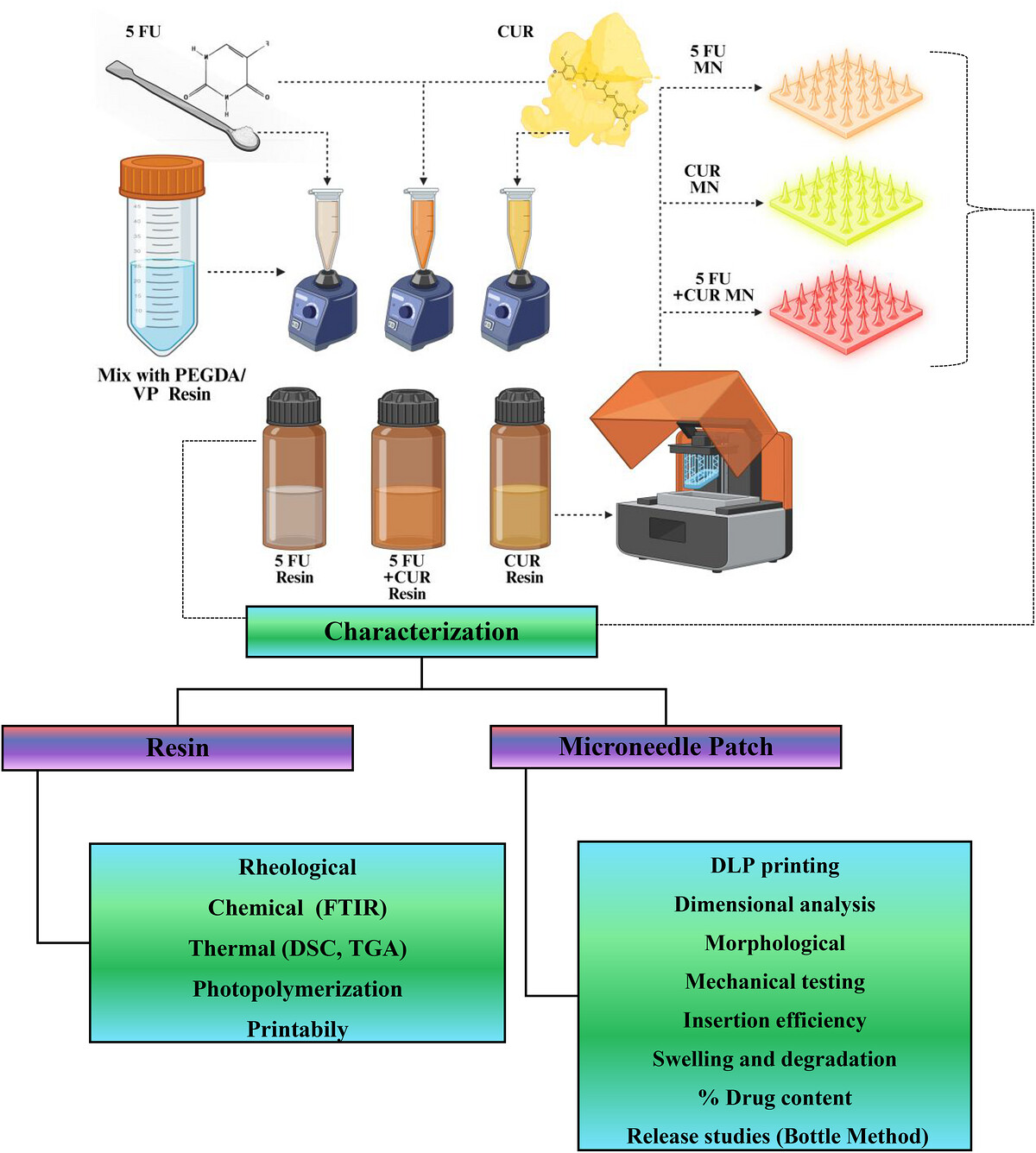
Queen’s University Belfast Researchers 3D Printing Dissolving Microneedles The roadmap illustrates the formulation, fabrication, and characterization of resin and MNs.According to a paper published by a pair of researchers from Queen’s University Belfast (QUB) School of Pharmacy, skin cancer is the most frequently diagnosed cancerous disease.So the two developed a dissolvable 3D printed microneedle patch that could help improve treatment for localized skin cancer.
Previous methods would coat pre-made microneedles (MNs) in the drugs, but the QUB researchers came up with a technique to blend the drugs right into the MNs during manufacturing.They designed microneedle array geometries in Tinkercad, and developed a one-step DLP 3D printing method that enables them to add anti-cancer drugs curcumin and 5-fluorouracil into a printable resin for 3D printing the patch.This means higher drug loading of the MNs, better skin penetration, and a controlled two-stage drug release.
The microneedles, which pass through the outer layer of skin without drawing blood, deliver anti-cancer drugs curcumin and 5-fluorouracil directly to the patient’s affected area of skin.This targeted drug delivery approach is less invasive, and also means that patients won’t need to return for repeated topical treatments.“Skin cancer is a major public health concern, and current treatments often require repeated topical applications, invasive procedures, or can cause unwanted side effects.
Many people also experience fear, discomfort, or inconvenience when treatments involve needles and injections,” said Professor Dimitrios A.Lamprou, Chair of Biofabrication and Advanced Manufacturing, who led the research.“Minimally invasive microneedle systems that dissolve after application could provide a more patient-friendly, simpler and less painful way to deliver cancer medicines.
Because the microneedles dissolve after use, they may also help reduce the risk of needle-stick injuries and decrease medical sharps waste.” Subscribe to Our Email Newsletter Stay up-to-date on all the latest news from the 3D printing industry and receive information and offers from third party vendors.Print Services Upload your 3D Models and get them printed quickly and efficiently.Powered by FacFox Powered by 3D Systems Powered by Craftcloud Powered by First Mold Powered by Xometry 3DPrinting Business Directory 3DPrinting Business Directory
Read More