For decades, the nuclear industry has quietly experimented with and implemented additive.Bouyed by the likes of ORNL, companies such as Westinghouse have 3D printed components serially.We have an insightful podcast on the industry, and an overview article as well.
A newer trend is that emerging nuclear energy startups are also using additive to accelerate their development.A new crop of Small Modular Reactor companies, such as Oklo, Valar Atomics, Ulta Safe Nuclear Corporation, Moltex Energy, Radiant, Nano Nuclear Energy, TerraPower, and NuScale, aim to make a new generation of easier-to-build, easier-to-deploy, hopefully safer nuclear power plants.Small Modular Reactors are meant to consist mainly of transportable modular components that can be made in factories at scale, rather than custom large plants built at one particular location with cost overruns.
Ideally, they have passive safety systems, which means that, whatever happens, the plant will shut down safely.These plants could be put in remote places more easily, so bases or remote communities could benefit.One in this crop of startups is NX Atomics, which presumably uses Siemens NX’s Vela reactor—a liquid fuel, lead coolant small reactor meant for data centers and shipping.
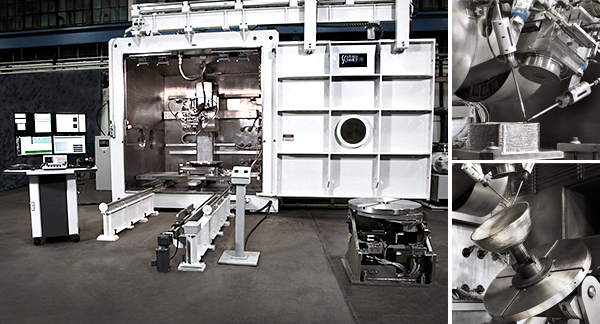
NX has now partnered with EBAM leader Sciaky to make components for their reactors.NX Atomics CEO John Warden said, “This is what bringing nuclear manufacturing into the modern era actually looks like, 3D printing opens up the potential for us to produce nuclear-qualified parts faster and at lower cost, where appropriate swap them out through life, and meaningfully reduce the unit cost of every small modular reactor we build.” Sciaky CEO John Criso states, “Sciaky has spent more than eight decades building the metal manufacturing technology that the world’s most demanding industries rely on.Our EBAM process produces parts that fly on commercial aircraft, sail on naval vessels, and orbit the earth.
Bringing that capability into America’s clean energy infrastructure with NX Atomics is a natural next step, and we are proud that two Midwestern companies are leading this transition.” The duo hopes to make low-cost nuclear parts quickly using an electron beam.They also say that some parts will be designed to be replaced rather than last forever, opening up an expanded reactor consumables market, presumably? Given the long lead times, traditional reactor economics is under threat.Costing decades and billions to build, traditional reactors are among the most daunting, massive, and complex engineering projects in existence.
For the financial set, delays and cost overruns play havoc with business plans and the underlying economics of building nuclear plants.Famously in the UK, Hinckley Point C has cost more than double its initial estimate.This not only causes problems for banks but also for governments.
Making lots of small plants in factories therefore sounds like a dream.It seems so logical, kind of like doing precast concrete or factory-built houses.This does not mean that it will work, of course.
There are only two Small Modular Nuclear reactors in operation, which are research units in Russia and China, and only a handful are actually under construction.Meanwhile, over 100 of these reactors are in a planning phase.The first to actually be operational will probably be made by the venerable Rolls-Royce.
In 3D printing, we often say that we have superior economics for first articles, prototypes, and small production runs.Ironically, NX is using additive to enable it to ameliorate the punishing economics of building its own factories.These nuclear reactor startups all have the same issue.
They have a massive upfront cost in design, regulatory, planning, approval, testing, and building their factories.I also think that there is something else going on, which no one mentions.It’s all good to have a few 3D printing OEMs making machines that ultimately don’t work.
It’s okay if we all have a Helios, Black Buffalo, or Sintratec printer to remind us of the hope and possibility of it all.But, what if you have a local nuclear power plant built by a startup that goes out of business? Will one of these startups provide safe nuclear power at low cost? Sure.But, will all of them work? No.
I can assure you that there will be bankruptcies.Many bankrupt 3D printing firms have been bought for IP, and others have been bought for parts, people, or printers.It’s relatively facile to make a calculation of supporting a printer that you didn’t design for a decade or more.
It’s relatively easy to look at it and determine how it will strengthen your lineup, revenue, and channel.And the liability is usually OK.Now, of course, a metal LPBF system is going to be a bit more difficult to determine than a desktop printer.
But, imagine a completely different design of nuclear reactor goes bankrupt.Imagine the liability.There are a lot of unknowns there.
Do you trust their engineering, internal processes, and people? Will they stay with you? And would you assume the liability of something that has little to nothing in common with your architecture, design or production methods? The chance of you selling two different models of nuclear plants with different technologies and methods of production is effectively zero.It would be too much risk and too much extra cost to subsume.To what end? It would just make everything worse for you without it having any tangible benefit.
Even if a company had patents or technology you want, you’d rather not take over the pilot plant.These startups have raised tens of billions, with TerraPower raising 3 billion and several others raising hundreds of millions.But, given our particular track record, this doesn’t seem like a lot.
We couldn’t make binder jet work for a billion dollars, and they have to make local safe nuclear power work for $100 million? Given Rolls-Royce’s experience, and that it is essentially the only valuable large industrial company in the UK, this market still looks like it’s Rolls-Royce’s to lose.There are an awful lot of people who don’t want nuclear power.There are many others who may want nuclear power, but not in their backyard.
I’d venture there are almost no people who’d want a half-built nuclear power plant in their backyard, with a design so unique they never made it again.So that, to me, is the problem with the underlying excitement and economics of small modular nuclear power.But, if these people are to make their schedules and their timelines, then additive may very well help them get to where they can build a factory for nuclear power plants. Subscribe to Our Email Newsletter Stay up-to-date on all the latest news from the 3D printing industry and receive information and offers from third party vendors.
Print Services Upload your 3D Models and get them printed quickly and efficiently.Powered by FacFox Powered by 3D Systems Powered by Craftcloud Powered by Xometry 3DPrinting Business Directory 3DPrinting Business Directory
Read More