There have been many, many CPUs released over the decades, but if we were to make a list of the best-performing CPUs of all time, it would consist of little more than a handful of the latest models from AMD and Intel.But this isn't that type of list.Instead, we're taking a look at some of the best CPUs ever released, taking into account everything from their relative performance at the time, price, how well they held up over the years, and how they were received by enthusiasts.
I've narrowed my picks down to just six, so let's see which CPUs made the cut.6 The Intel Celeron 300A was the ultimate CPU for overclockers The little Celeron that could Close The Celeron 300A, based on Intel's Mendocino core, was a legendary CPU that launched just a couple of weeks before yours truly was born in 1998—and just like me, it instantly changed the world for the better.I know it might be strange to see a budget Celeron CPU on this list, but it had several firsts in the world of home computing.
It was the first mass-market CPU with 128KB of on-die L2 cache, but the real secret of the Celeron 300A was its clock speed.It was clocked at just 300MHz from the factory, but with the right motherboard, overclockers could often get it running at 450MHz by increasing the FSB (Front-Side Bus) clock rate from 66MHz to 100MHz.We're talking about an impressive 50% clock speed boost from a chip that cost $149 at launch.
Once matched to the Pentium II 450's 450MHz clock speed, the Celeron was actually able to outperform the Pentium in video games and many other applications, thanks to its much faster on-die cache, which ran at the full 450MHz core clock, whereas the Pentium II's L2 cache was located off-die and ran at half the core clock speed, or 225MHz.Yes, you read that right: a $149 chip was able to outperform a $669 one.And that's why it has earned a definite spot on this list.
5 The AMD Ryzen 7 1700X gave Intel something to worry about after a decade of dominance Eight cores and SMT without the huge price tag Before AMD shook the world with the release of the first-generation Ryzen chips and its all-new Zen architecture, the company was struggling.The Bulldozer FX series was marketed as offering up to eight cores, but it used Clustered Multithreading (CMT), which shared resources between pairs of cores and often made the chips perform more like four-core CPUs in heavily single-threaded workloads.This is a gross oversimplification, but the point is that you could either get one of these flawed "eight-core" chips or buy an expensive Intel Core i7 with four cores and eight threads.
The more reasonably priced i5s offered solid gaming performance thanks to strong single-core performance, but they were stuck with just four threads.Fortunately for us, AMD was able to shake the world with the launch of the AMD Ryzen, with the Ryzen 7 1700X as the flagship.AMD now finally gave us an eight-core processor with 16 proper threads at an MSRP of just $399.
While Intel still had an edge in single-threaded performance and high-refresh-rate gaming, the Ryzen 7 1700X absolutely wiped the floor with the quad-core i7-7700K in heavily multithreaded workloads—you'd have to step up to an enterprise-grade Xeon to beat the humble 1700X.The Ryzen 7 1700X forced Intel to spend years playing catch-up just to match the multithreaded performance-per-dollar value that this iconic chip brought to the mainstream.Of course, as time went on, having so many cores only helped the 1700X's longevity, with modern apps and games increasingly able to take full advantage of its 16 threads.
AMD Ryzen 5 5600 The AMD Ryzen 5 5600 packs tons of gaming performance inside its six cores and is the best budget Ryzen CPU on the market.Its multithreaded performance won't impress anyone but for the price, it's more than a decent peformer.$165 at Amazon Expand Collapse 4 The Intel Core i7-8700K was Intel's answer to Ryzen Intel had to step things up Intel had to respond quickly to the new threat from Ryzen, and it took the company only a little over half a year to do so.
The pressure from AMD was real, and we were finally seeing some healthy competition in the CPU market after years of stagnation.The 8th-generation Coffee Lake lineup marked the first time Intel significantly increased core counts across its mainstream desktop lineup, with the i7-8700K spearheading this generational shift to six cores and 12 threads.Remember, Intel still had better single-threaded performance, which was further improved with the 8th generation, and bumping up the number of cores helped Intel close the performance gap in multithreaded workloads.
The Ryzen 7 1700X was still ahead in heavily threaded workloads thanks to its eight-core design, but the i7-8700K was a fantastic gaming CPU that remained competitive for years to come.Being a "K" chip, it was unlocked for overclocking, allowing enthusiasts to squeeze even more performance out of it with the right CPU cooler.It was an incredibly capable CPU at release, and many years later, you can still find it in the occasional gaming PC, which is a testament to the CPU's fantastic performance and longevity.
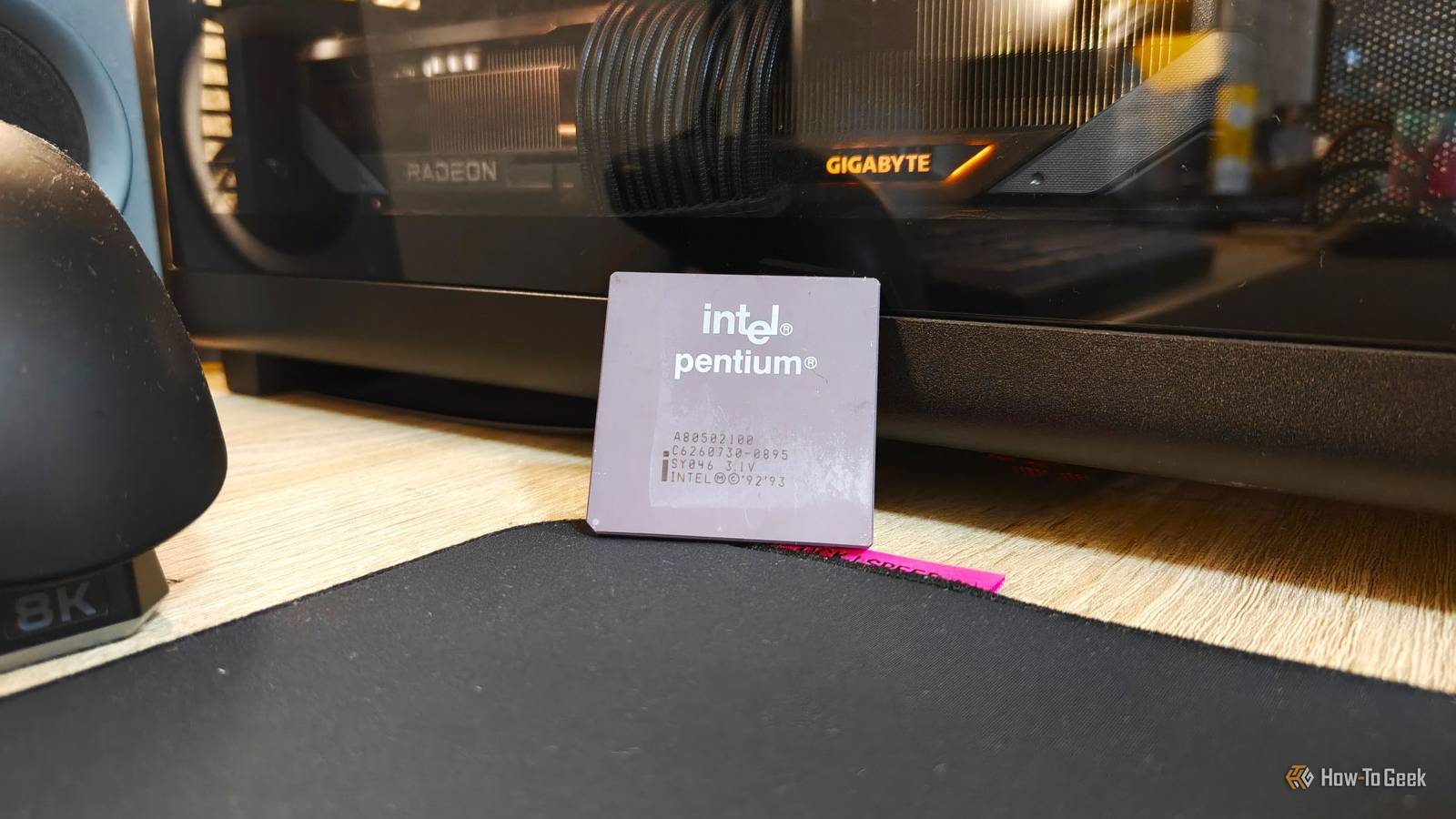
3 The original Intel Pentium defined the modern PC The CPU that became a household name for years to come It's hard to overstate just how legendary the original Intel Pentium from 1993 was.It was Intel's first superscalar x86 processor, meaning it could execute two instructions simultaneously in a single clock cycle under the right conditions.It also introduced numerous architectural improvements and a 64-bit data bus that doubled the width of the connection between the CPU and system memory.
All of this allowed the Pentium to leapfrog the i486 that had come several years before it.The Pentium's strong raw performance was incredibly important as PCs from the 1990s became increasingly capable.The Pentium could handle everything you'd throw at it: 3D games, complex graphical interfaces (such as those present in Windows 95), and multimedia applications.
For the first time, the average consumer could buy a PC that felt genuinely powerful across a wide range of workloads.The Pentium became an instantly recognizable brand name for consumer CPUs, with Intel carrying the name across multiple generations for years to come—and it all started with this one.2 The AMD Ryzen 7 5800X3D was so good that AMD had to bring it back The upgrade that's keeping AM4 alive AMD's AM4 socket launched in 2016 alongside the company's new Zen architecture, and it went on to support several generations of Ryzen processors over the following years.
Then, in 2022, AMD released the Ryzen 7 5800X3D, one of the most impressive gaming CPUs ever made for the platform, and this year, it got a 10th Anniversary re-release at an eye-watering price of $349.The best part? This re-release actually makes sense.If you've already got an AM4 system, upgrading to the 5800X3D is one of the easiest upgrades you can make, provided your motherboard's BIOS supports it.
You can keep your motherboard and DDR4 memory and just drop in a new CPU, giving an aging PC a massive gaming performance boost without having to rebuild the entire system.This is a significant cost saving, as moving to the AM5 platform also means buying a new motherboard and DDR5 memory.To understand why the Ryzen 7 5800X3D is so important, all you need to do is look at gaming benchmarks that include it, such as Gamers Nexus' CPU benchmarks.
Despite launching in 2022, its massive 96MB of L3 cache allows the 5800X3D to remain remarkably competitive with much newer processors in many games, including AMD's own 7000 and 9000 Series chips, as well as Intel's 13th- and 14th-generation models.It's rare to see a four-year-old CPU remain this relevant, especially in gaming.If you bought a Ryzen 7 5800X3D when it launched, you've got a processor that's likely to remain capable for many more years to come.
That's an impressive legacy for a CPU that arrived on a platform that was already considered old by that point.AMD Ryzen 7 5800X3D The king of gaming performanc CPUs got its crown thanks to heaps of advanced 3D-stacked cache memory, although it you also want to do tasks that benefit from more than 8 cores, it may not be as fast as the competition.$349 at Amazon Expand Collapse 1 The Intel Core i7-2600K was Intel's greatest hit The CPU that refused to die While the 5800X3D is still a gaming legend in the making, the i7-2600K has already earned its reputation as the CPU that refused to die.
It launched as part of the Sandy Bridge generation of CPUs in 2011, during Intel's long-running tick-tock cycle of architectural and manufacturing process improvements.This industry-wide stagnation was undeniably part of the reason why the 2600K was able to dominate for so long, but it doesn't change the fact that the 2600K remained an incredibly competitive chip years later.As you can probably guess, the i7-2600K was Intel's flagship mainstream model and one of the strongest consumer CPUs at launch, but the real beauty of this chip lay in its overclocking potential.
It had a boost clock of 3.8GHz, but enthusiasts regularly achieved stable overclocks of 4.5GHz or more with the right motherboard and cooler, giving the chip competitive performance against newer CPUs for years to come.The i7-2600K only had four cores, but it also had eight threads, which gave it a massive leg up in multithreaded workloads against AMD's Bulldozer chips from this era.The honorable mentions could fill another list Narrowing down this list to just six CPUs was a difficult task, so I've inevitably had to leave out a long list of deserving candidates.
Some of the CPUs that almost made the list include the AMD Athlon 64, which gave Intel a run for its money, the original Intel Core 2 Duo and Core 2 Quad, and even modern high-end chips like the AMD Ryzen 9 9950X3D, which represents the absolute peak of consumer CPUs today.Related The 10 Most Influential CPUs of All Time The All-Stars of Computation Posts By Sydney Butler
Read More