I'm a big Excel advocate.Whenever I see someone recommending that I replace it with another app, my first reaction is usually the same: what's the point? Excel already does most of what I need.One app I keep seeing recommended, though, is Airtable.
Add How-To Geek on Google Add as Preferred Source Follow on Google Discover I'd never properly tried it, and from a distance it looked like a spreadsheet with a nicer interface.So I exported a 500-task project tracker from Excel and imported it into Airtable.My assumption turned out to be wrong.
I expected a slightly different spreadsheet experience, but instead found a completely different way to work with the same data.Airtable understood my spreadsheet surprisingly well It did more than simply import my data I started by creating a new Airtable workspace and importing a CSV export of my project tracker.Before completing the import, Airtable presented a preview of the data and suggested field types for each column.
Some of those suggestions stood out straight away.After accepting them, my Due Date column became a date field, while the Name and Status columns became single-select fields.Airtable was already making educated guesses about how I'd use the data.
That sounds minor, but it shaped everything that followed.Airtable was already treating the data like something I could work with, rather than simply displaying my CSV.I noticed the effect as soon as the import finished.
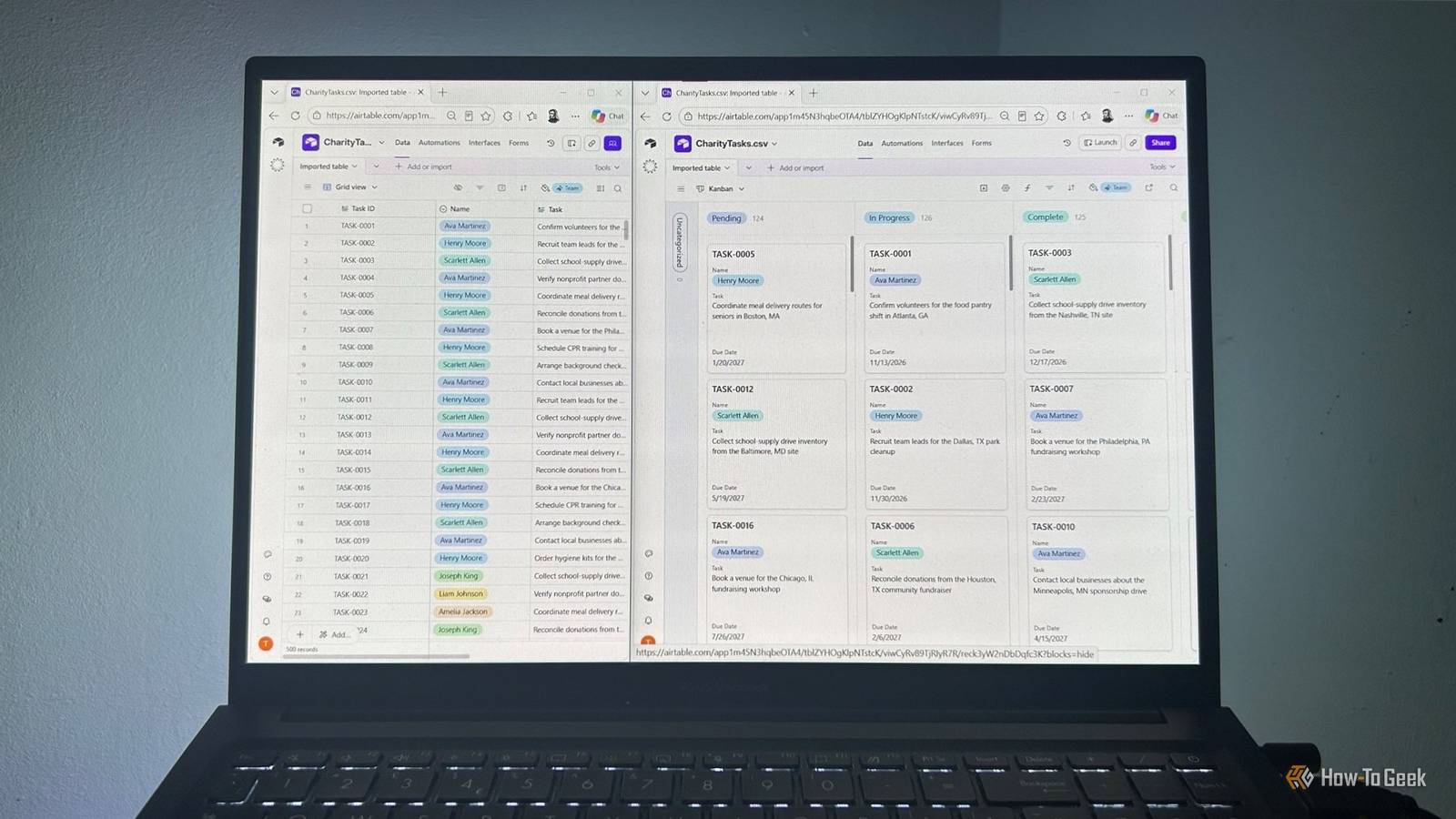
Status values like Pending, In Progress, Complete, and Needs Review appeared as color-coded pills instead of plain text.Airtable applied the same treatment to the names assigned to each task, so the tracker already felt organized before I'd touched a single setting.With 500 records, those visual touches earned their keep.
Instead of reading row by row, I could spot statuses and assignees at a glance.The Kanban board was when Airtable clicked The same spreadsheet suddenly felt like a project management tool Up to this point, I liked what I saw, but I still wasn't entirely sure what made Airtable so popular.That changed when I created a Kanban view.
Airtable asked which field I wanted to use for the columns, so I chose Status.A few seconds later, my tracker had been transformed into four columns: Pending, In Progress, Complete, and Needs Review.What impressed me wasn't the Kanban board itself, but how little effort it required.
Five minutes earlier, the same 500 tasks were rows in a grid.Now they were organized as cards in something that looked much closer to a dedicated project management app.I also customized the cards, adding the task description and due date and rearranging the fields into a more useful order.
A few clicks later, every card told me who owned the task, what needed doing, and when it was due.Better still, there was still only one tracker.Airtable was just giving me another way to work with it.
Moving one card changed everything The Kanban board wasn't a separate dashboard Close What really changed my mind about Airtable was a simple experiment.I took TASK-0001 and dragged it from the Pending column into In Progress.The card moved into its new column, and the counts in both columns updated accordingly.
When I switched back to the Grid view, TASK-0001 already showed In Progress in its Status field.I didn't need to edit a cell, refresh the tracker, or manually sync the two views.That's when Airtable finally clicked for me.
The Kanban board wasn't a separate dashboard, and the spreadsheet wasn't the "real" version of the data.Both views were looking at the same record, so a change in one showed up in the other.The calendar gave my tracker another purpose The same records became a scheduling tool After spending some time with the Kanban board, I wanted to see what else Airtable could do with the same data.
I created a Calendar view and selected my Due Date field.The tracker became something different again.Instead of organizing work by status, Airtable organized it by date.
The records behind the grid and the Kanban board were now spread across a calendar, and upcoming deadlines were far easier to read.Initially, the calendar displayed task IDs as labels, but I quickly replaced them with assignee names and task descriptions.That simple change made the calendar far more useful because I could quickly see who owned a task and what needed doing.
I also liked that the calendar wasn't tied to a single date field.If a tracker contained multiple dates, such as an assigned date and a due date, Airtable let me choose which one should drive the calendar.While exploring the calendar, I clicked one of the entries expecting to end up back in the spreadsheet.
Instead, Airtable opened the record itself and let me edit it right there.My spreadsheet had become a grid, a project board, and a deadline calendar without creating multiple copies of the data.Airtable isn't a replacement for Excel It's trying to solve a different problem The longer I used Airtable, the clearer it became that it wasn't trying to beat Excel at Excel's own game.
When I open Excel, I'm usually thinking about formulas, PivotTables, Power Query, reporting, and analysis.I'm trying to understand data, uncover patterns, or calculate something useful.Airtable felt fundamentally different.
Everywhere I looked, there were views, forms, interfaces, and automations.Even the onboarding process nudged me to build something around the data rather than just analyze it.Neither is better.
They just have different goals.Excel is brilliant at analysis, while Airtable cares more about helping you organize information and actually work with it.There's also one important limitation worth knowing about.
Because I imported a CSV, Airtable created its own copy of the data rather than a live connection to my Excel workbook.Changes I made in Airtable didn't automatically appear in the original workbook, and updates made in the workbook didn't automatically flow back into Airtable.That wasn't a problem for my experiment, but it's worth knowing if you expect the two apps to stay in sync.
I finally understand why people like Airtable After importing a real project tracker, I finally got why people like Airtable.The experience reminded me why I rarely think in terms of replacing Excel anymore.Some of my favorite Excel workflows involve pairing it with other tools, and Airtable fits neatly into that category.
My spreadsheet became a Kanban board, then a calendar, and changes I made in one view appeared everywhere else automatically.I went into this experiment expecting a nicer-looking spreadsheet.Instead, I found something closer to a system builder that just happens to start with spreadsheet data.
That's a much more interesting idea than I'd given it credit for.
Read More