Seals use their whiskers to hunt.Not Navy Seals, although they may in some way also, but this article is about lowercase seals.Not Seal the musician either, as far as I know, he doesn’t even have whiskers.
This is about different seals.Pinnipeds are marine mammals with flippers and blubber.One of the ways whiskers, or vibrissae, are used is as a flow sensor.
In humans, vibrissae are nose hairs that act as filters, while in cats, they’re used to hunt in the dark.Vibrissae can be used to sense air currents, changes in pressure, or to sense things.They’re embedded in the sensory system and are very sensitive.
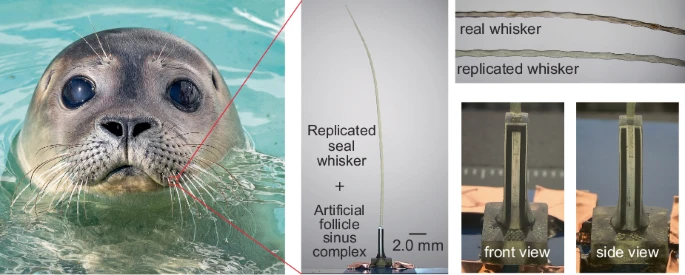
They can tell you that a crevice is too small for you to fit in, sense the air flow of a running prey animal, help an animal in flight orient itself, and act as signals of intent or mood.Cats have around 200 nerve cells on every whisker, while seals may have 1500.Biomimetic seal whisker-inspired fully printed MEMS sensor.
Image courtesy of Tekin et al., Microsystems & Nanoengineering (2026).These whiskers not only let them orient their bodies in the dark or sense rock formations, but also let seals track where prey has been.Through being sensitive to hydrodynamic trails.
These trails are pressure changes and swirling vortexes in the water left behind by swimming animals.They’re also called wake-induced vortexes.These trails can show direction, speed, size, or even what kind of animal was there.
So it’s kind of like tracking specific water footprints.When hunting in the dark, it’s easy to see how valuable these whiskers could be.Certain seals have evolved specialized morphologies to better track their prey.
Seal species, whisker morphologies and sensing mechanisms.Image courtesy of Tekin et al., Microsystems & Nanoengineering (2026).Now researchers have made a 3D printed “artificial follicle–sinus complex flow sensor” mimicking the setup the seals have.
They made a novel elastomeric resin and studied the whiskers of harbor seals, gray seals, and sea lions.They then designed and printed a compliant structure and used Boston Micro Fabrication‘s (BMF) system to 3D print the entire device in one step.Overall, the resolution was less than 10 μm.
The team then put graphene nanoplatelet ink into the printed channels, turning the device into a piezoresistive sensor.Tests showed that these sensors could work for at least 3000 cycles, sensing strain in vortexes just like the seals do.The team used a GOM ATOS III Triple Scan 8 M to scan different seal whiskers to get the target geometries.
They found that the harbor and gray seal whiskers were better at sensing and differentiating than the sea lions’ whiskers were.Later, an 8-cm-long whisker was tested for 3000 cycles.The researchers worked at the Department of Bioinspired MEMS and Biomedical Devices (BMBD) of the Engineering and Technology Institute (ENTEG) at the University of Groningen in the Netherlands.
Engincan Tekin, Ming Cao, and Ajay Giri Prakash Kottapalli got their work published in Nature Microsystems and Nanoengineering.PμSL printed MEMS mechanosensory artificial follicle sinus complex sensory base.Image courtesy of Tekin et al., Microsystems & Nanoengineering (2026).
The whiskers in the tests were ~80 mm in length and were made using the BMF microArch S240, the team’s own material, a blend of 3DResyns PDMS-like resin and BMF’s UTL resin mixed in a 70:30 volume ratio.Mixing resins like this is widely done in research and by hobbyists alike to try to achieve the right mix of properties.You should be very careful and orient yourself thoroughly if you’d like to try this at home or at the office.
This is great news for people working in bioinspiration.Also, for the soft robotics crowd, this could be an exciting proximity or action sensor.This kind of sensor could also point to a working mechanism to let a temperature gradient or current follow a soft robot descend or ascend appropriately.
In fact, if you would cover an entire robot in these whiskers, I bet that you could use it for sensing and navigation.At the same time, this work points to more possibilities for integrated 3D printed MEMS devices.This is something I’m super excited about.
MEMS are great but require significant up-front investment, especially for low-production-run MEMS, or indeed for my concept of Macro MEMS and 3D printed MEMS devices.Indeed, as we wrote in 2022, a class of entirely new devices and MEMS could be created much more rapidly and inexpensively through Additive.Here, where 3D printing produces almost the entire device from a single material in a single step, we can begin to see the outline of a world in which tiny devices could power sensing, navigation, actuation, and other functions across billions of devices.
Subscribe to Our Email Newsletter Stay up-to-date on all the latest news from the 3D printing industry and receive information and offers from third party vendors.Print Services Upload your 3D Models and get them printed quickly and efficiently.Powered by FacFox Powered by 3D Systems Powered by Craftcloud Powered by Xometry 3DPrinting Business Directory 3DPrinting Business Directory
Read More