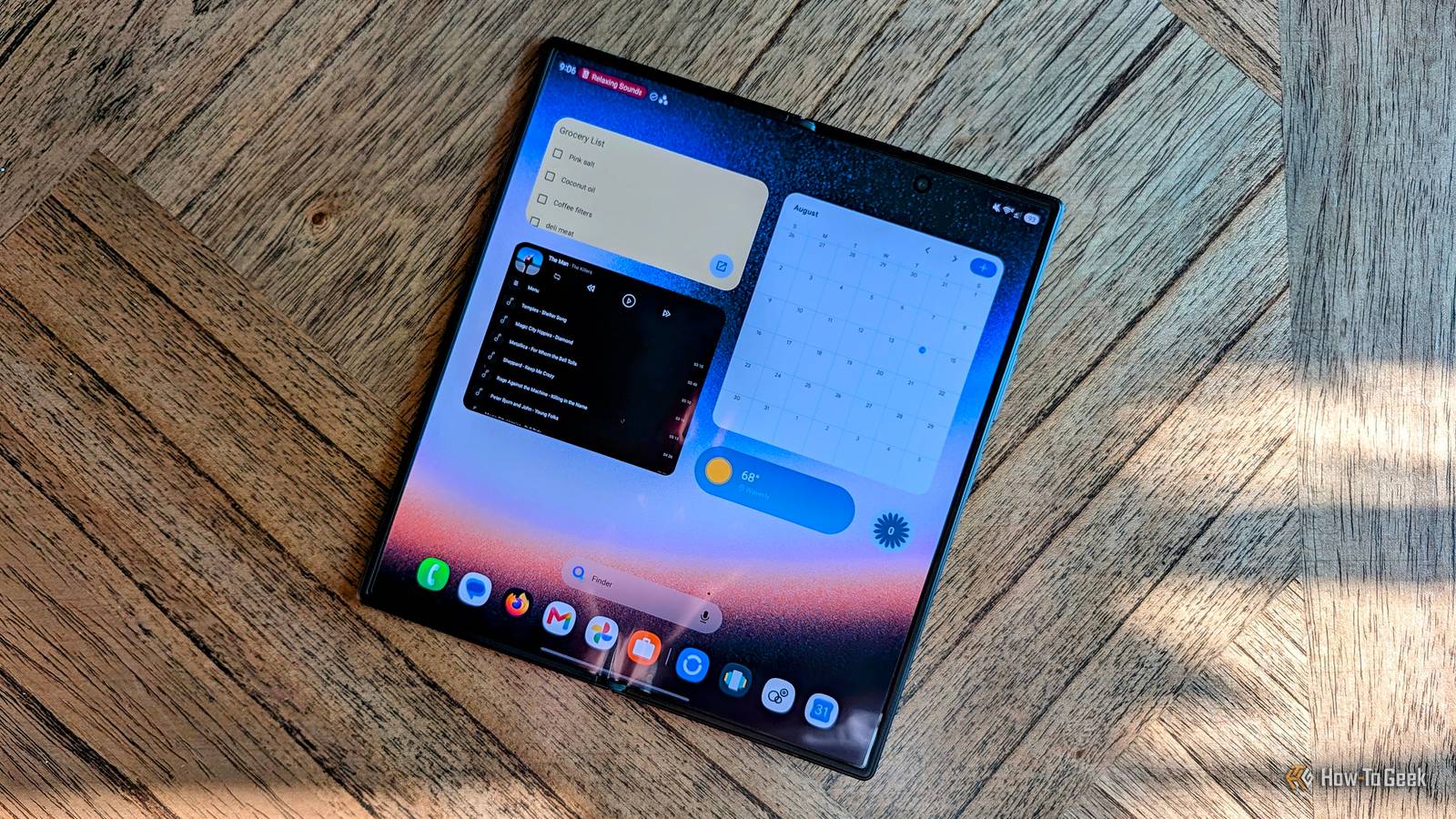
I first jumped into the fold with Samsung's Galaxy Z Fold4 back in 2022, and a foldable has been my primary smartphone since then.Four years later, the category has grown by leaps and bounds, and foldable technology has evolved drastically alongside that growth.That doesn't mean there's still a lot of room for foldables — and Samsung in particular — to further improve.
I'm a sucker for a brand-new phone, and Samsung's trade-in offers are normally too good to pass up...until this year.I'll be sticking with the Samsung Galaxy Z Fold7 for at least another generation; not because the wide Galaxy Z Fold8 and tall Galaxy Z Fold8 Ultra we reviewed aren't amazing in their own right, but because I simply want to see Samsung push the envelope even more next year.
Related I love the Galaxy Z Fold 8, but it's destined to be the next Galaxy Note Edge Samsung's best foldable phone will never get the attention it deserves.Posts By Jon Fingas Superior resistance to dust and everything else Let's bump that IP48 rating up to a much safer IP68 Arguably the greatest compromise you accept when choosing a fancy foldable over a traditional slab smartphone is the promise of durability.Moving parts that could fail over time, a soft screen that's more easily damaged, and inferior ingress protection...
though that last point has actually been improving year-over-year.For the unaware, Samsung's latest foldables boast an IP48 certification, which rates the phone for protection against large solid particles and water resistance (even when fully submerged).Water resistance was far from a given with early foldables, but the real threat is dust, sand, or other particles working their way into the phone through the hinge mechanism.
Many slab phones earn an IP68 certification, which promises full protection against those particles.It's understandably much harder to secure an equal rating for foldables and their moving hinge, but .The Google Pixel 11 Pro Fold we reviewed is the second Google foldable to rock that IP68 rating, showing it is possible.
If Samsung wants to keep its crown in the foldable world, ensuring its foldables are the most durable across the board certainly can't hurt.Proper Qi2 wireless charging support — magnets included Fast charging improvements are great, but I want more Samsung finally upgraded the Fold's charging speeds (from 25W to 40W wired and 15W to 20W wireless) with the Z Fold8 family, which is awesome, but the Google Pixel 11 Pro Fold makes another appearance in this article because it still does something Samsung (and most other foldables) still don't: proper Qi2 support.Simply put, Qi2 is the next generation of wireless charging and the industry standard that follows in the wake of Apple popularizing magnetically snapped chargers, battery packs, and other accessories with iPhone MagSafe.
The MagSafe ecosystem Qi2 can use has grown quite large, but few Android phones can take advantage of it without relying on a bulky (sometimes unreliable) case.As a staunch supporter of rocking a naked phone, I need Samsung to figure this out.If you're wondering why I don't simply buy a Google Pixel Pro Fold, the answer is simple: Samsung does foldables better in most other regards, from software to other hardware elements.
I believe Samsung has absolutely nailed how thin a foldable can and should be, too, and has finally started adopting silicon-carbon batteries to increase endurance — the next step isn't going even thinner; it's adding magnets for Qi2 support for easier charging and better accessories.Bring back the S-Pen and make it even better Give me another way to take advantage of that large screen Samsung is one of the few companies committed to offering a great stylus experience with its flagship Galaxy S26 Ultra smartphone, tablets, and even 2-in-1 laptops.In fact, more generations of the Z Fold have supported stylus input than not, using a special S Pen to protect the soft main screen.
Unfortunately, Samsung dropped S Pen support with last year's Z Fold7, and it hasn't returned for the newest generation.It's a shame, since foldables like the Motorola Razr Fold show there's real value in stylus support, and Samsung's S Pen software is genuinely fantastic.Dropping the S Pen display layer may have helped make the Z Fold thinner and lighter, and the decision was likely further justified by a minority of Z Fold owners taking advantage of the feature—but I still believe the Z Fold series is better with the S Pen, even if it'll never be stored internally like with the S26 Ultra.
The Galaxy Z Fold8 is already one of the best pocket-sized e-readers; imagine how much better it would be if you could annotate your books, take notes, and draw on that massive inner screen.Related The LG phone nobody wanted is making a comeback as the Samsung Galaxy Z Fold 8 LG walked so Samsung could...fold? Posts By Ismar Hrnjicevic Flagship cameras that actually justify the price Samsung has just been coasting along here Foldables are among the most expensive smartphones you can buy, and they mostly justify that extravagance with cutting-edge hardware.
One major area of weakness for many foldables, though, is camera quality that falls behind the best slab flagships.Samsung's foldables absolutely succumb to this weakness with downgraded camera systems compared to the top-of-the-line Galaxy S26 Ultra, and Samsung's smartphone cameras haven't been particularly competitive the last few years, anyway.I actually take all my photos with the Galaxy Z Fold7's 200MP primary camera and personally don't have many complaints about the camera system as a whole, but that doesn't mean I should accept that my $2,000 smartphone is noticeably inferior to phones that cost half the price.
The OPPO Find N6 is a great example of how you can have a thin-and-light foldable best-in-class cameras, and the necessary "camera plateau" to fit all that imaging hardware means less egregious wobbling on flat surfaces.I haven't forgotten about space constraints with the Z Fold, and I'm not expecting Samsung to break physics, but it'd be nice to see Samsung make a big push to improve all its flagship smartphone cameras next year, and to see the Fold9 series greatly benefit from those improvements.Oh, and I mean Z Fold variants.
Parity between the classic tall and brand-new wide I want to choose the form factor, not the specs Samsung largely did an excellent job making both the Z Fold8 and Z Fold8 Ultra even with each other, with the same Qualcomm Snapdragon Elite Gen 5 for Galaxy on the inside, the same titanium-reinforced display with a new anti-reflective coating, the same software running on Android 17, and the same upgrades to charging speeds.The Z Fold8 Ultra does have a slightly larger battery, but it's also physically larger.The new, wide Z Fold8 also loses the Flex Hinge feature, likely because its display halves are so wide and put additional leverage on the hinge.
Those differences are understandable, but choosing the Z Fold8 and its fascinating square-ish form factor means accepting a huge compromise: the cameras.I've already discussed how Samsung should innovate more with its foldable cameras, but the Z Fold8 is the greatest offender, downgrading the main sensor and losing the telephoto lens entirely.Next year, I hope Samsung ensures greater parity between both sizes so people can choose based on which size best fits their needs.
I, for one, am seriously intrigued by the wide Z Fold, but am not willing to accept an inferior camera system.The Z Fold8 line looks great, but it's also $2,000 One of my colleagues discussed what they wanted to see from the Z Fold8 series before it was announced, and Samsung only delivered one of those requested upgrades (larger batteries using silicon-carbon technology).Two of the others, camera improvements and S Pen support, also make an appearance on my list.
Here's hoping that Samsung can deliver with the Z Fold9 series, because it'll take more than iterative updates to convince me to drop another $2,000.
Read More