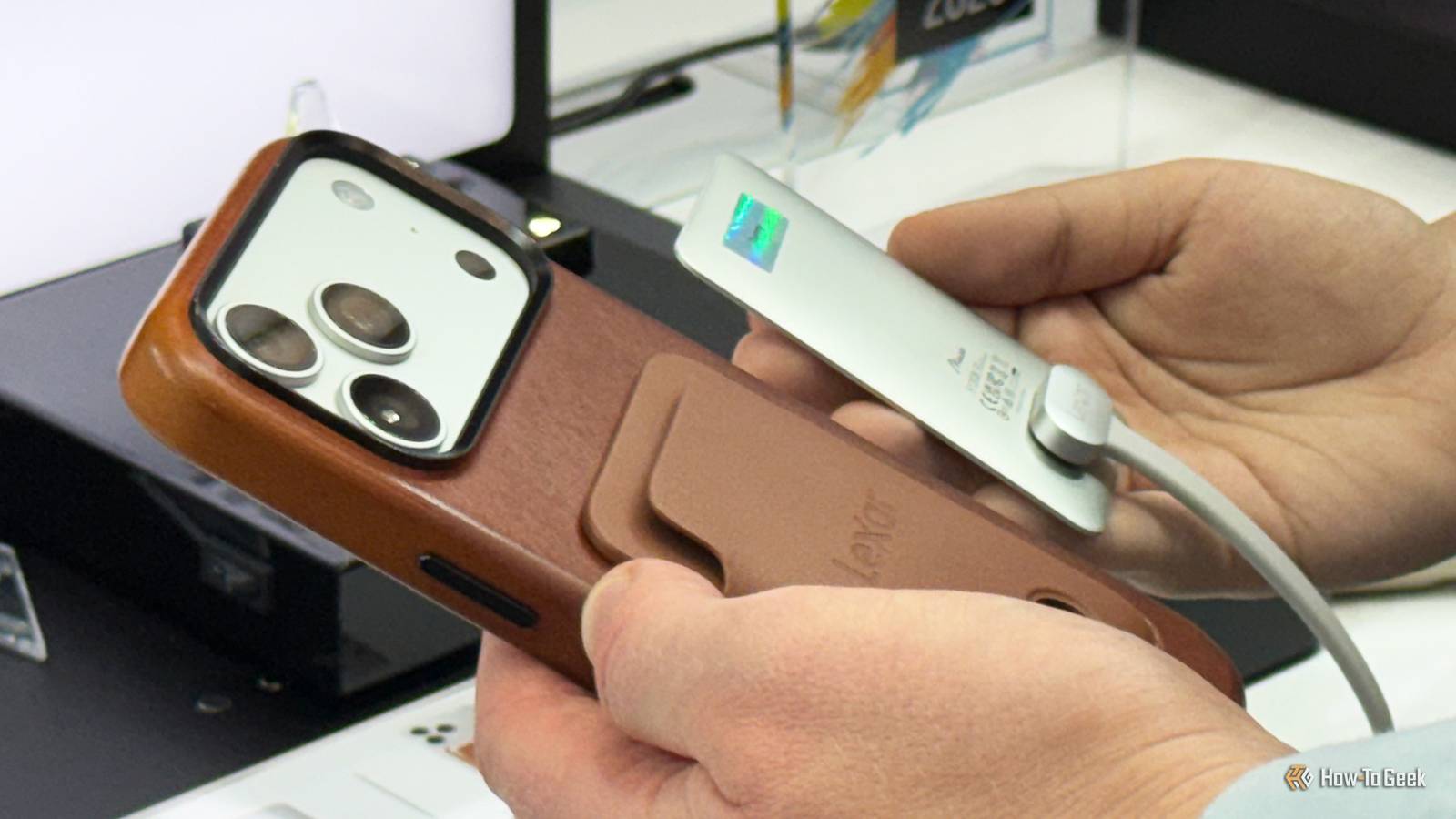
Many tech companies like to tout "world's best" claims, but here's one that actually matters.Lexar has introduced the "world's thinnest portable SSD," the Muse, and it looks to be genuinely helpful if you love recording video (or any media, really) on your phone.The new drive measures just 0.15 inches (3.8mm) at its thickest point, and it feels more like I'm holding a metal business card than digital storage.
It's so easy to carry that Lexar made a MagSafe (and effectively Qi2) case to hold it on the back of phones like the Pixel 11 Pro and iPhone 17 Pro.If you hate the bulk of conventional external SSDs and need something faster than a stick, you'll want the Muse — I found it almost invisible in practice.Close The Muse isn't the fastest SSD with claimed read and write speeds of 1,050MB/s and 1,000MB/s, respectively.
That's more than enough to feed high-bitrate video (up to 4K, 120FPS ProRes footage on iPhones), and it's no mean feat given the dimensions.Lexar says it achieved the thinness through a combination of "high-density" flash memory stacking, a custom thin circuit board, and an "integrated" internal design meant to make the most of very limited space.This isn't an off-the-shelf approach that puts everything in a box.
There is a compromise.As you might guess, there's not enough room for a conventional USB-C port.Instead, you attach a magnetic connector on a proprietary SnapLink cable.
That's acceptable given the mobile focus, but it does prevent you from using any USB-C cable you have on hand.Lexar hasn't said how much it will cost to get a replacement.Lexar Muse SSD: price, release date, and capacity The cost is still a mystery Lexar expects to release the Muse SSD in the fourth quarter of the year in 512GB and 1TB capacities.
The company hasn't provided a price, and that could be vital to making the drive accessible to everyday people.If it's too expensive, some might skip it altogether.With that said, the Muse is a one-of-a-kind storage device.
If you're using your phone for professional video or music production, the SSD could pay for itself by letting you record longer and without quite so many transfers to your computer.You also won't have to worry so much about the bulk of external storage affecting your hand grip or a gimbal's balance.This might also be the product that makes external phone drives relevant to everyday people.
If you capture mountains of personal photos and videos, or are simply running out of space, you don't have to upgrade your phone (or look for a phone with a microSD card slot) just to get some headroom.You'll just need a phone with MagSafe or Qi2 as an option, whether it's built-in or added through a case.That's more commonplace these days, and only likely to get better.
Read More