I lived in my previous apartment for more than seven years, and during most of that time, I used a small ISP that had a lot going for it.For starters, I paid the equivalent of $18, first for a 250/50Mbps plan and later for a 500/100Mbps plan, which was a great price no matter where you live, if you ask me.Better yet, I never signed a contract.
I was on their prepaid plan, so when I moved apartments, I just let them know I no longer needed their service, returned the equipment, and that was it.But about a year ago, when I moved to a new apartment, I had to switch ISPs.The two ISPs I was limited to couldn't match what my previous provider offered, and I ultimately settled on a 300/30Mbps plan that also includes a bunch of TV channels because my new ISP doesn't offer internet-only plans (sigh).
It costs me the equivalent of $45 a month (another sigh).While I hadn't used a custom DNS before—aside from on my phone—I decided to switch to one after signing the contract (the new ISP doesn't offer a prepaid option either).As it turned out, switching to a custom DNS did more than just make my browsing more private.
I didn't want my new ISP keeping a log of my DNS requests ISPs can see more than you might think Close The ISP I switched to isn't a large company by global standards by any means, but it's one of the biggest where I live.The catch is that it was bought out a while ago by a telecom company that doesn't have the best reputation in my neck of the woods.While the two entities operate as separate brands, my ISP is a wholly owned subsidiary of the telecom company.
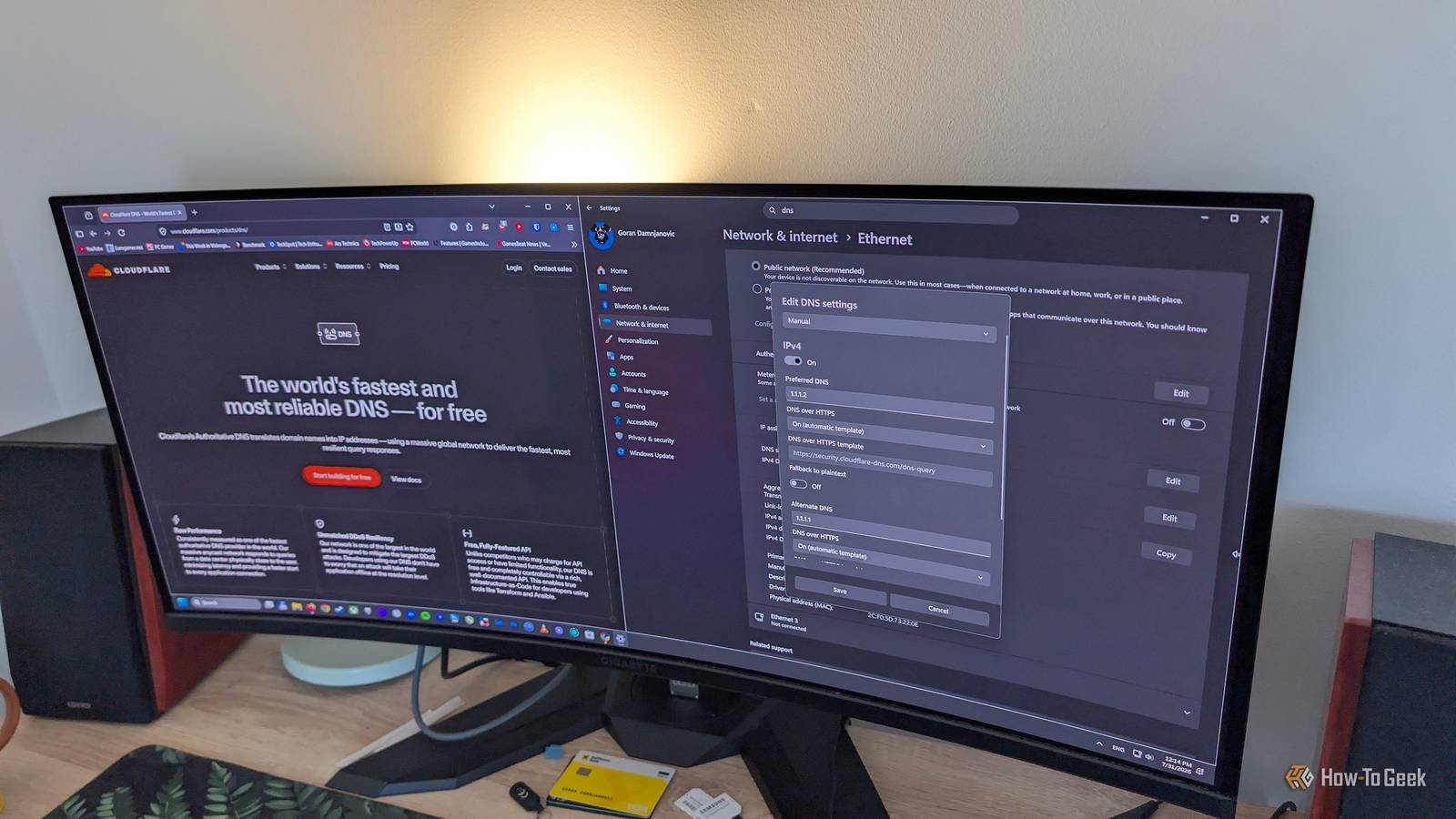
For those reasons, I decided to switch to a custom DNS.I want to share as little data with my current ISP as possible, and while I know that using a custom DNS won't make my internet browsing fully private, it's better than nothing.By using Cloudflare's DNS—I ended up picking it after running the DNS Speed Test benchmark—with DNS over HTTPS on all my computers, I can at least prevent my ISP from seeing and logging my DNS queries, making it much harder for them to determine which websites I visit and potentially monetize that information.
So, shortly after I moved into my new apartment and got settled, I switched all my computers to Cloudflare's DNS since the ISP router I was using at the time didn't support custom DNS.It was very simple on Windows, but required jumping through a few hoops on my Mac mini because macOS doesn't have a DNS over HTTPS toggle like Windows 11 does.I've been using Cloudflare's DNS for almost a year now, and I haven't encountered any issues during that time.
While I was worried that using a custom DNS would lead to intermittent issues (the AdGuard DNS I use on my phone has suffered a few outages over the years), that hasn't been the case.My DNS queries are resolved almost instantly, and I can say I'm pretty satisfied with the switch.Better still, on top of the privacy benefits, using Cloudflare's DNS came with a few other perks as well.
Quiz8 Questions · Test Your KnowledgeDNS servers & how the internet finds its wayTrivia challengeFrom 8.8.8.8 to how your browser finds cat videos — find out how much you really know about DNS.DNS BasicsIP AddressesSecurityProvidersHistoryBegin01 / 8DNS BasicsWhat does DNS stand for?ADigital Network SecurityBDomain Name SystemCDistributed Node ServiceDDynamic Naming StandardCorrect! DNS stands for Domain Name System — the internet's giant phone book that translates human-friendly domain names like 'howtogeek.com' into IP addresses computers can actually use.Without it, you'd need to memorize a string of numbers every time you wanted to visit a website.Not quite — DNS stands for Domain Name System.It acts like the internet's phone book, converting easy-to-remember domain names into the numerical IP addresses that computers use to route traffic.
It's one of the most fundamental building blocks of the modern web.Continue02 / 8HistoryBefore DNS was invented, how did computers resolve hostnames on the early internet (ARPANET)?AEach router kept its own lookup tableBUsers typed IP addresses directly every timeCA single text file called HOSTS.TXT was downloaded from a central serverDA broadcast message was sent across the network asking for the addressThat's right! Before DNS, every computer on ARPANET relied on a file called HOSTS.TXT maintained by the Stanford Research Institute.Admins had to manually download the updated file to get new hostname mappings — not exactly scalable once the network started growing rapidly.The answer is HOSTS.TXT.Before DNS existed, a single text file maintained at the Stanford Research Institute mapped all hostnames to addresses, and every machine had to download it periodically.
As the internet grew, this system became completely unmanageable, which is exactly what motivated the creation of DNS in 1983.Continue03 / 8ProvidersThe famous DNS server at IP address 8.8.8.8 is operated by which company?ACloudflareBOpenDNSCGoogleDMicrosoftCorrect! 8.8.8.8 (and its companion 8.8.4.4) is Google's Public DNS service, launched in 2009.It was one of the first major free public DNS resolvers and became incredibly popular as a fast, reliable alternative to ISP-provided DNS servers.The 8.8.8.8 address belongs to Google's Public DNS, launched in 2009.Google made 8.8.8.8 easy to remember on purpose.
Cloudflare runs 1.1.1.1, OpenDNS uses 208.67.222.222, and Microsoft's Azure DNS exists but isn't the same service — each provider pitches slightly different benefits like speed, privacy, or filtering.Continue04 / 8ProvidersCloudflare's DNS resolver at 1.1.1.1 launched in 2018 with a strong emphasis on what selling point?ABuilt-in ad blocking for all usersBUser privacy and not logging IP addressesCFaster speeds guaranteed by a global CDNDParental controls enabled by defaultSpot on! Cloudflare launched 1.1.1.1 on April 1, 2018 (yes, really) with privacy as its headline feature, promising never to log users' IP addresses or sell browsing data.It was independently audited by KPMG to back up those claims, which set it apart from many competitors.Cloudflare's big pitch for 1.1.1.1 was privacy — specifically the promise to never log users' IP addresses or sell their data.While 1.1.1.1 is also very fast (often ranking #1 in independent speed tests), privacy was the headline claim at launch, backed by a third-party audit from KPMG.
Ad blocking is available via a separate 1.1.1.2 address, but it's not on by default.Continue05 / 8DNS BasicsWhat is a DNS 'resolver' (also called a recursive resolver)?AThe server that stores the original authoritative records for a domainBA piece of hardware inside your router that caches all domain names locallyCThe server that does the legwork of querying other DNS servers on your behalfDA security certificate that verifies a domain name is legitimateExactly right! A recursive resolver (like 8.8.8.8 or 1.1.1.1) is the middleman that takes your query and chases down the answer by contacting root servers, TLD servers, and authoritative nameservers — then delivers the final IP address back to you.It does all the heavy lifting so you don't have to.A recursive resolver is the server that does the legwork on your behalf — it contacts root nameservers, top-level domain servers, and authoritative nameservers in sequence until it finds the IP address you need.The authoritative nameserver is the one that actually holds the official records.
Your resolver is essentially the internet's investigator, tracking down answers one clue at a time.Continue06 / 8SecurityWhat type of attack involves poisoning a DNS cache with false records to redirect users to malicious websites?ADNS spoofing (cache poisoning)BDDoS amplificationCBGP hijackingDARP floodingCorrect! DNS spoofing, also known as cache poisoning, tricks a DNS resolver into storing a fraudulent IP address for a legitimate domain.When users then request that domain, they're silently redirected to a malicious server — which is exactly why DNSSEC was developed to cryptographically sign DNS records.The attack you're thinking of is DNS spoofing or cache poisoning.An attacker injects fake DNS records into a resolver's cache, causing anyone who queries that resolver to be directed to the wrong — often malicious — IP address.
DNSSEC (DNS Security Extensions) was designed specifically to fight this by adding cryptographic signatures to DNS records.Continue07 / 8DNS BasicsWhich DNS record type is responsible for mapping a domain name to an IPv4 address?AMX recordBCNAME recordCA recordDTXT recordRight on! The 'A' record (short for Address record) is the most fundamental DNS record type, mapping a hostname directly to a 32-bit IPv4 address.Its cousin, the AAAA record, does the same job for 128-bit IPv6 addresses — you'll sometimes see both configured for the same domain.The correct answer is the A record (Address record), which maps a domain to an IPv4 address.An MX record handles mail routing, a CNAME is an alias pointing one domain name to another, and TXT records store arbitrary text — often used for things like SPF email verification or domain ownership confirmation.
The A record is the bread-and-butter of DNS.Continue08 / 8SecurityDNS-over-HTTPS (DoH) and DNS-over-TLS (DoT) both aim to solve the same core problem.What is it?ADNS queries are too slow over long distancesBTraditional DNS queries are sent in plain text, making them visible to eavesdroppersCISPs charge extra for unencrypted DNS trafficDIPv6 addresses are too long for standard DNS packets to carryAbsolutely correct! Traditional DNS queries travel as plain, unencrypted text — meaning your ISP, network admin, or anyone monitoring traffic can see every domain you look up.DoH wraps DNS in HTTPS (using port 443), while DoT uses a dedicated TLS connection (port 853), both making your browsing queries much harder to snoop on.The core problem that DoH and DoT solve is that standard DNS queries are completely unencrypted and readable by anyone watching your network traffic — your ISP, a coffee shop Wi-Fi operator, or a government.
DNS-over-HTTPS hides queries inside normal HTTPS traffic, while DNS-over-TLS uses a dedicated encrypted channel.Both approaches protect your privacy at the DNS layer, which is surprisingly often overlooked.See My ScoreChallenge CompleteYour Score/ 8Thanks for playing!Try Again Switching to a custom DNS came with a few extra benefits My ISP's DNS won't win any speed contests Close The first thing I noticed after switching to my new internet plan was that the webpages I visited loaded slightly (but noticeably) slower than they had in my previous apartment.The same was true when comparing page load times on my phone and my desktop PC.
So I ran the nslookup command in Command Prompt and discovered that my ISP's DNS consistently timed out during DNS lookups.Cloudflare's DNS didn't exhibit the same behavior, and after switching, webpages started loading noticeably faster.So not only did I improve my privacy, but switching to a custom DNS also resulted in faster page loads, which is a most welcome perk.
Subscribe to the newsletter for privacy and speed tips Get hands-on DNS, router and privacy guidance—subscribe to our newsletter for concise, actionable how-tos that improve browsing performance and security.Learn practical DNS choices, router setup tips, and troubleshooting steps.Get Updates By subscribing, you agree to receive newsletter and marketing emails, and accept our Terms of Use and Privacy Policy.
You can unsubscribe anytime.Another benefit is that, by using Cloudflare's 1.1.1.2 malware-blocking DNS, my browsing is also more secure than it was with my ISP's DNS.So at the end of the day, switching to a custom DNS resulted in a threefold improvement: my browsing is more private, webpages load faster, and my browsing is more secure.
Not too shabby.Related I use these 6 Windows networking commands to fix any connection problem Troubleshoot your networking problems like a pro, never having to deal with "Connection refused." Posts By Zunaid Ali You should also switch to a custom DNS if you can It's been almost a year since I switched to a custom DNS, and I've yet to encounter any issues.The webpages I visit load almost instantly, and my ISP has a much harder time determining which websites I visit.
So, if you can, I recommend switching to a custom DNS as well.If your router supports it, I also recommend configuring your custom DNS there instead of setting it up on every device individually, something I couldn't do at the time because I was using my ISP's router, which doesn't support custom DNS.
Read More