Unless you’re willing to settle for mid-tier hardware, it’s an unfortunate fact that phones don’t come with expandable storage anymore.As a response, external storage accessories are becoming more popular, but they lack the convenience of a built-in microSD card slot.I attempted to solve this problem with a 3D printed phone case.
This isn’t my first attempt at addressing this conundrum.Previously, I designed an enclosure that can be attached to the back of a phone.It included a microSD card slot and an extra USB-C port to allow for charging while the enclosure is plugged into the phone.
The idea was well received, but there was a common request: make it into a case.Good idea.The external storage catch-22 Great accessories, all with the same problem As I said, external storage accessories are having a bit of a moment.
Products such as the Sharge Disk Pro look super cool, and they provide a lot of extra storage in a compact, easily portable package.However, regardless of the cool factor, these devices share the same problem as a USB-C flash drive.You can’t charge your phone with the USB port if a storage drive is plugged in, and even if you could, they’re usually not slim enough to keep plugged in 24/7.
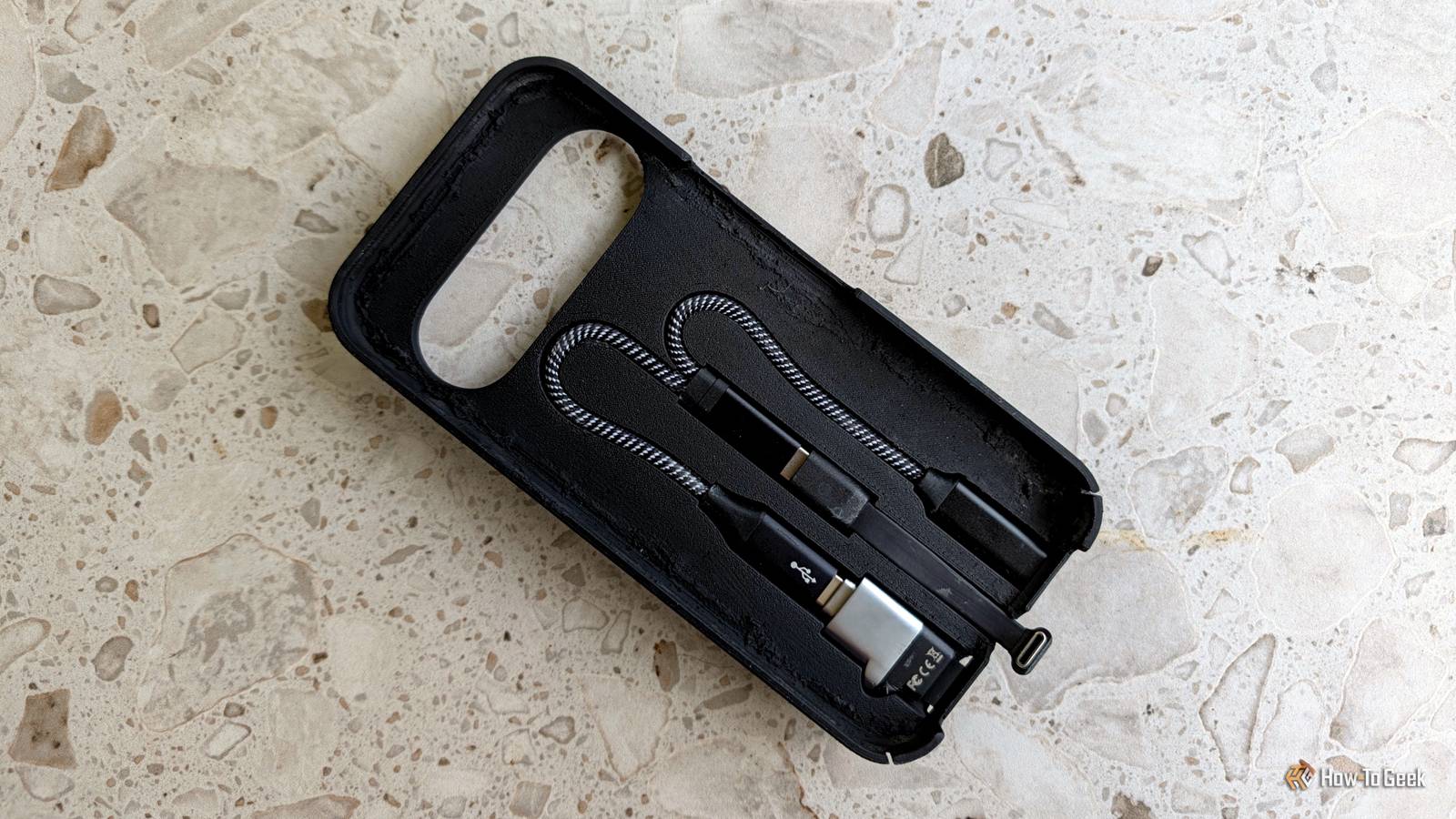
These were the two problems I attempted to solve with my storage enclosure, and I was able to do it for around $30.The solution was three separate accessories: a flat, 2.5-inch USB-C extension cable, a USB-C splitter cable with data and charging capabilities, and a USB-C microSD card reader.Putting these simple, cheap accessories together allowed for charging the phone while accessing the microSD card, and it was packed into a shell barely thicker than my Pixel 10’s camera bump.
It was more effective than I expected, but there was clearly room for improvement.Related I added microSD storage back to my phone for $30 without losing the charging port Solving the problems of portable external storage devices.Posts 44 By Joe Fedewa The people demanded a case Let’s give it a shot I have to agree with the people who suggested building the accessories into a case.
As happy as I was with the final product, I hadn’t really figured out a great way to attach it to the back of my phone.Magnets were my first thought, but most Android phones still don’t have that.It would also have added thickness that I was trying very hard to avoid.
A case makes a lot of sense.Thankfully, the case project was pretty simple.I already had the necessary components and did the hard work of measuring, printing, measuring again, printing again, and finally getting a snug fit for them.
I was also able to take advantage of my dabbling with 3D printed phone cases.It was just a matter of combining my model with Joak1m’s Pixel 10 case.There were two ways to do this.
I could have the enclosure attach to the case with some sort of hinge mechanism, allowing the owner to insert the components and then latch it shut.I wanted to minimize the thickness as much as possible, so I opted to retain the hollowed-out design—sandwiching the components between the case shell and phone back.From there, the last hurdle was figuring out the best way to print the model.
My first attempt was one piece with supports on the inside of the case.This worked okay, but the extra structure made the case too rigid—the downside of using PLA.It broke when trying to put the phone inside.
Instead, I decided to split the model into two parts and glue the halves together.This resulted in a much cleaner print, but I worry the case isn’t durable.Of course, printing the case in TPU would probably be the better choice, but that’s a material I’ve yet to experiment with.
This could be a real product It works remarkably well Not to brag, but I have to admit the end result is pretty awesome—the people were right.Despite having the exact same thickness as my previous enclosure, having it all built into a case makes it feel more compact (and secure).I can easily slide my phone into my pocket with the case on.
Close The only problem with the case solution is that it needs to be customized for specific phone models.That’s not terribly difficult with a ready-made case model for a phone.Otherwise, designing a case that fits a phone snuggly is a lengthy endeavor of its own.
Regardless, I legitimately think this could be a real product.Ideally, the components would be stripped of their plastic and rubber outer coverings, allowing them to be fully integrated into the case for an even slimmer package.This would also enable much, much better waterproofing than what I was able to achieve.
But, this is one man’s opinion—is it something you would be interested in purchasing?
Read More