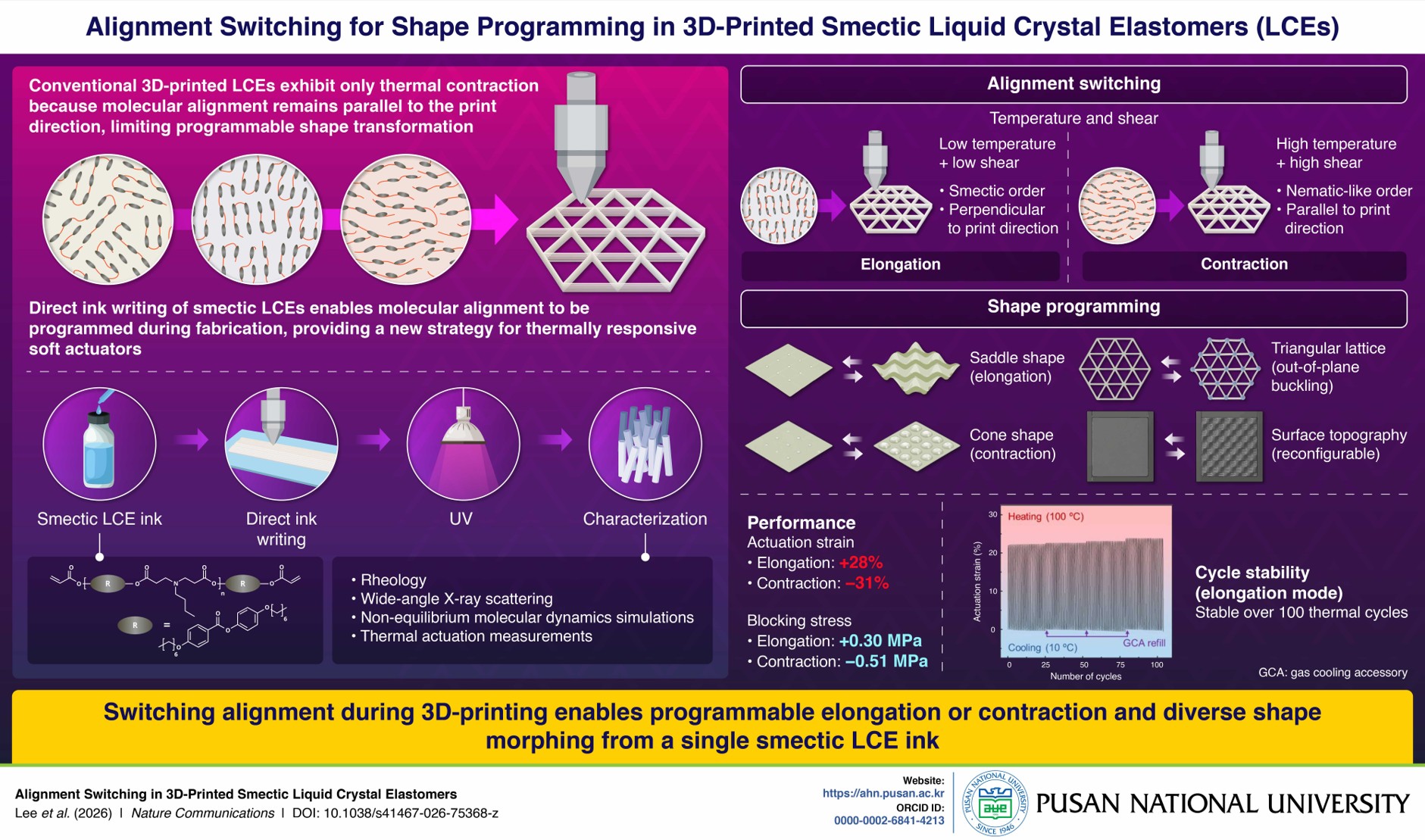
Korea’s Pusan National University has developed 3D printed elastomeric actuators.In a paper published in Nature, the team used elastomeric liquid crystal filaments.The filaments were printed while changing their molecular orientations, letting them either expand or contract and enabling switchable actuators.
The team consisted of Jin-Hyeong Lee, Kyeong Pyo Kim, Lijie Ding, Michael Li, Min Chan Kim, Kyu Hyun, Ji Hoon Kim, Jan-Michael Y.Carrillo, and Suk-kyun Ahn.The researchers came from Pusan’s School of Chemical Engineering and School of Mechanical Engineering.
On the Oak Ridge National Laboratory (ORNL) team, researchers joined from the Neutron Scattering Division & Center for Nanophase Materials Sciences.So here we’re seeing a multinational team, from very different disciplines, working together to make a lot of candle power shine brighter.It’s at this kind of interdisciplinary frontier that we expect to find major advances in our industry.
One of the key ingredients here is smectic ink; this is a Liquid Crystal Elastomeric ink that, through differences in print speeds and temperature, can switch the alignment of its molecules.Usually in liquid crystal inks, the smectic phase occurs when molecules are neatly aligned in direction and layers, in contrast to the nematic phase, where molecules are directionally aligned by interspersed, and the cholesteric phase, where they´re kind of fanned out haphazardly.To remember this: smectic is ladyfingers in a box, nematic is ladyfingers assembled into tiramisu, cholesteric is I threw the tiramisu.
So what they’ve done here is made an ink that allows you to repeatedly switch between these states by changing process variables such as print temperature and speed.That then could let you make a part where portions of it can elongate or contract.So more so than a paper, they’ve shown a technology that can be used by many other researchers to make all sorts of interesting shapes and properties.
Indeed, it’s easy to see how this can lead to the development of machines, microfluidics, and optoelectronic components.This is partially because Liquid Crystal Polymers are super weird.They’re kind of like glass in the sense that it’s difficult to tell if it’s like a very bad liquid or like a terrible solid depending on how you look at it.
But, glass, of course, is super usable, changeable, and useful because of its useful changes of state and its weirdness.Liquid Crystal Polymers are kind of like that in a sense and have very orderly crystalline structures when melting, different states, and low melt viscosity.This means that you could turn them into many things, many thin things and complex structures.
At the same time, these parts are inherently flame-resistant, have high strength, and good continuous service temperatures of around 240C.That’s why we’ve been so enthusiastic about NematX, which made a dream of a printer to print these materials.The reason for all the marble and precise control on NematX’s system is precisely the crux of these materials; while the properties are inspiring, printing these materials day to day is not fun.
So it’s easy to see why making small machines out of these materials would be intensely valuable.Think of the sensor applications, the missile parts, the opto-electronics, the miniaturized aircraft components, the connectors, the drone parts, the circuit boards, and the antenna.It’s almost as if a whole imagined future of making integrated robots out of one material runs through this material or this material coupled with copper or similar.
Just looking at electronics, making light, dimensionally accurate, thin-walled antennas for phones could be a huge application, and there’s much more besides.Implants, wearable sensors, implanted sensors, and defense could all be impacted by this, as could a new wave of opto-electronic devices.By changing molecular alignment during the print, lots of complex properties can be made.
What’s more, this direct ink writing technique could be reproducible and work at scale.To do it, the team worked with X-Ray scattering as well as simulation and rheology tools to determine when and how they could make the material switch and switch back.Professor Suk-kyun Ahn stated, “Our work provides the first demonstration of switching molecular alignment between two orthogonal directions using a single 3D-printable smectic LCE ink, simply by tuning the printing speed and temperature.
Potential real-life applications include soft robotic actuators and artificial muscles, reconfigurable surfaces for haptic displays, and adaptive textures that regulate aerodynamic drag.Over the next 5–10 years, this work could help 3D-printed objects go beyond just holding a fixed shape.Instead, they could actively change shape and carry out specific functions.” The team has demonstrated not only repeatable switching but has done so with specific lattice and conformal shapes.
It’s easy to see how, if this works, they could develop a technology to make complex assemblies that can move, change, and work at a very small scale while having high performance.This could be a very interesting technology to watch, as it could enable more researchers to do more Subscribe to Our Email Newsletter Stay up-to-date on all the latest news from the 3D printing industry and receive information and offers from third party vendors.Print Services Upload your 3D Models and get them printed quickly and efficiently.
Powered by FacFox Powered by 3D Systems Powered by Craftcloud Powered by First Mold Powered by Xometry 3DPrinting Business Directory 3DPrinting Business Directory
Read More