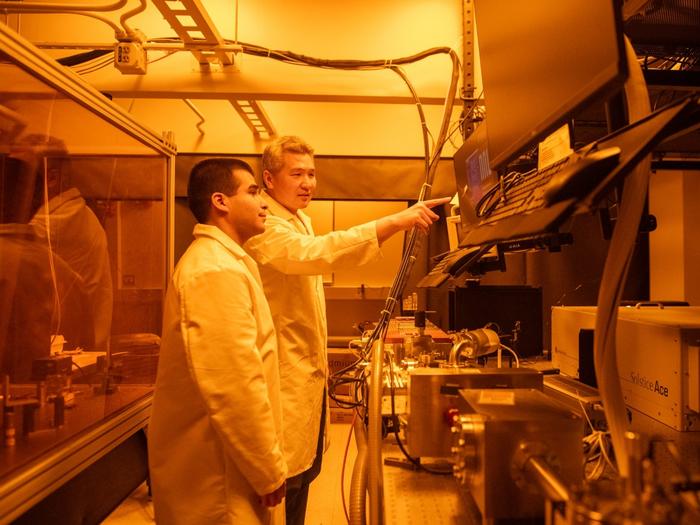
Photolithography, the semiconductor manufacturing process whereby lasers transfer patterns onto chemical layers coating a substrate, is one of the most amazing industrial processes humanity has ever created.It is also by far one of the most expensive, with the most sophisticated machines (High-NA EUV) only produced by a single company (ASML) and carrying a price tag of around $400 million.Researchers at the University of Texas (UT) are attempting to upend the barriers-to-entry standing in the way of broad access to EUV lithography by developing a low-cost, “tabletop” machine that leverages volumetric 3D printing.
This process typically involves spinning vats of photopolymers exposed to light from every angle, allowing users to print entire objects all at once.The method the UT researchers utilized instead relies on a single source of light that passes through stationary, self-assembling nanospheres — still creating objects all at once, but on a much smaller scale.Traditional EUV lithography can only create 3D structures by building them from a large number of 2D layers, patterned one layer at a time.
The method the UT researchers have created, documented in a recent article in the journal Nano Letters, prints entire 3D nanostructures all at once, drastically shrinking the time from design to output.A new 3D printing device and technique could speed up semiconductor research.In addition to the machine they developed, the team at UT’s Cockrell School of Engineering also benefited from access to EUV materials developed by collaborators at UT Dallas and Johns Hopkins.
The work was funded in part by a 2024 grant from the National Science Foundation (NSF), awarded to winners of the Future of Semiconductors (FuSe2) competition.In a press release about UT researchers’ development of a low-cost EUV process centered around volumetric 3D printing, UT professor Chin-Hao Chang (one of the lead authors for the associated research paper) contrasted the novel method, which reportedly works on a scale of minutes, against conventional EUV lithography: “The actual printing [in conventional EUV] might not take very long.But the processing can take days.
Saurav Mohanty, a recent Ph.D.graduate student in the group and the first author of the study, said, “Beyond semiconductor manufacturing, the ability to pattern 3D nanostructures can find applications in medicine for nanodrugs, quantum computing or synthesizing novel materials.” I’ve noted many times that the additive manufacturing (AM) industry needs to continue to pay just as much attention as it always has to R&D applications, even as companies simultaneously pivot towards focusing on a growing number of production-level use cases.It’s perfectly logical that the AM industry would want to move past being relegated almost exclusively to the world of prototyping, but AM’s evolution is far more nuanced than a simple binary choice between prototyping and production.
For one thing, in practical terms, prototyping and production are not mutually exclusive phases.The industries in which AM has achieved the greatest penetration when it comes to end-use parts tend to be precisely those industries where AM had already reached some significant degree of adoption first in the R&D stage.Additionally, now would be the worst time to stop targeting the R&D market, which is booming and should continue to do so for the foreseeable future.
The semiconductor industry is the best example of this, but it is far from the only one.And even in the case of semiconductors, if projects like the one at UT can ultimately yield broadly accessible research tools, it will vastly expand the number of industries that can afford to fund their own semiconductor research.Among the most profound consequences of the long-term accumulation of greater AM adoption is that the traditional lines between R&D and production have been blurred.
The successful companies will be the ones that view prototyping and production not in terms of an either/or, but rather in terms of a deliberately strategized pathway from the former to the latter.Images courtesy of the University of Texas Subscribe to Our Email Newsletter Stay up-to-date on all the latest news from the 3D printing industry and receive information and offers from third party vendors.Print Services Upload your 3D Models and get them printed quickly and efficiently.
Powered by FacFox Powered by 3D Systems Powered by Craftcloud Powered by Xometry 3DPrinting Business Directory 3DPrinting Business Directory
Read More