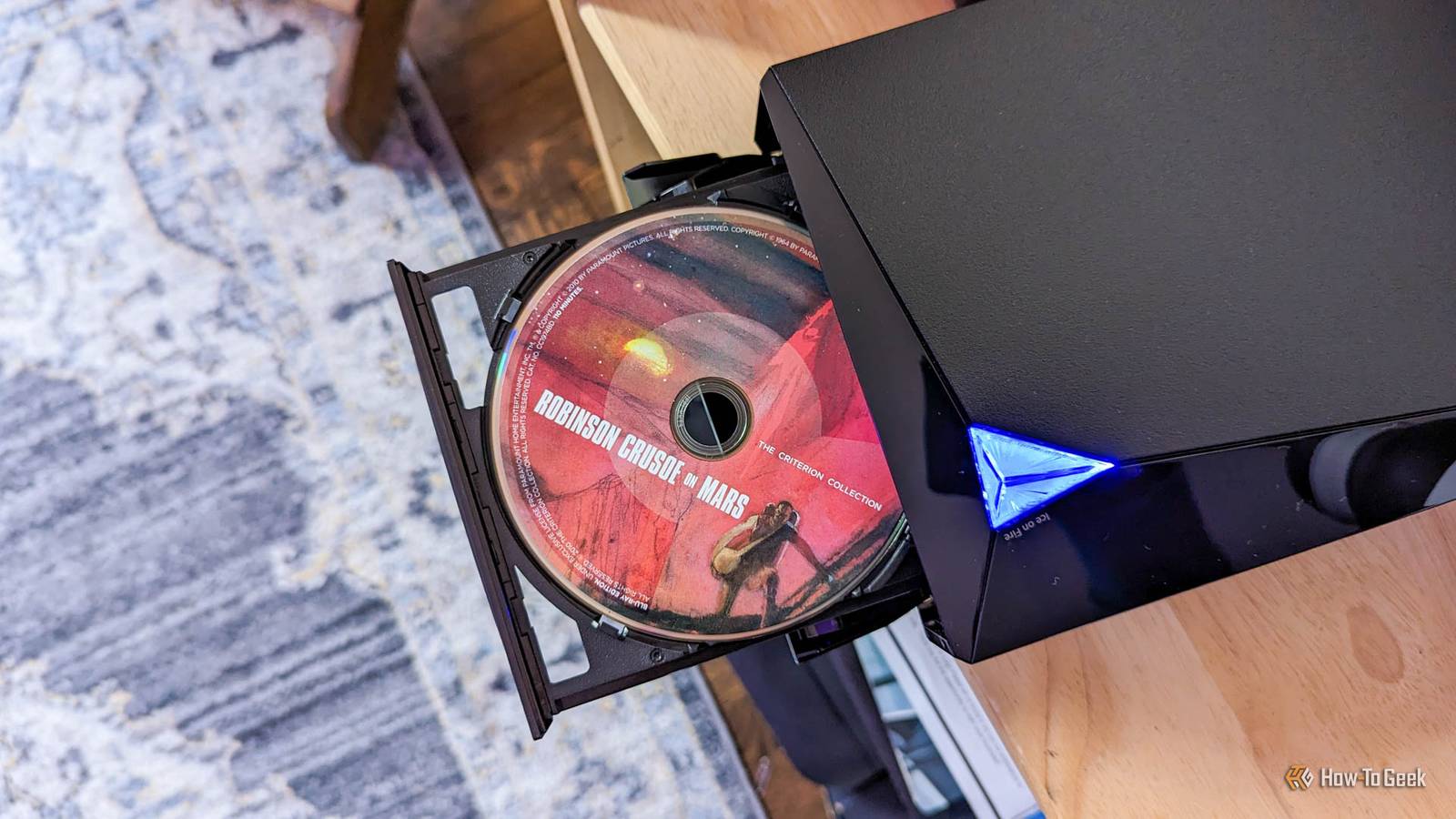
Whenever the discussion about physical media and its inevitable demise comes up, the argument that "discs rot and degrade" will inevitably raise its head.It should be obvious that any physical object will degrade over time.The question isn't whether your movie, music, and video game discs will eventually degrade past usability.
What matters is whether they'll remain usable long enough so that it makes no practical difference to .More importantly, the implication that media in a data center will be around long-term is just flat-out unsupported.Companies disappear, but a disc doesn't need a business to exist It's not bothering anyone on your shelf Close When you buy a disc with content on it and then store it somewhere (cool and dry!), that disc doesn't require any active, costly maintenance.
The data is at rest in cold storage.When you buy a game, song, or movie that's stored in the "cloud," it's actually being maintained across several active storage devices connected to running servers.Every second that passes, it costs money, maintenance, and labor to keep that content accessible.
Quiz 8 Questions · Test Your Knowledge The history of DVDs and Blu-rayTrivia challenge From laser discs to 4K Ultra HD — how well do you know the optical formats that changed home entertainment forever? HistoryTechnologyFormat WarsPioneersStandards Begin 01 / 8 History In what year was the DVD format officially introduced to consumers? A1994B1996C1997D1999 Correct! DVDs were officially launched in Japan in 1996, with North American and European releases following in 1997.The format was developed by a consortium of major electronics companies including Sony, Panasonic, Philips, and Toshiba. Not quite.DVDs debuted in Japan in 1996, then rolled out to North America and Europe in 1997.
The format was a collaborative effort between major electronics giants like Sony, Panasonic, Philips, and Toshiba. Continue 02 / 8 Format Wars Which two competing formats were merged to create the unified DVD standard, avoiding a format war in the mid-1990s? ALaserDisc and VCDBMMCD and SDCHD-DVD and DIVXDCDV and MiniDisc Correct! The Multimedia CD (MMCD), backed by Sony and Philips, and the Super Density disc (SD), backed by Toshiba and Time Warner, were merged into a single standard after industry pressure to avoid consumer confusion.The compromise largely favored the SD format's physical design. Not quite.The two competing formats were MMCD (Multimedia CD), pushed by Sony and Philips, and SD (Super Density), championed by Toshiba and Time Warner.
They were unified into the DVD standard after Hollywood studios pushed for a single format. Continue 03 / 8 Technology What is the standard storage capacity of a single-layer, single-sided DVD? A4.37 GBB5.2 GBC650 MBD8.5 GB Correct! A standard single-layer, single-sided DVD holds 4.7 GB in marketing terms, but this translates to approximately 4.37 GiB (gibibytes) in binary measurement.This was a massive leap over the 650 MB capacity of a standard CD. Not quite.A single-layer, single-sided DVD holds 4.7 GB as marketed, which equals roughly 4.37 GiB in binary terms.
The 8.5 GB figure refers to dual-layer DVDs, and 650 MB is a standard CD's capacity. Continue 04 / 8 Format Wars Which company's format won the high-definition disc format war that concluded in 2008? AToshiba's HD DVDBSony's Blu-rayCPanasonic's D-VHSDMicrosoft's iHD Correct! Sony's Blu-ray format emerged victorious in February 2008 when Toshiba officially announced it was discontinuing HD DVD.A key turning point was Warner Bros.dropping HD DVD support in January 2008, which prompted major retailers to follow suit with Blu-ray exclusivity. Not quite.
Blu-ray, developed by Sony and its partners, won the format war when Toshiba conceded defeat in February 2008.Warner Bros.'s decision to go Blu-ray exclusive in January 2008 is widely credited as the decisive blow that ended HD DVD's chances. Continue 05 / 8 Technology What color laser does a Blu-ray player use to read discs, and what is its approximate wavelength? ARed laser at 650 nmBGreen laser at 532 nmCBlue-violet laser at 405 nmDUltraviolet laser at 380 nm Correct! Blu-ray uses a blue-violet laser operating at 405 nanometers, which is much shorter than the 650 nm red laser used in DVDs.The shorter wavelength allows the laser to read much smaller data pits, enabling the higher storage density that Blu-ray is known for. Not quite.
Blu-ray gets its name from its blue-violet laser, which operates at approximately 405 nanometers.This shorter wavelength compared to the red DVD laser (650 nm) is precisely what allows Blu-ray discs to store significantly more data in the same physical space. Continue 06 / 8 Pioneers Which movie studio was the first to release a title on DVD in the United States? AWarner Bros.BUniversal PicturesCColumbia PicturesDParamount Pictures Correct! Warner Bros.was the first major studio to commit to and release titles on DVD in the US, with releases arriving alongside the format's 1997 North American launch.
Warner's early and enthusiastic support for DVD was crucial in establishing the format's credibility with consumers. Not quite.Warner Bros.was the pioneer studio in the US DVD market, releasing titles alongside the format's 1997 American launch.
Their early commitment was a significant factor in convincing other studios and consumers to embrace the new format. Continue 07 / 8 Standards What maximum video resolution does a standard Blu-ray disc support? A1080i (1920×1080 interlaced)B1080p (1920×1080 progressive)C2160p (3840×2160 progressive)D720p (1280×720 progressive) Correct! Standard Blu-ray discs support up to 1080p (Full HD) resolution at 1920×1080 pixels in progressive scan.For 4K content at 2160p, a separate format called Ultra HD Blu-ray was introduced in 2015, requiring different players and discs. Not quite.Standard Blu-ray tops out at 1080p Full HD resolution (1920×1080 progressive scan).
The 4K resolution of 2160p is supported by a different format entirely — Ultra HD Blu-ray — which was introduced in 2015 with its own dedicated players and disc specification. Continue 08 / 8 History The PlayStation 3 is often credited with helping Blu-ray win the format war. Approximately how many PS3 units were sold worldwide by the end of 2007? A5 millionB10 millionC17 millionD25 million Correct! Sony had sold approximately 10 million PlayStation 3 consoles worldwide by the end of 2007, each of which included a built-in Blu-ray player.This effectively made the PS3 the most affordable Blu-ray player on the market and massively accelerated Blu-ray hardware adoption. Not quite.Around 10 million PS3 consoles had been sold globally by end of 2007, and since each unit included a Blu-ray drive, Sony effectively flooded the market with Blu-ray players.
This strategic bundling is widely seen as one of the key factors that tipped the format war in Blu-ray's favor. See My Score Challenge Complete Your Score / 8 Thanks for playing! Try Again A company that can no longer pay to maintain this content will shut it down.Even if a disc "only" lasted a few decades, a cloud service hosting content you paid for could shut down tomorrow, not in 20 years.Worst of all, you have exactly zero control over when it happens, and there might be no warning at all.
With a disc, you control how it's treated and stored.You have the option of making backups at your own discretion.You can periodically verify that it still works.
You are the custodian of the data.Panasonic DP-UB9000 Connectivity Wired, Wi-Fi 5 The Panasonic DP-UB9000 is a premium Blu-ray player that delivers exceptional picture and audio quality, with support for all major HDR formats and extensive connectivity options.Its robust build quality and reference-class performance make it an top-tier choice for home theater enthusiasts seeking the ultimate viewing experience.
$1615 at Amazon Expand Collapse Cloud services are designed to change, not preserve Your goals are not aligned Cloud services are, as the name strongly implies, .A service is dynamic.It changes with the times and in response to current market conditions.
A cloud service is not a museum or an archive.In a data center, nothing is ever truly at rest.Data is migrated to new hardware, and storage is purged, replaced, and retired as part of routine business.
"Legacy" services end, and if there's no demand for the thing that justifies its existence in that data center, it will be decommissioned.When Sony announced the end of PlayStation 5 disc production in 2028, it also announced the shutdown of the Vita and PlayStation 3 online stores.There's no technical reason these stores have to be shut down.
Sony could maintain them in perpetuity, and it probably wouldn't even cost that much in the greater scheme of things, but the handful of people who still use their Vitas and PlayStation 3s across the world don't represent a profitable customer base, so that content is gone.Luckily, you can still get physical media for both the PlayStation 3 and PlayStation Vita, but going ahead with all-digital game consoles, that won't be the case anymore.Licenses expire long before optical discs do The devil is in the (contractual) details Ending physical disc production and closing the Vita and PS3 stores were not enough for Sony in 2026.
We also saw (as reported by PC Magazine) over 500 "purchased" movies deleted from PlayStation Network accounts because a licensing agreement with StudioCanal had ended.That includes , one of my all-time favorite movies.Keep in mind that the people affected did not "rent" these movies; they paid full price, just as you would for your own copy on disc.
You know who didn't lose their copy of despite paying a similar amount of money? This guy.Data centers are incredibly reliable—but they're not permanent It's not about media reliability This is not an argument against the technical reliability of data centers.Not even a little! A data center that's run in accordance with industry standards will almost certainly preserve its data against any reasonable prospect of loss.
It's not just a single copy of a movie on one hard drive in one location.We're talking multiple backups spread across independent locations, with both hot and cold storage in use.The thing is, it doesn't matter if the infrastructure is healthy or if the data center is being run correctly.
The entire outfit was never designed to be a permanent data fortress.You're thinking of the Library of Congress and the National Film Registry, which preserves up to 25 movies a year if they are deemed to be historically, aesthetically, or culturally significant.A for-profit business like a data center will never be a place to preserve things.
The closest digital equivalent we have is the Internet Archive, which makes thousands of media items available independent of their creators or copyright holders.Discs usually die from abuse, not age How long do discs last? Any answer you read is speculation by necessity.Optical discs haven't been around that long in the greater scheme of things, so claims that discs will last centuries aren't proven yet.
We do know that CDs from the '80s and DVDs from the '90s that didn't have manufacturing defects and have been stored and handled correctly are still perfectly fine.My LaserDisc collection, a medium notorious for "laser rot," is all good as well.When discussing the lifespan of Blu-rays or DVDs, people often mistakenly point to the numbers related to discs, not factory-pressed metal-layer discs.
These are two completely different technologies, so their durability isn't comparable.The bottom line is that if your discs are dry, cool, and unscratched, I'd put money on them outlasting every data center that exists today.
Read More