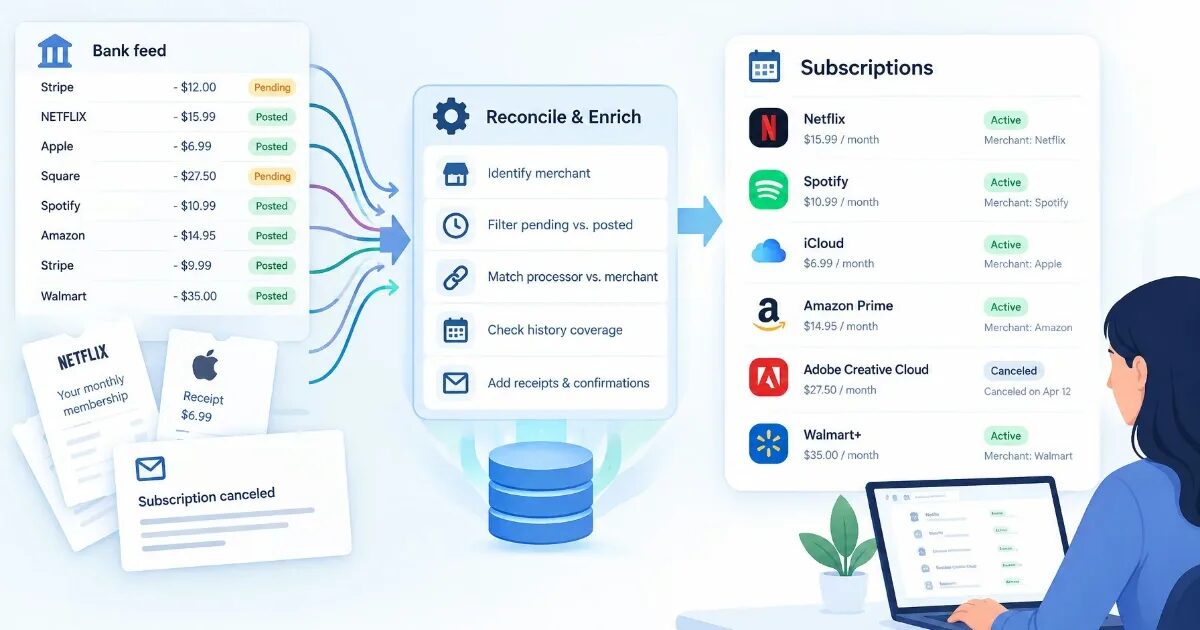
Bank-linked subscription trackers detect recurring payments by comparing transaction dates, amounts and merchant descriptions.Their hardest errors often start earlier: a pending charge becomes a new posted record, a processor hides the merchant name, or an annual renewal falls outside the available history.ContentsHow do subscription trackers work with bank transaction data?How should a subscription tracker reconcile transactions and identify merchants?How much history does recurring-charge detection need?Where do email receipts help subscription tracking?When should an app mark a subscription as cancelled?What does read-only bank access allow?How should an app report a subscription price change?How should a conversational query layer handle ambiguous transaction data?What each tracker component can establishHow do you test a subscription tracker before release?What should customers see when their bank connection stops updating?Keep the Evidence Behind the Next Subscription AlertFrequently Asked QuestionsHow do subscription trackers identify recurring payments?Why can a subscription tracker miss an annual subscription?Does sending a cancellation request mean a subscription is cancelled?Subscription trackers must reconcile raw bank-feed records before they can reliably detect, explain or act on a recurring charge.Your app has to distinguish pending payments from posted payments, processors from merchants, and partial histories from complete coverage.
Receipts and cancellation confirmations supply context that transaction records alone cannot establish.A bank feed can show a purchase while it is pending, then supply another record when the payment posts.In Plaid’s transaction documentation, the posted payment gets a new transaction ID.The pending record is removed, and Plaid links the two where it can identify the match.
The amount or description may change along the way.A developer who simply adds each incoming record to a spending history can leave both entries in place.The customer then sees a duplicate that the software created.Subscription tracking starts with this sort of bookkeeping.
Before the app can offer useful advice about a recurring bill, someone has to reconcile the records behind it.Pending and posted records can create false duplicates if the app does not reconcile them.Keep the original description alongside the cleaned merchant name so processor names do not obscure which business received a payment.History depth must match the billing cycle.Plaid recommends at least 180 days for its recurring-transactions product, without guaranteeing that every subscription will be detectable.Email receipts can supply plan names and renewal dates, but each message still needs to match the right account and payment.Cancellation tracking needs separate requested, in-progress and confirmed states.Read-only access does not authorise payments.The Financial Conduct Authority distinguishes account information from payment initiation.How do subscription trackers work with bank transaction data?Open banking transaction data helps an app examine payments across the accounts a customer connects.
Amounts, dates and descriptions provide evidence of recurring spending.They leave questions unanswered, though: what the customer bought, whether they still use it and why a bill changed.Suppose a service charges $12 in January and February, then $15 in March.A tracker has enough information to draw attention to the increase.
It would need more evidence to explain it.A renewal email might announce a new price; an invoice might show that the customer added a feature.The useful alert would show the three charges and let the customer investigate.Calling the increase an overcharge would go beyond the evidence.
Developers also need to distinguish recurring payments from subscriptions.Plaid’s recurring-transactions API groups both incoming and outgoing payments, including deposits and expenses.Its output describes payment patterns.
The application still has to decide how to present those findings.More Read Long Term Financial Planning with Financial Data Analytics Why Are Organizations Focusing on Data Security? Public vs.Private vs.Hybrid Cloud – Exploring the use Cases Data Analytics Helps Marketers Make the Most of Instagram Stories How AI-Driven Cybersecurity Drastically Impacts Our Lives That decision matters when the next button says “Cancel.” A customer should be able to see which service the app identified, which charges support the finding and what action they are being asked to approve.How should a subscription tracker reconcile transactions and identify merchants?For a Plaid integration, use pending_transaction_id to link a posted payment to its pending predecessor when supplied.
A null value leaves that relationship unresolved; do not merge charges on matching amounts alone.Apply added, modified and removed updates across the complete /transactions/sync update before recalculating totals.Plaid notes that a replacement and removal can arrive on different pages.Keep a stable internal payment reference and retain the provider IDs it replaces.
Make replaying an update safe: a retry should not add the same payment or send the same alert twice.These are implementation recommendations; the exact storage and retry mechanism depend on your application.Keep the original transaction description alongside any merchant name the app assigns.Use the cleaned name to help customers recognise a payment, while retaining the source record so the team can investigate a wrong match.
Recognising the merchant name tells you almost nothing about whether a given charge is a subscriptionMichal Maliarov, writing for transaction-data vendor Tapix: The European Subscription Economy Runs Through Transaction DataA description can contain the name of a payment processor as well as the business that received the money.Removing the processor’s name may make the entry easier to read.Removing too much can erase the detail that distinguishes one seller from another.Consider a customer who buys products from an online marketplace and pays for a membership through the same company.
Grouping every charge under that company’s name would mix shopping with subscription spending.A familiar logo would make the result look convincing without resolving the mistake.The interface should let the customer open the underlying charges.Dates, amounts and original descriptions give them a way to check what the app has grouped together.
If they correct a merchant match, retain that correction and its scope.Changing one transaction should not automatically relabel every payment with a similar description.How much history does recurring-charge detection need?It needs enough history to observe the billing pattern being assessed.Several months may reveal a monthly payment, while an annual renewal can remain difficult to identify from a short transaction history.
The app should show the period it examined.For its recurring-transactions product, Plaid recommends requesting at least 180 days of history for the best results.That is guidance for a particular service, not a universal threshold that makes every subscription detectable.Six months of records might contain only one payment for an annual software licence.
A receipt or renewal notice could help explain it.Keep a single observed payment labelled as uncertain until further evidence supports a recurring pattern.Coverage matters just as much as duration.A customer may connect their main bank account while paying for several services on another card.
Showing which accounts were checked, and when they last updated, helps the customer understand what might still be missing.Where do email receipts help subscription tracking?Email receipts can supply details that a payment record leaves out, such as the plan name, billing period or reason for a price change.A renewal notice may also arrive before the charge.An app can use that information to help a customer review an upcoming payment while there is still time to act.The records will not always agree neatly.
Someone might register with a work email and pay with a personal card.A household could have two accounts with the same provider, and forwarded receipts can introduce duplicates.Match the service, account, amount and billing period where available; a company-name match alone is insufficient.For an annual subscription, last year’s bank charge and this year’s renewal notice answer different questions: what was paid and what the merchant plans to charge next.
Keep the source of each detail visible.When dates or amounts conflict, show the discrepancy until there is enough evidence to resolve it.Email access also deserves its own explanation during setup.
Tell customers what the app needs to read and which features work without that connection.When should an app mark a subscription as cancelled?The published explanation of how PennyGuard works, step by step illustrates the distinction.PennyGuard says bank or card connections use Plaid and email access is optional.For supported services, the customer confirms before a cancellation request is sent through their connected inbox or a partner.
Its requested, in-progress and confirmed labels describe different stages.These are the company’s published descriptions, not an independent test of its service.Mark it as cancelled when there is evidence that the cancellation succeeded.Record a submitted request as a separate event, with its date and current status.
The customer needs to know whether the merchant has accepted the request or still needs something from them.An outgoing email establishes that a request was sent.A reply asking for an account number means there is more work to do.Even after confirmation, the customer may retain access until the end of a paid billing period.
Keep those details visible.Store the confirmation alongside the request and show any stated end date.If another charge arrives, the customer then has a record to check against the merchant’s response.A missed payment is weaker evidence.
Before treating it as a successful cancellation, check whether the connected account has refreshed.An app that has stopped receiving transactions cannot tell the customer whether billing has stopped.What does read-only bank access allow?Read-only access lets a service retrieve the account information covered by the connection.That permission does not authorise it to initiate payments.
Customers still need to understand which records the service receives, how it uses them and what happens to copies it has already stored.The UK’s Financial Conduct Authority distinguishes account information from payment initiation.It also tells customers to check how a provider will use their information and whether it will share that information with others.Those questions remain relevant even when the app cannot move money.
For a subscription tracker, access should follow the work the customer has asked it to do.Reviewing bank transactions and reading email receipts involve different sources of personal information.Explain each connection separately, including what the customer can still do if they choose not to connect their inbox.Make disconnection equally clear.
Stopping future retrieval and deleting previously collected records are separate operations.Explain both controls and any applicable retention limits so customers understand what each action changes.How should an app report a subscription price change?Show the new charge beside the previous charges and identify what changed.Describe the reason only when there is supporting evidence, such as an invoice or renewal notice.
A larger payment alone does not establish that the merchant raised its prices.Suppose a customer usually pays $30 for a service and the next charge is $36.The app can show the $6 difference.It should leave the explanation open until it has more information: the customer may have changed plans, added a user or bought something separately.Keep the original currency visible when it is available.
A charge billed in another currency can change in the customer’s home currency even when the merchant’s price stays the same.Give customers a way to mark an increase as expected.Once someone confirms a plan change, repeating the same warning every month adds little value.Retain that explanation with the payment history so they can check it later.How should a conversational query layer handle ambiguous transaction data?A conversational interface should show the records behind its answer and state what remains unresolved.
When your customer asks why they were charged twice, compare the payment states and original descriptions before offering an explanation.Two entries alone do not establish that two payments happened.For example, a customer asks, “Why was I charged twice this month?” One record might be pending and the other posted.Where the feed identifies the match, your answer can explain that relationship and link to both records, consistent with Plaid’s pending-to-posted transaction handling.
Without a confirmed match, show the dates, amounts and descriptions and leave the relationship unresolved.If the entries share a processor name but identify different sellers, show that distinction too.The customer should be able to inspect each raw description without having to accept the conversational answer as proof.What each tracker component can establishHow do you test a subscription tracker before release?Test recurring-payment detection against a labelled set of expected outcomes, including ordinary repeat purchases.
This follows the broader principle of finding data-quality defects before customers encounter them.Include incomplete histories and interrupted connections; neat monthly charges alone are an inadequate test.Start with a small set of fictional accounts whose histories you control.Give one account a monthly subscription, another several unrelated purchases from the same merchant, and a third an annual payment with no earlier renewal in the available history.
Record what the app should conclude in each case, including when it should leave a payment unclassified.Then change the records.Replace a pending charge with its posted version.Add a refund.
Correct a merchant description after the app has already grouped the payment.Plaid’s transaction-state documentation explains that integrations need to handle additions, modifications and removals to stay consistent with the underlying account.Replay the same update, split a pending removal and posted addition across two pages, and provide a posted record without a pending match.The expected outcomes are one counted payment for a confirmed replacement, no duplicate alert on replay, and an unresolved match when the data cannot establish one.
Add a connection outage over a renewal date and check that the app reports missing data without declaring a successful cancellation.Check what the customer sees after each update.A corrected transaction should not leave an old warning behind.A refund should not silently erase the original charge from a history the customer may need to review.Measure missed subscriptions and false alerts separately.
Precision is the share of flagged subscriptions that your labelled review confirms; recall is the share of known subscriptions the tracker finds.Review both by monthly and annual billing, merchant ambiguity and history coverage.These are proposed evaluation measures, not results from a benchmark run for this article.What should customers see when their bank connection stops updating?Show the last successful update and explain which account needs attention.
Keep the available history accessible, but make clear that recent payments may be missing.The absence of a new charge means little when the app has stopped receiving records.That distinction becomes important after a cancellation request.If the expected billing date passes during a connection outage, the app has no new evidence that the merchant stopped charging.
Leave the request’s status tied to the confirmation received, and check later transactions when the connection resumes.Renewal estimates need similar treatment.Display them as estimates when they come from payment history, and distinguish them from dates supplied by a merchant.Customers can then decide how much confidence to place in the reminder.Keep the Evidence Behind the Next Subscription AlertA useful subscription tracker gives someone a payment they can recognise, enough context to investigate it and a clear record of any action taken.
The engineering behind that experience includes reconciling changed records, preserving evidence and admitting when the feed cannot answer a question.Those details determine whether the customer can rely on the next alert.Frequently Asked QuestionsHow do subscription trackers identify recurring payments?Bank-linked trackers look for patterns in transaction dates, amounts and merchant descriptions.They must reconcile pending and posted records so that one payment is not counted twice.
A recurring pattern is evidence to investigate, not proof of a subscription: regular purchases from the same merchant can look similar.Why can a subscription tracker miss an annual subscription?A short transaction history may contain only one annual payment, leaving too little evidence to establish a yearly pattern.The tracker may also lack access to the account used to pay.Email receipts and renewal notices can help identify the service and billing period, but the app should keep uncertain findings clearly labelled.Does sending a cancellation request mean a subscription is cancelled?No.
A sent request establishes only that cancellation was requested.The tracker should distinguish submitted, in-progress and confirmed outcomes, retain evidence of successful cancellation and show any stated end date.A missing charge alone is not confirmation, especially if the bank connection has stopped updating.
Read More