There are plenty of ways to get into homelabbing.Some of us repurpose something we already own (I built my first home server using an old laptop), while others prefer to pick up a cheap starter device like a Raspberry Pi or mini PC.For those who want more power and room for expansion, old office and gaming PCs can make great first homelabs, too.
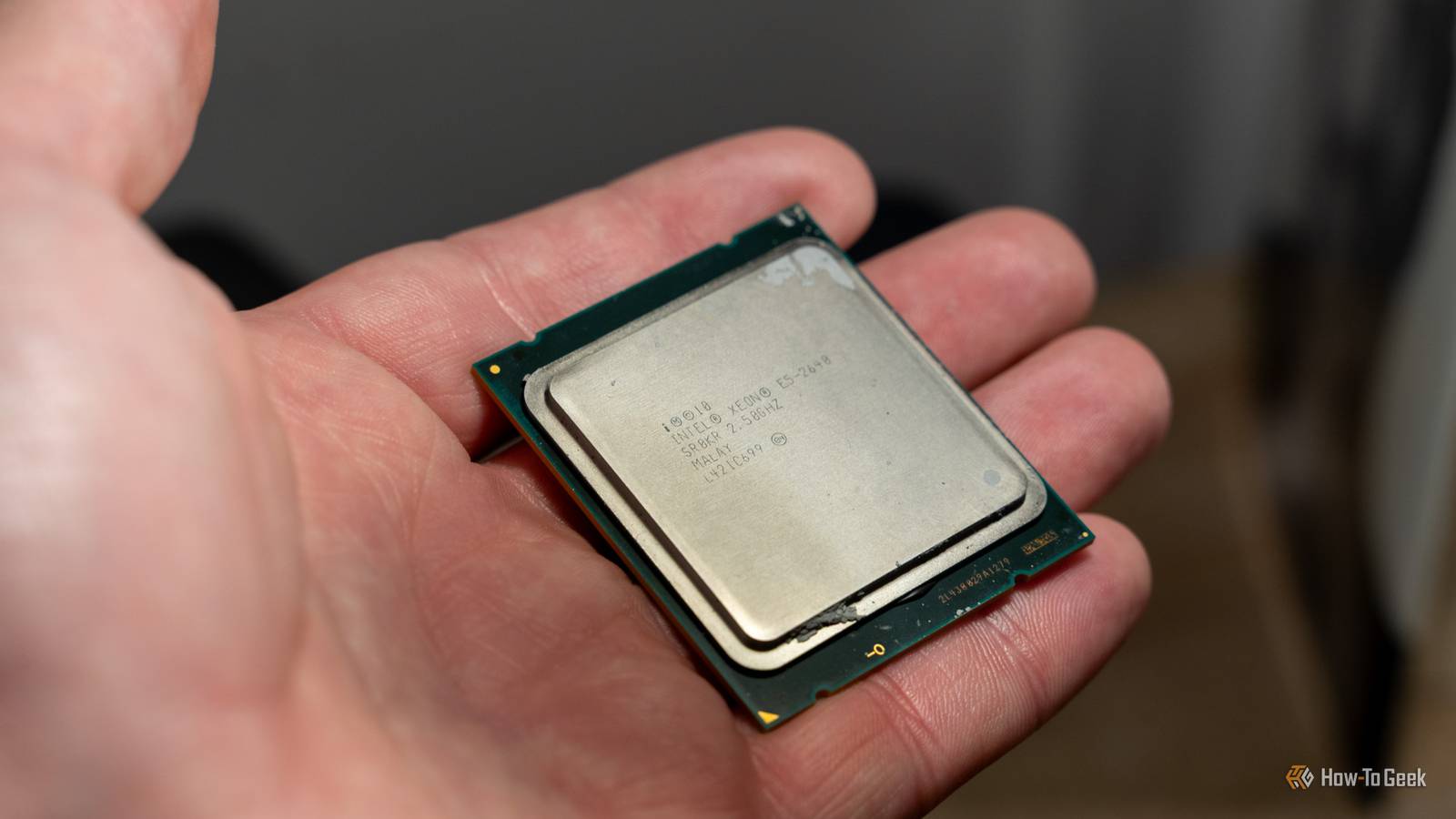
But if you want a lot of computing power without spending much money, the answer might lie in something else entirely: an old, enterprise-grade Intel Xeon CPU.An old Intel Xeon often costs less than a dollar per core A lot of cores for not a lot of money Close Xeon is Intel's line of processors primarily designed for use in professional environments, such as workstations and servers.These CPUs prioritize a different set of features than desktop Core CPUs, which I'll talk about later.
For now, what interests us is the raw specs you get for the price.Xeon chips often provide a significant number of cores with Hyper-Threading.Xeon cores are usually clocked at significantly lower speeds than equivalent desktop chips, but that doesn't matter as much for a home server that runs lots of lighter workloads.
The best thing about old Xeons is their price.Hop on eBay, Facebook Marketplace, AliExpress, Amazon, or any other website where you can buy used and refurbished hardware, and you'll find an abundance of old Intel Xeons that cost less than a lunch.One of the cheapest Xeons I could find in terms of core count per dollar, and one that's widely available, is the Intel Xeon E5-2690 v3, a 12-core, 24-thread beast with a 2.6GHz base clock that regularly sells for $10 or less.
It's a 2014 model based on the Haswell-EP architecture, with DDR4 RAM support.Intel Xeon E5-2690 V3 Brand Intel CPU Model Xeon E5-2690 V3 The Intel Xeon E5-2690 v3 is an affordable LGA2011-3 server CPU with 12 cores, 24 threads, and a 2.6GHz base clock.It boosts up to 3.5GHz, has 30MB of cache, supports quad-channel DDR4 memory, and has a 135W TDP.
See at eBay See at Amazon Expand Collapse DDR4 memory can be expensive or difficult to source, though, so a slightly older DDR3-compatible Xeon could make more sense, depending on your requirements.The Intel Xeon E5-2680 v2 sells for around $12 to $20, making it a fantastic buy, as it's one of the cheapest 10-core Xeons that supports DDR3 ECC RAM.Interestingly, you can find ultra-cheap Xeons dating back as recently as 2017, like the Skylake-based, 10-core Intel Xeon Silver 4114.
It's an incredible CPU for a homelab, but the catch is that finding a compatible LGA3647 motherboard at a low price can be incredibly challenging.It's worth pointing out that not all Xeons have a large number of cores.Some older entry-level Xeon E3 models had only 2 to 4 cores, while mid-range models had 6 to 8.
The good news is that many of the Xeons readily available on the used market today were once high-end enterprise hardware, so you can find chips with a whopping 18 cores, like the Intel Xeon E5-2699 v3, for under $20.Old Xeons bring server-grade features to a budget build PCIe lanes and lots of space for RAM are just the beginning The best part about buying a server-grade CPU for a home server is that you gain access to server-centric features that are less common on consumer platforms.One of the biggest advantages is the sheer number of PCIe lanes.
A typical consumer CPU supports around 20 to 24 PCIe lanes, but many Xeons offer 40 to 48, giving you plenty of room for expansion cards.Even if the motherboard doesn't have M.2 slots, you can use PCIe-to-M.2 adapters to add NVMe drives for storage or caching, install a dedicated graphics card for specialized tasks like media transcoding or GPU passthrough to virtual machines, add a high-bandwidth network card, and install various other expansion cards as needed.You also get support for quad-channel memory and, more importantly, ECC (Error-Correcting Code) RAM.
In fact, ECC RAM is required on some Xeon platforms, so be sure to do some research if you're looking to build a machine.The great thing about ECC RAM is that it can detect and correct certain random bit flips that could otherwise corrupt data, improving system reliability.It's especially beneficial in a server that runs continuously for months.
But perhaps the biggest benefit comes from Intel VT-x and VT-d support, which is incredibly useful for running several VMs on your machine.If you're building a server to run Proxmox, VMware, or Hyper-V, an old Xeon is an excellent budget option thanks to its high core count and virtualization features.Finding compatible hardware can be challenging, but buying a complete server might be cheaper The cheapest way to buy a Xeon is in a complete machine While Xeon CPUs are cheap, their compatible motherboards can set you back.
They offer a long list of features: many have several PCIe slots, some support dual CPUs, and some have eight or more RAM slots.Depending on how desirable a particular platform is, sourcing a motherboard can cost well over $10, $20, or even $100.As far as server and workstation platforms go, LGA2011-3 X99 motherboards are on the cheaper end of the spectrum, sometimes costing less than $50, while LGA3647 motherboards can go for several hundred dollars, undermining the idea of buying a $10 server CPU to build a powerful homelab on the cheap.
Not all of them are expensive, though.LGA1155 motherboards for lower-end Xeons are often consumer-grade, which makes them fairly cheap and easy to find, though this limits you to lower-end Xeon E3-1200 and E3-1200 v2 chips that don't have nearly as many cores.It's not all bad, though.
One of the cheapest ways to get into homelabbing with a Xeon is to buy an entire server.To give you a real example, I found someone selling an old Dell PowerEdge R620 on eBay, which comes with two 6-core Xeon E5-2620 v2 CPUs, two power supplies, and 16GB of RAM for just $140.Some of these servers use proprietary parts, connectors, and power supplies, which can limit upgradeability, but they can offer excellent value and serve as the perfect starting point for a homelab.
Old Xeon CPUs are worth considering for a home server, but be aware of their limits If you need a powerful homelab to experiment with virtualization, run dozens of Docker containers, and host services, an old Xeon is often one of the cheapest ways to get started.However, be sure to do your research before investing in a platform, particularly when it comes to motherboard and RAM costs.That being said, Xeons aren't the best starting point for everyone.
They're still old and can be incredibly inefficient, making them costly to run 24/7.If you live somewhere with expensive electricity and don't want to dump extra heat into your room, a mini PC or old laptop could be a drastically more efficient alternative.Related Don't turn your old PC into a DIY homelab: This tiny board is the smarter choice Skip the old desktop PC—this $100 motherboard is the real foundation for a homelab Posts 3 By Ismar Hrnjicevic
Read More