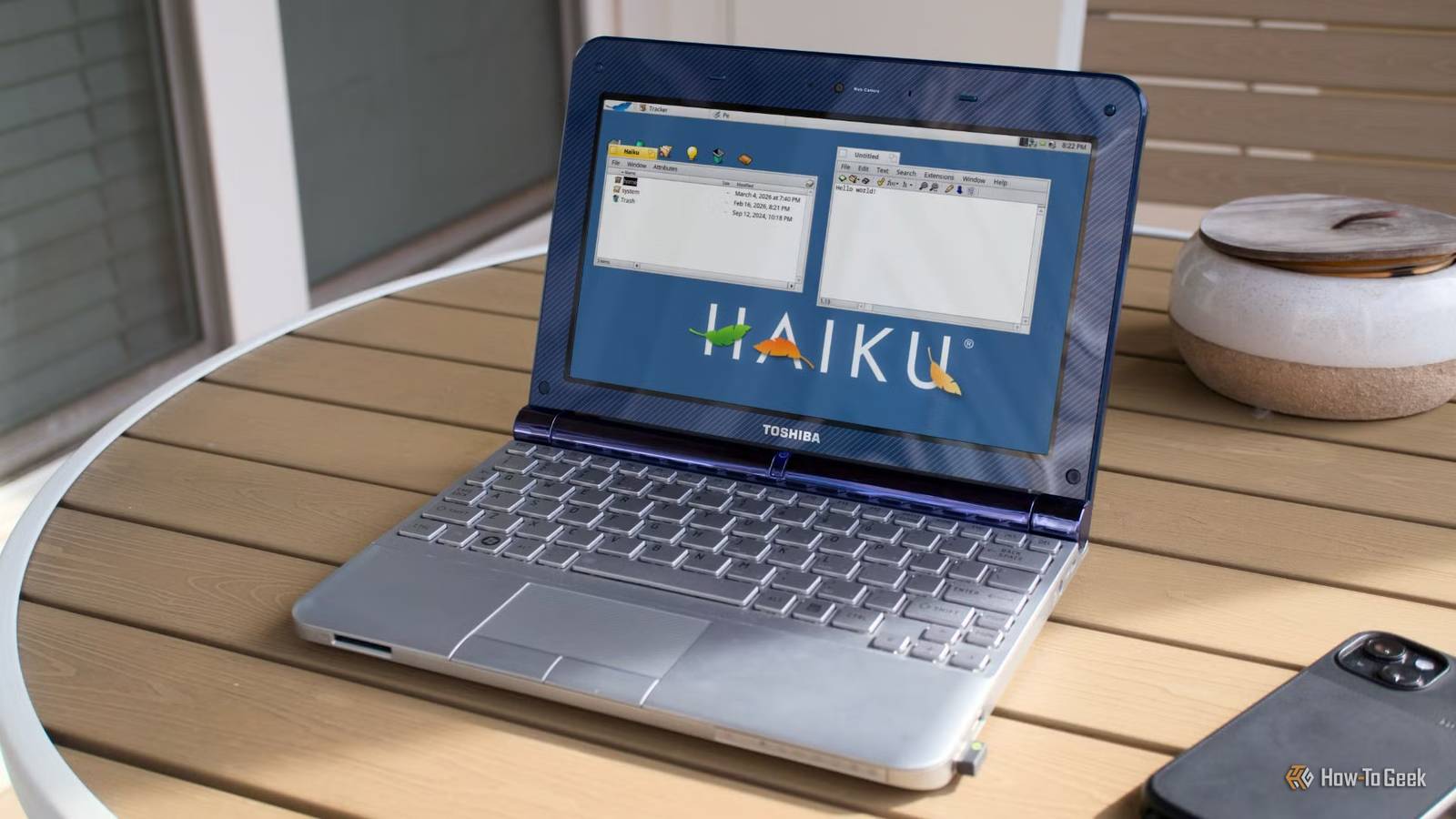
Haiku OS is a very interesting operating system.It's fun, unique, and user-friendly.It’s probably the ideal hobbyist operating system for someone who wants to dabble outside of Linux, Windows, and macOS.
It is, however, a bit limited.Regardless, I found a few apps and a game that were ported to Haiku OS by the open-source community.The results are pretty neat.
Add How-To Geek on Google Add as Preferred Source Follow on Google Discover Getting started with Haiku OS for the first time A quick primer on why I’m doing this bizarre thing I’ve been spending some of my free time testing out different operating systems, like CachyOS.Haiku OS was next on my list because it seems cool, and I find it fascinating.It works right away, but some of its functionality is a bit basic.
The open-source software that we take for granted every day on Windows, Linux, or (gasp!) even on Macs is built for systems.Haiku implements things partially, differently, or not at all.Multimedia tools also crash sometimes, so that's a thing.
But it's still a pretty solid OS.My impressions so far are that Haiku has a very clean design and strong system architecture.You really can't beat that in a lightweight OS.
Haiku obviously has its own apps that work natively and well with the OS.I'm looking at it through the lens of a hobbyist.I've never used BeOS (Haiku is a reimplementation of it), and I used GNOME Boxes to run a virtual instance of Haiku to test it out.
In fact, if you have an ISO of the most recent version of Haiku OS, you don’t even need to create a partition or install it in GNOME Boxes.There’s an option to just try it out.The simple, minimalist design reminds me of what I liked about the early days of Windows.
The OS is also pretty fast.So I dove into some of my favorite apps just to see if they would work (spoiler: they did, or I wouldn’t be writing about them).GIMP The Photoshop alternative that shouldn’t work on Haiku Close GIMP is a very interesting app.
It’s powerful, but it's never been my favorite photo editor/drawing app.I like Pinta quite a bit for the basic work that I do.That said, I used GIMP in the past for work and college assignments.
So it’s not unfamiliar; just not preferred.It’s pretty powerful software, loaded with features, but I always had issues with it running smoothly on Windows (back when I used Windows consistently).The fact that it works at all on Haiku OS is both impressive and a bit wild to me.
There’s a reason for that, and it’s pretty clever! Its architecture wasn’t natively compatible with Haiku OS, so the community made the Xlibe project (it was actually built by waddlesplash, one of Haiku’s main developers) to allow X11 applications to run on Haiku OS.How amazing is that? So why would someone use it? Haiku OS has a few sketching tools baked into the platform, but none as powerful as GIMP.It’s just that simple.
ScummVM Playing my favorite games ever on Haiku OS Official Haiku releases don't have 3D hardware acceleration, although there are some experimental drivers out there.Modern 3D games probably aren’t going to work well or at all on the OS.ScummVM actually supports Haiku OS on its SDL backend, where a lot of other things don’t.
SCUMM stands for Script Creation Utility for Maniac Mansion.You guys remember , right? I played it on the NES a long time ago.It’s a fantastic title, but other games I own, like and use the engine.
So of course, I wanted to try playing them on Haiku OS! They work pretty well, and it was super fun to revisit some of these on a completely different OS.LibreOffice The FOSS tool to end all FOSS tools It’s no secret that LibreOffice is one of my favorite and most-often used FOSS tools.It’s always getting new updates and functionality.
Back in 2018, a member of the Haiku community, KapiX, finished porting it over to the Haiku OS.His tale of porting LibreOffice to Haiku reads like a technical .It was a tremendous undertaking that probably seemed impossible at first.
The gist of it is that getting the Document Liberation Project libraries ported over wasn't that bad (most dependencies worked right out of the box according to KapiX).He got stuck on other dependencies like NSPR and NSS and ended up building several modules instead.KapiX worked extensively on the port.
Two other community members, diver and 3dEyes, helped with handling the Qt (what the UI runs through) side of things.A ton of work went into it over the course of several years, and it definitely shows.I tested a spreadsheet and a document in the Haiku port of LibreOffice, and it felt like I was using my good old Linux version.
I recommend giving it a go yourself.Haiku OS is a great little operating system with some very enthusiastic users I had a lot of fun trying things out on this little OS.I'm impressed with the way the community works on it as a whole.
I can understand why people love Haiku OS, and it'll be interesting to see what else gets ported over there in the future.
Read More