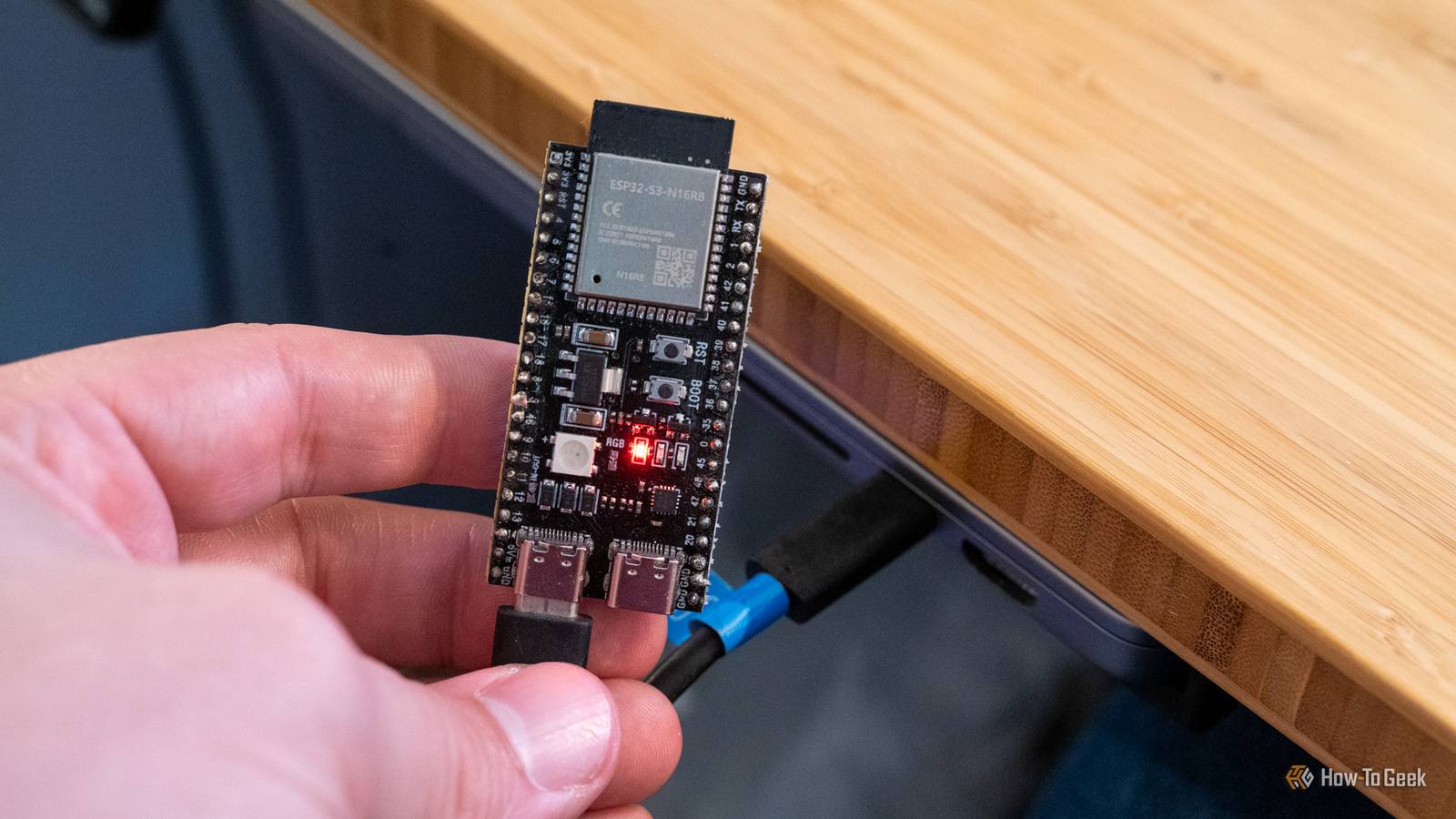
You can use an ESP32 to build smart home sensors that can measure temperature, humidity, light levels, and more.An ESP32 can detect much more, including invisible things around your home that you may be completely unaware of.Detect people using nothing but Wi-Fi ESPectre can sense how bodies disturb Wi-Fi signals Close The ESPectre project is pretty crazy.
It's an open-source project that uses an ESP32 and Wi-Fi Channel State Information (CSI) to detect human motion.Wi-Fi signals in your home bounce off walls, furniture, and other objects, but when you walk through a room, you alter those paths.ESPectre analyzes the changes and converts them into presence and motion information.
You don't need a PIR sensor or an mmWave module.The Wi-Fi that's already flooding your home is the medium used to detect motion.You can integrate ESPectre with Home Assistant through ESPHome and use it to trigger motion-based automations.
Related The best smart home sensors are the ones you'll never see Your smart home doesn't need to look like one.Posts 1 By Tim Brookes Watch people moving like radar blips An mmWave sensor can track X/Y coordinates An alternative way to detect presence is to hook up an mmWave sensor to an ESP32.These sensors use radar to detect movement, and some models can be accurate enough to detect the rise and fall of your chest as you breathe, enabling much more accurate presence detection, even when people are sitting still.
An mmWave sensor can do more than just detect presence.An ESP32 can access the X/Y coordinates of detected targets, as well as speed, distance, and other data.Popular modules such as the HLK-LD2450 mmWave radar can track up to three targets at once.
You can use this information to plot target coordinates on a floor plan.You can then watch the targets move around the room almost in real time.See your home in infrared Spot leaky windows or overheating devices An ESP32 and temperature sensor can measure a room's ambient temperature, but that only tells part of the story.
Different objects and different parts of your room may be at significantly different temperatures.You can combine an ESP32 with an MLX90640 thermal sensor to create a DIY thermal camera.The tiny infrared camera can measure temperature at the pixel level and display the data as a color thermal image.
Using this setup, you can detect cold patches around leaking windows, overheating devices, and temperature differences across your rooms that would otherwise be invisible.It's no match for a professional thermal imaging tool, but it lets you get basic thermal imaging with inexpensive hardware.Find out what's in the air you breathe Pollution isn't limited to the outdoors If you live in a built-up area, you'll know that air pollution can be a major concern.
While we're understandably concerned about the air we breathe outdoors, we sometimes ignore the air in our homes.Common habits such as cooking or 3D printing can release pollution into our homes on a daily basis.An ESP32 combined with a sensor such as the Sensirion SEN66 can measure the air quality in your home, including CO2 levels, particulate matter, VOCs, and NOx.
With ESPHome, you can share this data with Home Assistant, build an air quality dashboard, or set up alerts when levels get too high.If you have older kids, there's an additional benefit.Alcoholic drinks such as a glass of wine or beer can cause VOCs to spike.
If your kids throw a party while you're away, your smart home may alert you if alcohol is involved.Measure the radiation passing through your home HAT Geiger turns an ESP32 into a radiation monitor Another invisible world air quality monitors can't detect is radiation.It's unlikely the radiation levels in your home will ever reach dangerous levels, but you may be surprised by the background radiation in a typical home.
You can measure radiation levels using HAT Geiger, an open-source ESPHome Geiger-counter project.Radiation strikes the detector and produces pulses you can count, like the clicks you hear on TV shows and movies.The ESP32 can count these clicks and convert them into an estimated dose rate.
Unlike a handheld Geiger counter, you can leave your ESP32 radiation detector running non-stop and track your home's background radiation to see how it changes over time.Just be aware that detecting a level of background radiation doesn't mean you need to move out; some level of background radiation is always present.Your home may be stranger than it looks These ESP32 projects can see things that are normally invisible in your home.
Once you've set them up, you'll get a whole new perspective on what's happening where you live, and that can be a real eye-opener.
Read More