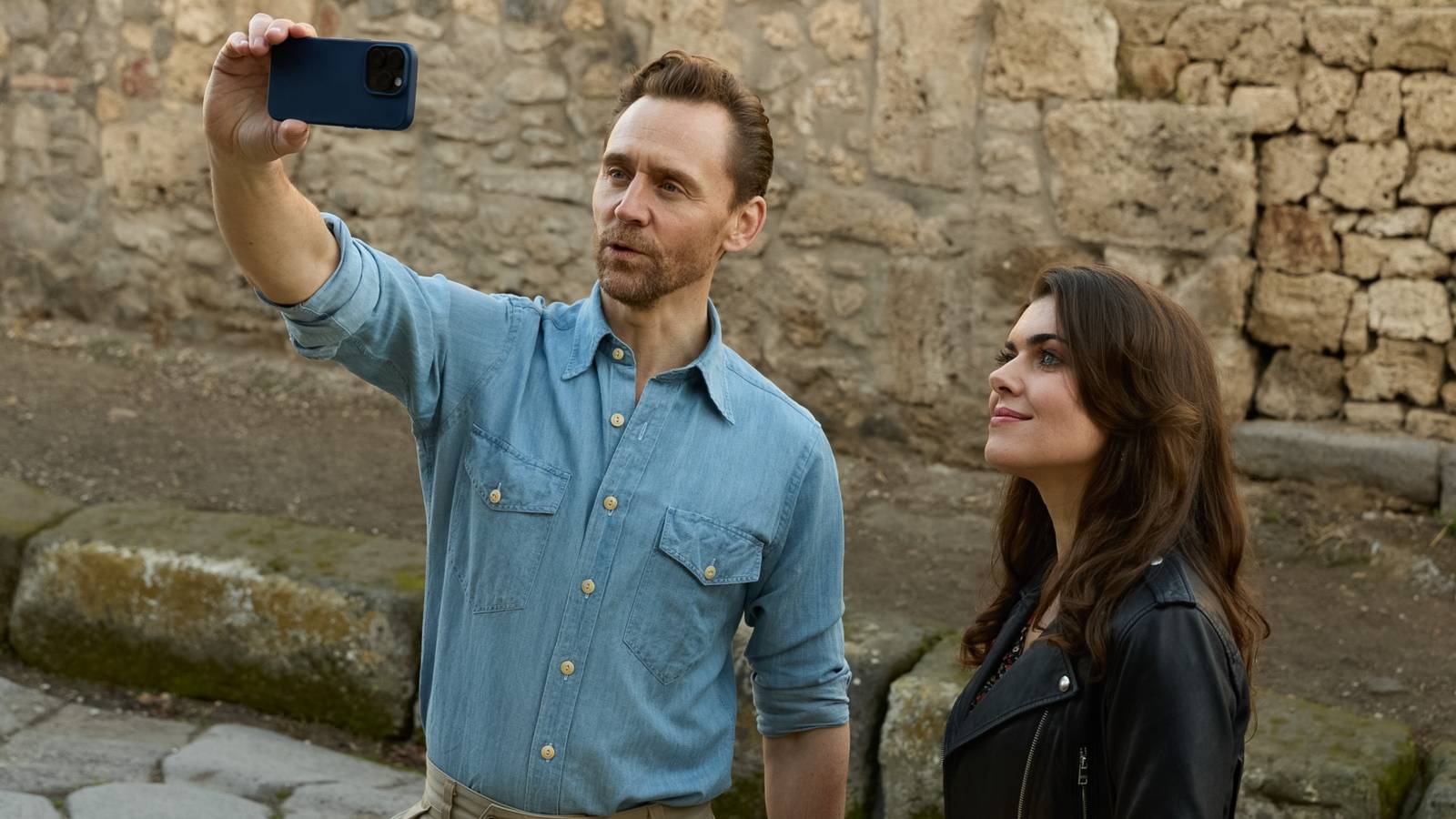
Tom Hiddleston is fascinated by Pompeii.As he tells me below, "Pompeii isn't just a place; it's the people." Outside of acting, one of Hiddleston's true passions in life is the ancient world.Stealing a page out of his character Loki's playbook on the Marvel show on Disney+, Hiddleston attempts to travel back to 79 AD to investigate the eruption of Mount Vesuvius in In the three-part docudrama, Hiddleston revisits that fateful day in Pompeii, where thousands of residents died, leaving the city frozen in time, its remains buried beneath volcanic ash.
Pompeii has become an obsession for Hiddleston, whose trip to the ruins as a teenager altered the course of his life and his interest in ancient history.Most people know the tragedy of Pompeii.But what if there was a hopeful ending for a select few? What if someone managed to escape and start a new life? In Hiddleston is a host, travel guide, and investigator.
The award-winning actor examines the lives of three people—a Praetorian Guard, a teenage boy, and a businesswoman—in Pompeii on the day of the eruption.Starting hours before the eruption, Hiddleston traces the backstory of three individuals and the decisions they made during the chaos.The innovative documentary features scripted drama, investigative storytelling, and interviews with geologists, disaster experts, historians, and archaeologists.
Ahead, Hiddleston explains to HTG how his life-changing trip to Pompeii reshaped his perspective on the ancient city.He also discusses how studying the history of Pompeii has made him a better storyteller.This interview has been edited for length and clarity.
Tom Hiddleston examines his place in history What artifact could tell the story of Tom Hiddleston? Close HTG: Congrats on the series.It feels like such an accomplishment.HIDDLESTON: Thank you very much.
That means a lot.I really appreciate that.It's a big passion project of mine, so to hear that it resonated with you means the world I want to start with what stood out to me the most.
And I think what was so powerful to me is how you could take an object and just trace someone back through history.Look at the Praetorian Guard.You looked at his sword, his belt, and the attention to detail, and from that, you knew that he was experienced.
He fought through combat and a lot of bloodshed.I started to think, what if I had left something behind? Could someone piece together my story? So for you, is there maybe a photo or a belonging that if you left behind hundreds of years from now, could someone tell the story of Tom Hiddleston? HIDDLESTON: [Laughs] That's a great question.Gosh, I don't know.
I mean, I feel like I'm cheating with this answer, but I suppose if you found my phone, with all the photos on it, you could piece together a story.But that I feel like is cheating.By the way, that's an amazing insight, that takeaway from the show.
And you're right, just while I think of something.It speaks to the extraordinary diligence and rigor of historians, archaeologists, academics, and classicists who can use the sources of the ancient texts that the stories and the written word that's been left behind and understand.OK, so a stipend for the Praetorian Guard is a specific amount of denarii or a specific number of coins.
The Praetorians were the elite unit surrounding the emperor, almost akin to special forces.They were paid a specific amount, and we know that from the writing.And then you find that amount with a sword, so you think, Well, this man was an elite soldier.
You can piece together the details from different constellations in the classical universe, in a way.That's why we know and understand the ancient world to that degree, because there are people who've taken the time to do that jigsaw puzzle.But to answer your question, for me, what would it be? Goodness, me.
Maybe it's like my dog's lead and harness.That works.HIDDLESTON: [Laughs] I think there would somehow be like DNA from where I lived and where I went with the dog and where I lived in London.
I think photos would be it.HIDDLESTON: Yeah, photos.Well, actually, what was interesting about doing this is I first went to Pompeii in 1998 at the age of 17 with two friends.
We really went there.We got an Interrail ticket, which is a train ticket you can buy, or you used to be able to.We traveled around Europe on trains, staying in youth hostels.
And Tom Barbor-Might, our director and showrunner, asked me while they were in the edit of the show, "Look, it'd be interesting to sort of set up your relationship with Pompeii.Do you have any of those old photographs?" I went into the attic and I found a sort of container of all my printed photographs from my youth in the 1990s because I grew up without smartphones.So if you took photographs, you had to take them with the roll of film and give it to the developers and get them back.
To find these photographs was like the story of my life, or the story of my life until a certain point.Pompeii: Out of Time with Tom Hiddleston PG13 Documentary Release Date July 23, 2026 Network National Geographic Directors Tom Barbor-Might Powered by Expand Collapse How one trip to Pompeii changed his life The ancient city became his new obsession I was lucky enough to go [to Pompeii] when I was 21.HIDDLESTON: How was it? Like you talked about, it's so jarring at first because you think this city went through so much trauma, and you see the remains.
And I think what this series argues is it's not just a story of trauma.It's a story of survival and hope.I saw this series and that kind of made me look at things differently.
You went [to Pompeii] as a teenager, and now you're doing this story as a man.When did you have that epiphany that there's more to Pompeii than just loss? That there is hope and survival.HIDDLESTON: I think it was going back and approaching this story.
There's a huge amount of academic research at the moment because we have so much more data, to be honest.Steven Tuck, who I talk to in the show.A genius.
HIDDLESTON: Genius.Yeah.[Tuck] has released a new book about the survivors of Pompeii because they have so much.
There is so much useful graffiti in that people carve their names into walls and stone tablets.They didn't have paper and passports and the paperwork that we have to identify us, but they would carve their names onto headstones or on the lintel above an archway to say this was a business owned by a particular person.Now, you can trace where the same names, which are written inside Pompeii, actually exist outside.
And you think, "Well, this person got out.Maybe the whole family didn't get out, but the young boy got out or the uncle got out, and then they go on to have lives.In a way, the story of Pompeii is a story—what I didn't realize and what I realized I knew for the first time making this—that in the wake of that eruption and in the wake of the burial of the city by the pyroclastic surge, there was a massive refugee scenario.
You have all these people whose homes have been buried, and they are fleeing to neighboring towns and communities and resettling.Now, you can track through the inscriptions on tablets that they found the survivors on.So there's hope, you know, and what I think it does is it generates enormous empathy.
I feel the image of it is incredibly contemporary and very resonant.It made me feel moved in a way that Pompeii isn't just a place, it's the people.Some of those people lived on and had families and futures and then gave away to the next generation.
The innovative documentary made him a better storyteller Stories need empathy and imagination You talked about empathy, how history is not just facts and numbers.You need empathy and imagination to tell stories.So now that you did this series, how do you think you've become a better storyteller studying the people of Pompeii? HIDDLESTON: I think it's given me enormous rigor because I felt very respectful of the historical record and of the facts.
Sometimes, imagination can get carried away and get sort of unmoored from factual evidence.But I think that's what archaeology and classical history and, actually, history are: a constant redraft of imagination.We have as much evidence as we can find, and that's why the study of history is always changing, because to sort of use a commonly known phrase and change it slightly, history is in the eye of the beholder.
Where you're standing at any point in time—your gender, your nationality, the country, your own privilege, and how you look at history—depends entirely on who you are, especially ancient history.Recently there have been so many, for example, eminent female classical historians who have completely reinvigorated the research of the ancient world because you realize that so much of the early research was done by Victorian men.Like, it was always men writing from the point of view of being men and saying, "Well, obviously the ancient world did it like this." Now you've got women going, "Well, actually, I don't think it was like that." What I suppose I'm trying to say is that any study of a particular time or a particular civilization involves immense, diligent, conscientious academic rigor.
You have to cleave to the facts and the evidence as you see it.And the rest of it, you are dressing up with your imagination.You're having to draw two strands together.
You're trying to connect A and D, and you don't have B and C, so your imagination has to fill the gap.That's what the study of ancient history is.What's extraordinary is that we still get more information that can connect us through A and B.
Maybe we don't have C, but we've got B now, and actually, we predicted it in an accurate way.So how has it made me a better storyteller? You need both.You've got to do your homework, and then you've got to be brave, courageous, sincere, and empathetic with your imagination.
Disney+ Subscription with ads Yes, the Disney Basic plan Simultaneous streams Up to 4 Visit Disney+ Expand Collapse More shows to check out on streaming is one of several new shows to check out on streaming.Keep an eye on on Apple TV and on Netflix as two shows that could break out this summer.Hulu Subscription with ads Yes, $10/month Live TV Yes, various plans available Visit Hulu Expand Collapse
Read More