Thonet, a chair manufacturer, pioneered bending wood, mass production, and composites.Then a strange wooden airplane takes to the skies and, against all expectations, does well.It takes on many roles and has over 40 versions; the Mosquito’s most enduring legacy, however, is in composites and the dream of the multi-role fighter.
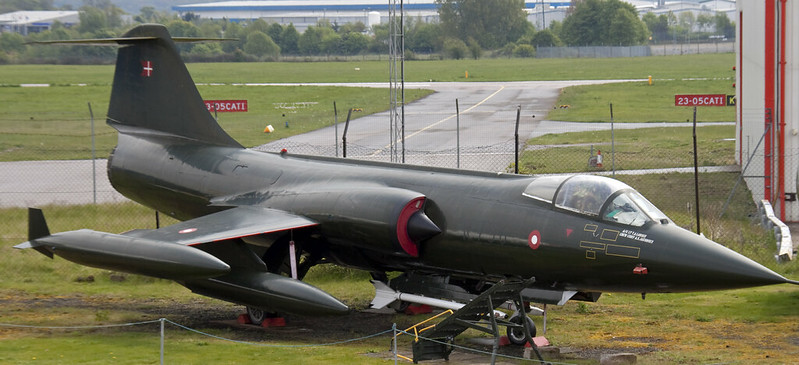
Another design direction was found in supremely specific aircraft.And the battle between these two sides has defined modern military aircraft design and development.Later, the legendary Kelly Johnson would go on to develop the infamous Lockheed F-104 Starfighter.
This plane was developed specifically to out-climb MiGs over Vietnam by putting a huge engine into something like a missile and an airplane.It was made to accelerate during the day, in fair weather, and climb.It was meant to be a quick engagement tool against Russian high-altitude bombers.
14 countries adopted the plane, and it was a disaster.Germany turned it into a low-level, all-weather ground-attack aircraft, which resulted in 292 crashes and 116 pilot deaths and gave it the nickname the widowmaker.Early downward-firing ejection seats didn’t help, but engine issues and nervous low-level flying continued to take its toll.
The Starfighter was the perfect scalpel for one role, but when pressed into service as a hammer, it became a disaster.Once a client asked me, “What is the biggest risk to the project?” and I replied, “The client.” Now, that wasn’t a very smart thing for me to say, but I was being truthful: the client is always the biggest risk to the project.Not seeing yourself as a risk specifically is the biggest risk.
Later, when Europe developed its own Panavia Tornado, the Strike, Air Interceptor, and Electronic Combat versions mostly swapped out cannons for sensors, although the British added 180CM to their interceptor.The Eurofighter Typhoon, meanwhile, was largely unchanged overall, but successive upgrades to mission computers and other subsystems significantly changed its capabilities.The Typhoon was also organized into coherent Tranche and block upgrades, meaning the plane would evolve; they would not try to make many versions at once.
Tranche 1 was primarily an air-to-air combat version, while Tranche 2 added ground-attack capability, and Tranche 4 added long-range missiles and array radar.The F-16 and F-18 had different chassis reinforcements or second seats; generally, their different roles came from changes to systems and design within the overall aircraft.With the F-35 Lightning ambition, caution was again thrown into the wind.
They designed a short-takeoff, conventional, and carrier version of the plane.With different wing sizes and control surfaces, the program may have had one name, but it was more like developing at least two different aircraft.Costs of one F35 start at $90 million, with a Lockheed representative being quoted as saying, ¨inflation is real.¨ Over $2 trillion has been spent on the Lockheed F35.
If I had $90 million in 1945, I could have purchased 142 Mosquitos.In the Second World War, the UK spent around $4 billion on aircraft and could, very optimistically, have purchased around 1500 F-35s.Instead, it paid for 131,000 other aircraft.
So yes, inflation is real.But not only monetary inflation, but an inflation of expectations, because this is what defense contractors sell.Do you want real money? Real innovation? Something really new? Scare the other guy.
Be scared like Wilfrid was scared, and you’ll drive true innovation.So who would win in the Battle of Britain: 131,000 World War II aircraft or 1500 F35’s? The answer lies in how many are airborne and where.If the aircraft are thousands of miles apart, the F-35 could win; the guys in the Hawker Hurricanes and Brewster Buffalos won’t even see one.
But if we’re doing a Battle of Britain with F-35s against a swarm of 131,000 planes, then the F-35s will eventually be destroyed on the ground while rearming.If the F-35s manage to run away to a far-off carrier, they can then, in a second round, come from afar and pick off all the WWII aircraft.But they’d have to, in my mind, retreat to win and be far enough away not to be closed in on.
In part, nations lined up to buy the F-35 because it was a stealth fighter and promised unbridled air superiority.But what does that mean? It means that with that one purchase you could sleep well at night.The Mosquito was difficult to spot on radar because it was made mostly of wood and glue.
It was faster and more maneuverable than many fighters it faced.Is it the first stealth bomber? First stealth fighter? It has a lower radar cross section, was meant to come in undetected, and it’s nice and smooth.We could argue if it was stealth.
But the idea of having one aircraft go in ahead of the others, one undetected aircraft coming in first or bombing out of nowhere, that was because of the Mosquito.That idea morphed into the F-117 and B-2, supremely specialized aircraft designed to come in undetected.The idea that speed could outperform armor was a lasting legacy, and it finds its purest expression in the SR-71.
And this broadly influenced more aircraft.But more than that, its influence lies in the idea of the multi-role.The Mosquito had perhaps 40 different versions and excelled at many of them.
A great bomber, but also a great pathfinder and fighter.This has led to the trillion-dollar dream of the multi-role fighter.Paradoxically, then, if we look at the supremely specialized aircraft or the mythical do-it-all airframe, it’s the Mosquito that influenced both of them.
But in manufacturing and industry, beyond its glue sandwich, that really has set us on a peculiar path.Images courtesy of Tony Hisgett, Rob Schlieffert, Clemens Vasters Subscribe to Our Email Newsletter Stay up-to-date on all the latest news from the 3D printing industry and receive information and offers from third party vendors.Print Services Upload your 3D Models and get them printed quickly and efficiently.
Powered by FacFox Powered by 3D Systems Powered by Craftcloud Powered by First Mold Powered by Xometry 3DPrinting Business Directory 3DPrinting Business Directory
Read More