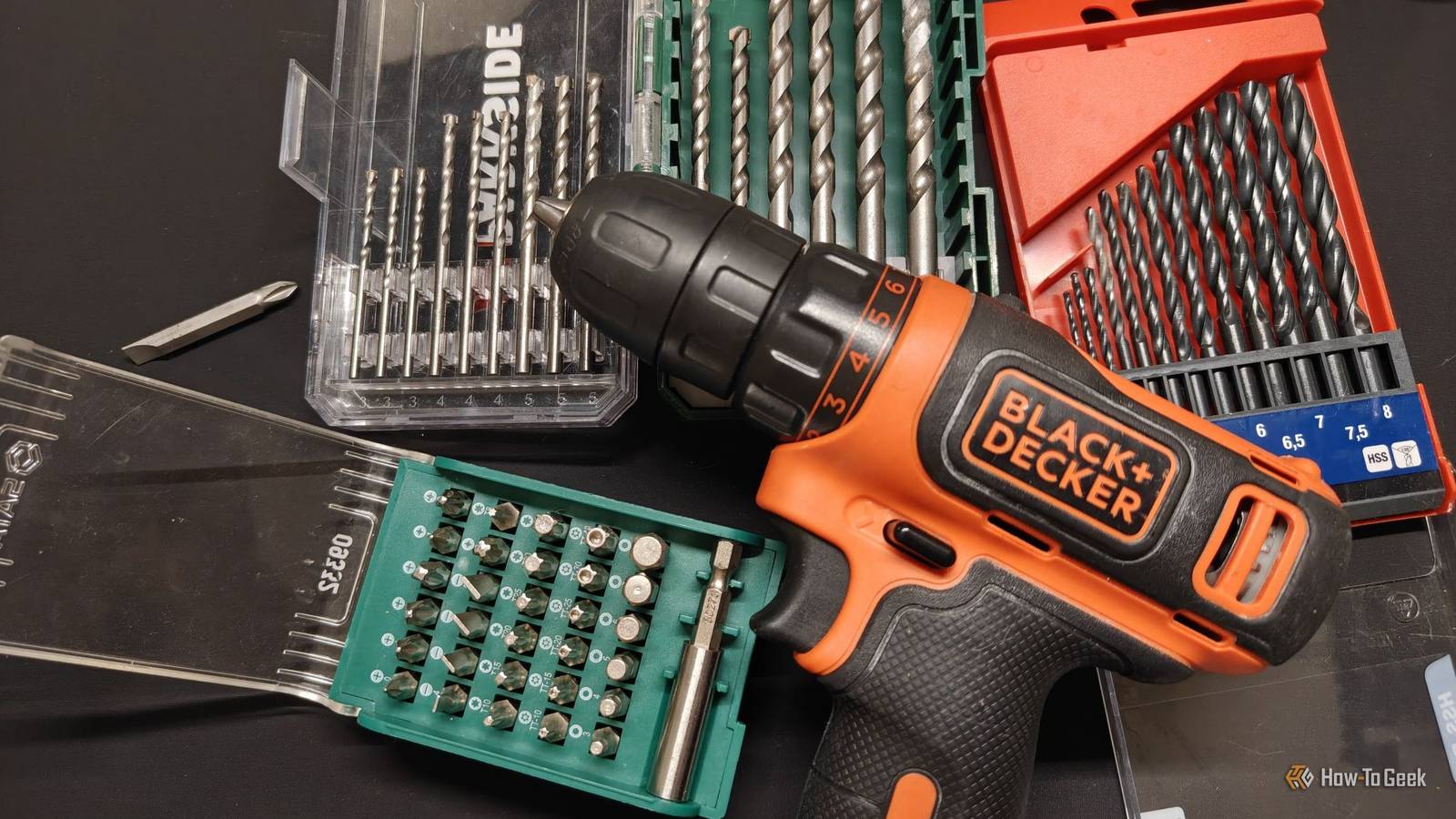
If you know a thing or two about power tool brands, you're probably well aware that Black+Decker is primarily aimed at at-home DIYers looking for affordable, easy-to-use power tools.On paper, I sound like the perfect customer, but I have some real regrets a year after buying my first cordless drill from the company.My first drill was about as basic as it gets It seemed like all I needed Close My first, and to date, only power drill/driver is the Black+Decker BDCDD12.
Its peak voltage is 12V, but its actual nominal voltage is 10.8V.That aside, the drill in question is an entry-level $50 cordless drill that is heavily marketed as a lightweight tool for DIY projects and repairs around the house.It has a 0–550 RPM range and a 3/8-inch keyless chuck rather than the larger 1/2-inch chuck, but honestly, that's perfectly fine for a relatively underpowered drill.
It holds all of my drill bits just fine, and since it's keyless, it allows for effortless bit swaps.The 10-position clutch allows you to easily select how much torque is applied when driving screws, which helps avoid overtorquing and stripping screws—and it's actually one of the main reasons I bought the drill in the first place.I got it just a few days before my wedding because I was buying and assembling a lot of furniture while moving into a new place, and I didn't want to waste hours or suffer from wrist pain screwing everything together with a regular screwdriver.
Aside from the 10 torque levels, there's an 11th, dedicated drill mode that provides the maximum available torque for drill bits.The LED is another massive plus.It's located at the bottom but angled upward, so it illuminates the area in front of the drill surprisingly well.
It's an excellent addition for putting together cabinets, working under furniture, and dealing with other poorly lit areas.All things considered, the drill seemed like decent value at the time.For $50, I got the drill, a battery and charger, and even a double-ended Phillips/slotted screwdriver bit.
It was everything I needed to assemble my furniture before the big day.Related Please stop ignoring 12V tools if you are a DIY homeowner I bought Milwaukee's M12 line as a "compromise," but these tools quickly replaced my 18V setup.Here is why.
Posts 5 By Patrick Campanale Drilling into concrete and metal quickly revealed where the drill falls short Problems started as soon as I hit something hard I didn't encounter many problems when I first started using my Black+Decker drill.Apart from a few stripped screws, which were likely user error from me using too high a torque setting and physically pushing too hard, the drill worked fine.The small battery surprised me in particular: the drill lasted through quite a few furniture assemblies before it needed a recharge.
However, everything changed when I started using the drill for jobs that required me to drill into something substantially harder than soft particle board and MDF.The first problem came when I had to drill six relatively wide holes to mount my new 55-inch OLED TV to the wall.The walls in my building are made of concrete, and I quickly learned that my little Black+Decker drill was ill-equipped for the job.
Despite going slowly and using a masonry drill bit, the drill struggled to push through the hard concrete.Granted, a hammer drill would've been a much better choice for this job, but I bought the Black+Decker with these kinds of once-a-year projects in mind.If it couldn't make a hole in a wall, it was little more than an overpriced driver and not much of a drill, if you ask me.
Long story short, I ended up using a hammer and a massive concrete screw to break the concrete loose before finishing the job with my power drill.Rinse and repeat, and my TV was finally mounted to the wall.It's worth noting that the drill was overheating quite a bit, and I noticed a faint burning plastic smell after just a few minutes, so I had to let the drill rest for a few minutes between sessions to avoid permanently damaging the internals.
The drill didn't need the hammer-and-screw trick for the smaller holes I used to mount things like wall-mounted coat racks and IKEA Skadis pegboards in my office, so at least there's that.Drilling into metal is another area where I found my little drill struggling.I only had to punch a tiny hole through the thin aluminum frame to fit new hinges.
However, the maximum 550 RPM was incredibly slow and took forever to drill through the thin sheet metal.I did manage to finish the job in the end, though, so I suppose it was better than not having a drill at all.I didn't realize I was buying into a dead-end platform I should have thought about the battery The main appeal of the Black+Decker BDCDD12 is that you get both a drill and an included battery for just $50.
However, what I didn't realize at the time was that power tools and batteries are typically designed with a platform in mind—you buy one or two battery packs and share them across a variety of different power tools.Even one pack can be plenty and opens up your budget for inexpensive cordless drills, impact drivers, orbital sanders, oscillating tools, circular saws, reciprocating saws, and so on.I know this was completely my fault.
I had basically zero knowledge about power tools.I didn't know anything about battery platforms and simply wanted the cheapest cordless drill I could find because I was in a rush.Unfortunately, my 12V Black+Decker drill is essentially a standalone product rather than part of a broader ecosystem, so the battery pack is effectively only useful for this one tool.
I wouldn't buy the same kind of drill again When it comes to power tools, a little more money goes a long way Although the Black+Decker BDCDD12 isn't a terrible value at $50, it's not great, either.I should've spent a bit more and invested in a proper platform that would open the door to other power tools.For instance, RYOBI's famous 18V ONE+ system has used the same battery layout since the mid-'90s.
The 3/8-inch cordless drill/driver PCL201K1 kit, which comes with a battery and charger, can often be found for just $50 at Home Depot, and it would give me an entry point into one of the most universal budget-friendly platforms out there.Not to mention that the 18V cordless drill is way, way more powerful and better built than my B+D model and has more than twice as many torque levels.Ryobi 18V One+ Cordless 3/8-inch Drill/Driver Kit Weight 2.8lb Power source Battery The Ryobi 18V ONE+ 3/8-inch Drill/Driver Kit (PCL201K1) uses Ryobi's popular 18V ONE+ battery platform.
This means the included 1.5Ah battery can also power any of the 300+ compatible ONE+ tools. $50 at Home Depot Expand Collapse At $70, an even better choice would've been the Craftsman V20 Brushless RP Compact Drill/Driver, which has a 2-speed gearbox, a more powerful 20V battery, and a significantly more powerful brushless motor.And your options only get better and more diverse as you go up in price.
Despite all the drawbacks, it's fine for basic DIY When you compare the Black+Decker BDCDD12 with other options on the market, it's easy to see why the included battery pack just isn't as valuable as I initially thought.It's not all bad, though.For the right price, I think my drill still makes sense.
Although I overpaid for it, Amazon's price history indicates that it frequently drops to $35 or even less, which honestly doesn't sound like such a bad deal for a cordless drill.
Read More