Diversifying manufacturing supply chains to locales outside of China has nothing to do with actually cultivating “substitutes” to the Chinese economy.The real stakes are these: China is an irreplaceable lodestone in global manufacturing, but that’s exactly what makes it necessary to supplement China-based manufacturing capacity with capacity in non-Chinese economies.The consulting lingo associated with this, ‘China+1‘, is pretty accurate in describing the reality of the situation.
Essentially, the idea is that the more dependent you are on China as a source of materials, labor, goods, etc., the more you must also develop redundancies in your supply chains that act more or less as insurance policies against the precariousness of sourcing everything from a single point-of-origin.This is the context within which India, for instance, matters as a destination for foreign direct investment (FDI).A data point that aptly puts things into perspective is that India’s FDI increased well over 40 percent in 2025, and yet the world’s most populous nation was still only the 11th largest recipient of FDI in 2025.
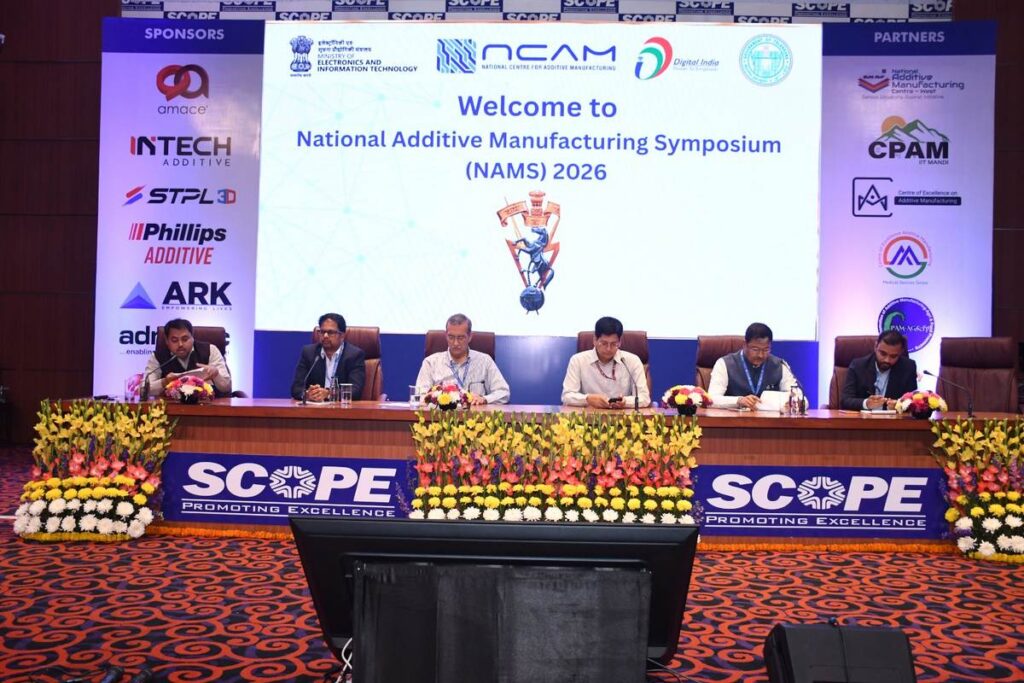
Thus, it’s rapidly growing as a contingency plan, but it’s still more or less a contingency plan.The relevance of all that for 3D printing lies in the second iteration of India’s National Additive Manufacturing Strategy (NSAM) that the nation’s government is currently working on.India’s Ministry of Electronics and Information Technology (MEIT) released the first NSAM in 2022, setting a list of clearly-defined goals to be accomplished within 2-3 years of the NSAM’s enactment.
India had achieved some of those (fairly modest) goals by last year, but it is still well behind in what are arguably the most important goals — contribution to GDP and global AM market share — and the nation is still far from a major factor in the global AM industry.Nevertheless, according to India’s government, over 150,000 people have been trained in AM since the first NSAM, which meaningfully surpassed the goal of 100,000 that the nation set back in 2022, and India has at least demonstrated that its public-private decision-makers understand which sectors it should be targeting.Additionally, some of the most important manufacturing-centric brands in the West, most namely Apple, have made investing in India’s manufacturing sector a major priority, so there should certainly be plenty of business opportunities available to Indian AM companies going forward.
Nike, too, as I recently discussed, is making the Indian market more of a priority, in terms of both demand and supply, and I think it would be reasonable to argue that the NSAM push has contributed to making that possible.Since NSAM 2.0 is still in progress (presumably it will be released at the beginning of next year, if it follows the timeline of NSAM 1.0), we obviously can’t speculate what the plan’s chances of success are, but there are, however, some interesting details floating around.Currently, the “proposed priorities” seem to be mainly focused on lowering barriers to entry by making machines and materials more affordable, and on accelerating commercialization, by situating AM within a more general context of generating valuable IP through advanced digital technology integration.
It’s important to note that the approach involved in lowering barriers to entry focuses on industrial clusters, which closely resembles the general approaches the US and China have taken to growing their own AM industries over the last several years.It’s also encouraging to see that India has specifically called out 3D printed electronics as a likely focus area for NSAM 2.0, especially given how much of the nation’s overall manufacturing push depends upon diversification within the global electronics supply chain.Additionally, medical devices would appear to be a good bet as a focal area for the next phase of the plan, with the Indian government giving AM credit for helping move the needle on domestic medical device production capacity between 2020 and 2025.
Finally, additive construction (AC) has gained a decent amount of traction in India, and I think NSAM 2.0 is likely to reinforce that trajectory.Again, from NSAM 1.0, the workforce development piece is the big takeaway, because the progress towards all the other goals won’t be sustainable without that foundation.Everything may hinge, then, on how much of a priority workforce development continues to be in NSAM 2.0.
Western multinationals, and not just them, do genuinely seem to be taking India seriously as a part of their long-term strategies.The questions for pure-play AM companies are — for companies that aren’t already there — whether they can afford to stay out of the Indian market, and, for those that are there already, how much they should emphasize the south Asian country as part of their future plans.In addition to waiting to let NSAM 2.0 help you make those kinds of decisions, I would say that it mostly depends on how much India can continue to increase its FDI.
If India can crack the top 10 this year and keep advancing in 2027, then it’s probably a good idea to have at least something along the lines of a strategic partnership there, if not a genuine dedicated physical presence.Moreover, it depends on how forward-looking your corporate strategy is.If you’re focused exclusively on the next couple of years, then whether you’re not in India probably won’t matter much.
If you have the luxury of being able to focus on where you’ll be by 2030, then it’s a worthwhile thing to take into consideration.The jury will probably be out for some time to come, then, as to whether India can truly help companies that are looking to be less exclusively reliant on the Chinese market.But I will say that, if India does indeed end up making a difference in that regard, AM will have to be a major part of the equation.
Images courtesy of India’s MEIT Subscribe to Our Email Newsletter Stay up-to-date on all the latest news from the 3D printing industry and receive information and offers from third party vendors.Print Services Upload your 3D Models and get them printed quickly and efficiently.Powered by FacFox Powered by 3D Systems Powered by Craftcloud Powered by First Mold Powered by Xometry 3DPrinting Business Directory 3DPrinting Business Directory
Read More