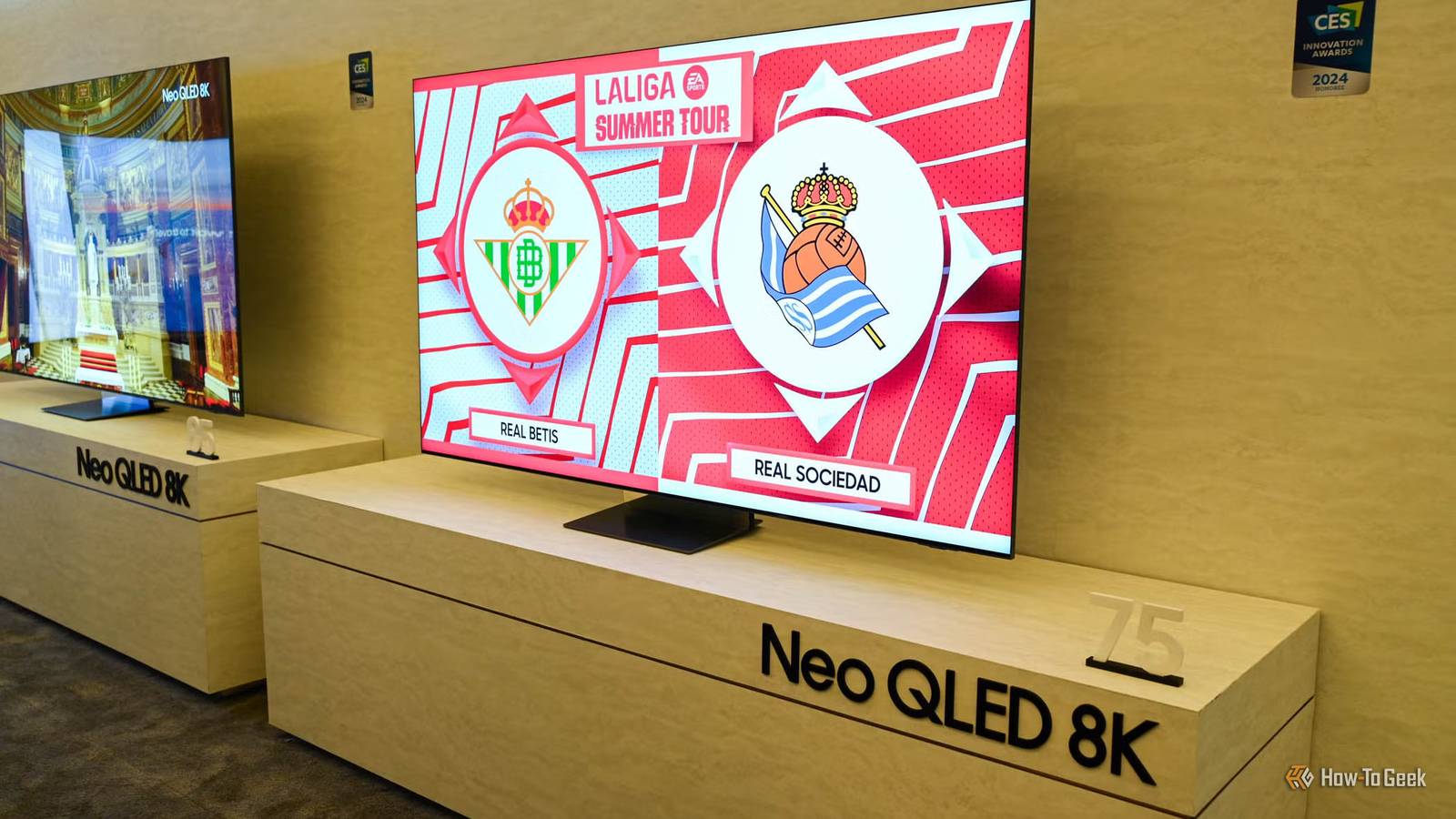
TVs have progressed when it comes to image quality at a steady pace.From small black-and-white tubes to full-color broadcasts, EDTVs, HD, and today's 4K UHD.From the 300K-ish pixels in a 480p SD image to the over eight million pixels in a 4K TV.
It's an enormous leap.The next logical step was another quadrupling of resolution.So-called "8K" TVs and monitors have about 33.2 million pixels.
These TVs exist, and there are even a few 2026 models you can buy if you feel like setting your money on fire.However, for all intents and purposes, this format is dead before anyone has even got to try it.The TV makers have almost completely abandoned 8K Abandon ship! Close LG pulled out of the 8K game, with the discontinuation of its 8K OLEDs and LCDs, as reported by FlatPanelsHD.
TCL paused 8K TV production in 2023, and Sony ended production of its last 8K model in 2025.These companies have stopped making new 8K TVs because no one is buying them.We'll get to why later, but the fact is that without demand there's no reason for anyone to make 8K TVs.
It's been years, but the adoption is nowhere near where 4K TVs were at the same point in their timeline.The notable holdout here is Samsung.If you have $8,500, you can be the proud owner of a 2026 8K QN990H, though maybe you're better off buying last year's model at less than half the price.
There is no 8K content, and probably never will be if you don't build it, no one will come When I bought my first 4K TV in 2016, I had exactly zero 4K content to watch on it.I bought a 4K TV because my 720p plasma had reached the end of its life, and 4K TVs were a reasonable price.However, it didn't take very long before I had plenty of 4K content to watch.
My launch PS5 gave me access to 4K games and UHD Blu-ray, and rapid increases in cheap bandwidth gave me access to 4K streaming.So I felt like I was getting my money's worth from my 4K TV, because the content was easy to get and plentiful.If you buy an 8K TV today, there is effectively no content for it.
You can download a few 8K demo videos to wow your friends, but even if you have the most powerful PC in the world, you're not playing games at native 8K resolution at enjoyable settings or frame rates.Movies and TV shows are not being made at this resolution either, and streaming services wouldn't want the nightmare of hosting them.Most people will never see the difference, so what's the point? Your eyes are the limit here This is a problem that 4K TVs already have.
Even though you might add more and more pixels to a TV, there's a point where the human eye just can't see them anymore.Think of it this way.If you have two TVs that are the same size, but one is 4K and the other 1080p, then there will be a distance at which your eyes can't tell the difference between one and the other.
As you can see from the chart above, that distance is probably way closer than you thought.I've written before that your TV is probably too small for 4K to matter, but at four times the pixel count of 4K, you're looking at an enormous image size before you'll even notice the benefits of 8K.And that's if you're specifically looking for them.
There are a few A/B tests on YouTube where people are asked whether the image they see on an 8K TV is in fact 8K or 4K, and for the most part they have no idea.So even if the content for 8K did exist, it's unlikely most people would see any justification for the high early-adopter cost.It's also important to realize that image resolution is only one part of perceived image quality.
Color gamut, contrast, motion clarity, and brightness can all weigh more heavily on how good an image looks to your brain.With companies hitting a roadblock on resolution, they've been pouring resources into improving these other aspects of image quality, and we've all benefited as a result.8K might happen when it's trivial to include I'm not ready to say that 8K will stay off the table forever.
As technology progresses, it may become trivial to produce 8K content, and perhaps one day home consoles and computers will spit out 8K 3D graphics like it's nothing.I can also foresee 8K getting some traction in the world of computer monitors, because it makes sense on a large-format screen where you're sitting at arm's length while you work.However, unless our eyeballs get upgraded, it seems quite unlikely that 8K will ever reach the ubiquity that 4K is clearly heading towards.
Most people, even if they can afford it, probably don't want the enormous screens or projected images in their home; you'd need to make 8K worth it.Much less the hardware and bandwidth needed to access that content, even if it existed.
Read More