The Greenland Arctic Development Corp (GADC) has bought a Caracol Heron 400 system.The rail-based, six-plus-axis robotic 3D printer is designed to produce large polymer and composite components.It will initially be installed and tested in Chicago, with plans to eventually deploy it in Greenland.
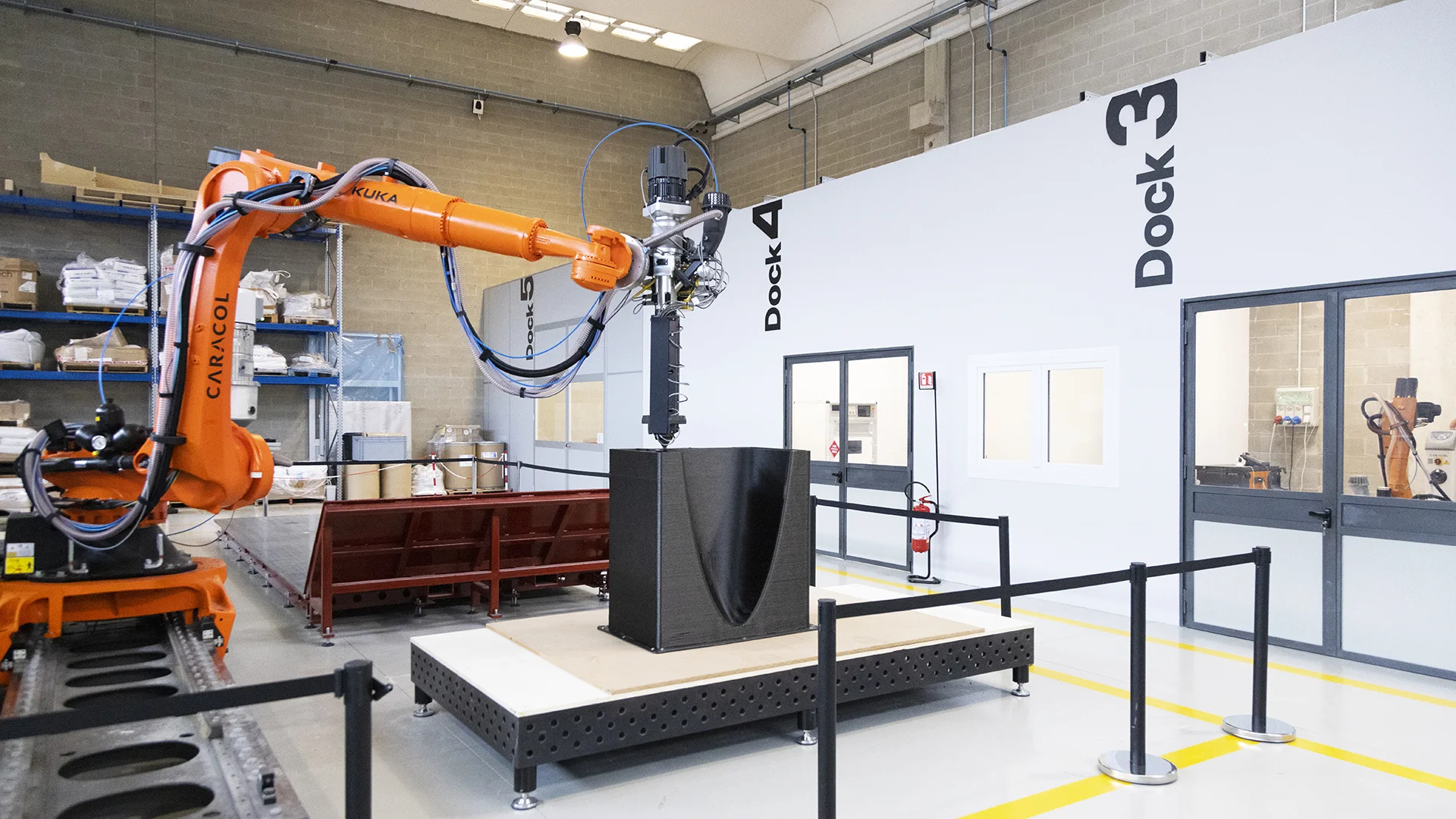
The idea is to establish a local manufacturing business that can make parts and products in Greenland rather than shipping everything in.GADC plans to recruit a Greenlandic entrepreneur, provide technical training, and help establish a joint venture to operate the printer.The Heron 400 has a robotic arm with a reach of approximately four meters, mounted on a rail that allows more than 10 meters of travel along the X-axis.
It uses thermoplastic pellets and fiber-reinforced composites.Its multiple axes also allow it to print non-planar paths and reduce the need for supports on certain geometries.Potential applications include furniture, marine components, replacement parts for boats, ATVs and snowmobiles, construction elements, and other products needed in Arctic conditions.
These are often low-volume parts that can be expensive or slow to obtain through conventional supply chains.Instead of shipping a finished part over long distances, the idea is to send a digital file and make it locally.Larry G.
Swets Jr., Chairman of Greenland Arctic Development Corp., said: “Outside investment can bring substantial economic activity to Greenland, particularly through natural-resource exploration and infrastructure development, but the lasting value will come from building capabilities that remain in Greenland.By combining advanced manufacturing equipment with local training, education and entrepreneurship, we can create skilled jobs and productive capacity that support major development projects while also serving the practical needs of Greenlandic communities.Our goal is not simply to bring a machine to Greenland – it is to help build a locally led business around it.” The company expects the facility to serve Greenland’s natural-resource, infrastructure and tourism sectors, as well as local businesses and consumers.
Caracol already produces large-format components for customers in aerospace, maritime, energy and construction, including tooling, structural parts and concrete formwork.Large format additive manufacturing launches in Milan.Image courtesy of Caracol.
Francesco Pantaleone, Caracol’s Head of Sales, Americas, noted that, “For decades, production has been concentrated in a few large industrial hubs, and remote regions have paid for it in shipping costs and long waits for parts.Robotic large-format additive manufacturing makes a different model possible: a flexible production cell that turns digital designs into boat components, construction elements or furniture where they are needed, in the quantities needed.” Before shipping the printer to Greenland, GADC and its partners will use the Chicago installation to test materials, production methods, and potential Arctic applications.The company also plans to use this period to develop the joint venture’s training and business model.
A local operating partner and the final location in Greenland have not yet been announced.Heron AM.Image courtesy of Caracol.
So the idea is super nice.Remote manufacturing really would be an interesting thing to try out in a place as remote as Greenland.Larry Swets Jr.
is connected to US President Trump.Swets has also been involved in American investment efforts in Greenland, which have attracted attention amid Trump’s renewed interest in the territory.That doesn’t mean this particular 3D printing project is tied to those ambitions, but the political backdrop is hard to ignore.
Greenland is a self-governing territory within the Kingdom of Denmark, and the US has been seeking to expand its military presence there.And the US is said to want to do construction to build bigger bases there.But we must remember that previously the US had a rather spectacular nuclear accident in Greenland.
The US used the base there as an early warning site for Russian ICBM strikes.For a time, it permanently operated a B-52 as part of its airborne nuclear alert operations.The idea behind Operation Chrome Dome was to keep nuclear-armed bombers in the air so they could respond quickly to a Soviet attack.
In 1968, a fire broke out aboard one of these aircraft near Thule Air Base.The crew was forced to abandon the bomber, which crashed onto the ice carrying four nuclear weapons.The conventional explosives in the weapons detonated, scattering radioactive material across the ice.
There was no nuclear explosion, but the cleanup was enormous, and the recovery of all the weapon components remains a subject of historical debate.The US also, in secret and without the knowledge of the Danish government, constructed Project Iceworm.At Camp Century, the US Army built a network of tunnels beneath the Greenland ice sheet.
The idea was to eventually make thousands of kilometers of tunnels under the ice.Then the US would build a railway network in the tunnels to continuously move around hundreds of nuclear weapons.The US actually built a nuclear reactor in Greenland to power the Camp Century facility.
But the Army found out that the ice sheet actually moved continuously, and tunnels began to sag; meanwhile, the tunnels themselves had to be reworked all the time.The project was eventually abandoned.Given the US’s history of construction in Greenland, I’m more than a bit skeptical about this project.
Also, installing it somewhere else first seems of little use in finding out what can actually go wrong there.Testing in Chicago makes sense for getting the printer running and training operators, but it won’t tell you everything about operating a large industrial machine in Greenland.I’m also thinking that, given the local sentiment about threats to Denmark and Greenland, finding a local entrepreneur will be difficult.
Subscribe to Our Email Newsletter Stay up-to-date on all the latest news from the 3D printing industry and receive information and offers from third party vendors.Print Services Upload your 3D Models and get them printed quickly and efficiently.Powered by FacFox Powered by 3D Systems Powered by Craftcloud Powered by First Mold Powered by Xometry 3DPrinting Business Directory 3DPrinting Business Directory
Read More