We’re starting with metal 3D printing business news in today’s 3D Printing News Briefs, as SBO is expanding its capacity in the US and the UK, and Continuum Powders is partnering with Mastrex.Moving on, ASTM International’s F42 committee is developing a proposed design guide for ceramics, and Continuous Composites filed a patent infringement lawsuit.Finally, Artec 3D launched a metrology laser scanner.
SBO Expanding & Strengthening Position in Metal 3D Printing in US & UK Austria-based SBO AG, which manufactures high-alloy, non-magnetic steels, high-precision components, and high-tech equipment for industrial sectors, is expanding its metal additive manufacturing (AM) capacity in both the US and the UK.In Q2 of 2026, the company added one Velo3D Sapphire XC 3D printer to its US facility, as well as two Renishaw 500Q 3D printers, for high-performance titanium and Inconel alloys; additionally, two more Sapphire XC systems will be delivered in Q3.SBO is also expanding the AM space at its site in Houston by 50%, for a total of more than 2,100 m².
This expansion is forecasted to help the company grow from about $1.5 billion in 2025 to $4.8 billion by 2030.As for its operations in Europe, SBO subsidiary 3T Additive Manufacturing Limited was named “Tech SME of the Year” at the 2026 Thames Valley Tech & Innovation Awards.Plus, 3T added another EOS M400 to its fleet, and and second system will be delivered by the end of Q3.
All told, these moves in the US and the UK help advance SBO’s diversification strategy in the AM market.“3D metal printing is a key pillar of our diversification strategy, through which we are broadening our business beyond the oil and gas industry and continuing our transformation into a high-precision technology group.It is an attractive growth market: 3D metal printing is growing significantly faster than our core business and is gaining further momentum.
We are capitalizing on that dynamic.We leverage our core capabilities in high-performance materials and high-precision manufacturing, offering the entire value chain from a single source, from printing to post-processing.With the new printers and expanded manufacturing space in the US and the award-winning performance of 3T in Europe, we are expanding where demand is highest: in space, aerospace, defense and semiconductors,” said SBO’s CEO Klaus Mader.
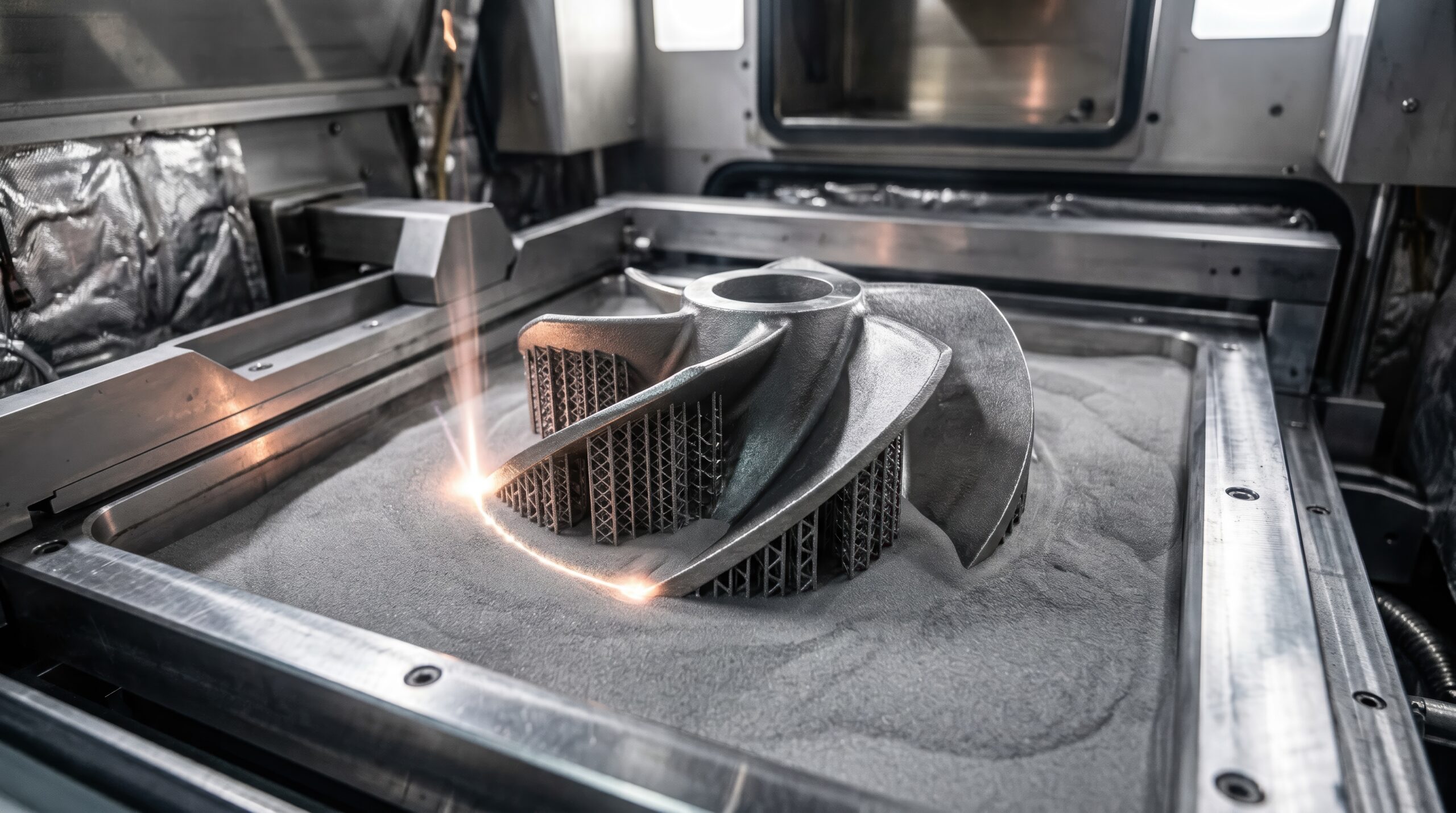
Continuum Powders & Mastrex Validating Sustainable Metal AM Powders 3D printing a metal pump impeller prototype with intricate lattice structures, showcasing advanced powder bed fusion additive manufacturing technology.Image: Continuum Powders High-performance metal powder provider Continuum Powders and laser powder bed fusion (LPBF) manufacturer Mastrex have announced a partnership.Initially focused on Ti-6Al-4V, 17-4 stainless steel, and cobalt chrome, their technical collaboration will focus on developing optimized process parameters for Continuum’s sustainable metal AM powders, as well as validating the materials across all Mastrex MX series printers and ensuring a repeatable print performance.
The two companies will be assessing things like powder behavior, build consistency, processing conditions, and material performance, and plan to add additional materials, like copper-nickel alloys and nickel-based superalloys, later on.Mastrex and Continuum view this as the beginning of a broader strategic partnership, instead of simply a one-time initiative.They plan to share application data, technical updates, and customer success stories as more of Continuum’s metal powder materials get through validation and qualification milestones on the MX printers.
“One of the biggest barriers to broader adoption of additive manufacturing isn’t a lack of innovation—it’s reducing the effort required for customers to confidently implement new materials and technologies.By working closely with Mastrex from the beginning, we’re helping create a more seamless path from material selection and process development to successful production.Ultimately, our shared goal is to give customers greater confidence in the complete manufacturing solution, not just the powder,” said Jon Cozens, the CEO of Continuum Powders.
“The future of additive manufacturing depends on strong collaboration across the industry.Success isn’t determined by great hardware or great materials alone.It’s achieved when every part of the manufacturing ecosystem works together to help customers move faster, reduce risk, and manufacture with confidence.” ASTM’s F42 Committee Developing Proposed Design Guide for AM Ceramics In 2009, standards organization ASTM International formed the F42 technical committee, which is specifically focused on developing standards for AM.
The work done in F42 is coordinated with other ASTM committees, as well as other national and international standards organizations with related or mutual interests, like the International Standards Organization (ISO).This month, the F42 committee announced the proposal of a standard to outline the design process for 3D printing ceramics.The proposed standard, WK84355, is meant to act as a guide for product planners and designers who want to use 3D printed ceramic parts.
It will provide basic knowledge, align the practical uses of additive ceramics with safe design criteria, and offer a framework to manufacturers to help reduce embrittlement and cracking in ceramic products.This guide relates directly to the United Nations Sustainable Development Goal #9 on industry, innovation, and infrastructure, as well as SDG #12 on responsible consumption and production.“Ceramics are known to be useful for their strength, heat resistance, hardness, chemical inertness and electrical insulation properties, while also being brittle and undergoing shrinkage during the final sintering process.
This guide could help customers and regulators evaluate whether AM ceramic parts were designed properly based on related technical needs,” said ASTM member Brandon Cox, lead engineer with Electron Optics Lab.Continuous Composites Files Another Patent Infringement Lawsuit Continuous Composites, which developed the patented Continuous Fiber 3D Printing (CF3D) platform, is back in the courtroom.After entering into a Settlement and Patent License Agreement with Markforged for its composite manufacturing technology two years ago, the company has now filed a patent infringement lawsuit against Anisoprint S.a.r.l. and Anisoprint 3D Printing Technology (Suzhou) Limited, doing business as FibreSeek.
The company has spent about three years attempting to resolve the matter through licensing discussions, but finally had to turn to litigation.The complaint alleges that FibreSeek’s products, including its FibreSeeker 3 continuous fiber 3D printer, infringe 10 Continuous Composites-owned U.S.patents, covering systems and methods for fabricating structural composite parts by pairing polymer matrix materials with continuous reinforcement fibers during printing.
The company says that FibreSeek used a similar approach with its products, and began to engage with FibreSeek in 2023, later providing a licensing term sheet that was meant to set up a commercial framework so FibreSeek could keep up operations while still respecting the intellectual property rights of Continuous Composites.“We did not rush into litigation.For nearly three years, we pursued what we believed was the right path: direct engagement, good-faith discussions, and multiple opportunities to reach a licensing agreement.
Litigation became necessary only after those efforts failed to produce a resolution,” said Steve Starner, CEO of Continuous Composites.“These patents represent almost fifteen years of investment, engineering development, testing, and commercialization.Our employees, customers, partners, and investors expect us to protect the innovations they helped build.
We have a responsibility to defend that investment.” Artec 3D Launches Artec Point II Metrology Laser Scanner Finally, global 3D scanning hardware and software company Artec 3D, based in Luxembourg, recently announced the next generation of its metrology-grade Artec Point target-based handheld laser scanner.The new Artec Point II features an expanded laser configuration, so it can capture up to 5.8 million points a second; that’s more than double what the original Artec Point can do.This configuration increases how many laser laser lines are projected in each mode—17 parallel lines in hyperfine and 54 in ultra-fast—so each pass captures more surface data, making for highly detailed digitization and faster scanning.
There’s also a single-laser mode for deep holes and hard-to-reach surfaces, and you just touch a button to switch between the three modes.The lightweight, ergonomic Point II is fully integrated with the professional scanning and processing Artec Studio software, and can be combined with other Artec scanners for combined strength.The new scanner’s repeatability and 0.02 mm accuracy have been verified in an ISO-certified lab, and it is also compliant with VDI/VDE 2634 and JJF 1951 standards for metrology-grade results.
Art Yukhin, the President and CEO of Artec 3D, said, “Artec Point set a high bar for accessible, certified metrology.Point II raises it — more data in every pass, greater detail, and faster scans, with the same accuracy professionals have come to rely on.” Subscribe to Our Email Newsletter Stay up-to-date on all the latest news from the 3D printing industry and receive information and offers from third party vendors.Print Services Upload your 3D Models and get them printed quickly and efficiently.
Powered by FacFox Powered by 3D Systems Powered by Craftcloud Powered by First Mold Powered by Xometry 3DPrinting Business Directory 3DPrinting Business Directory
Read More