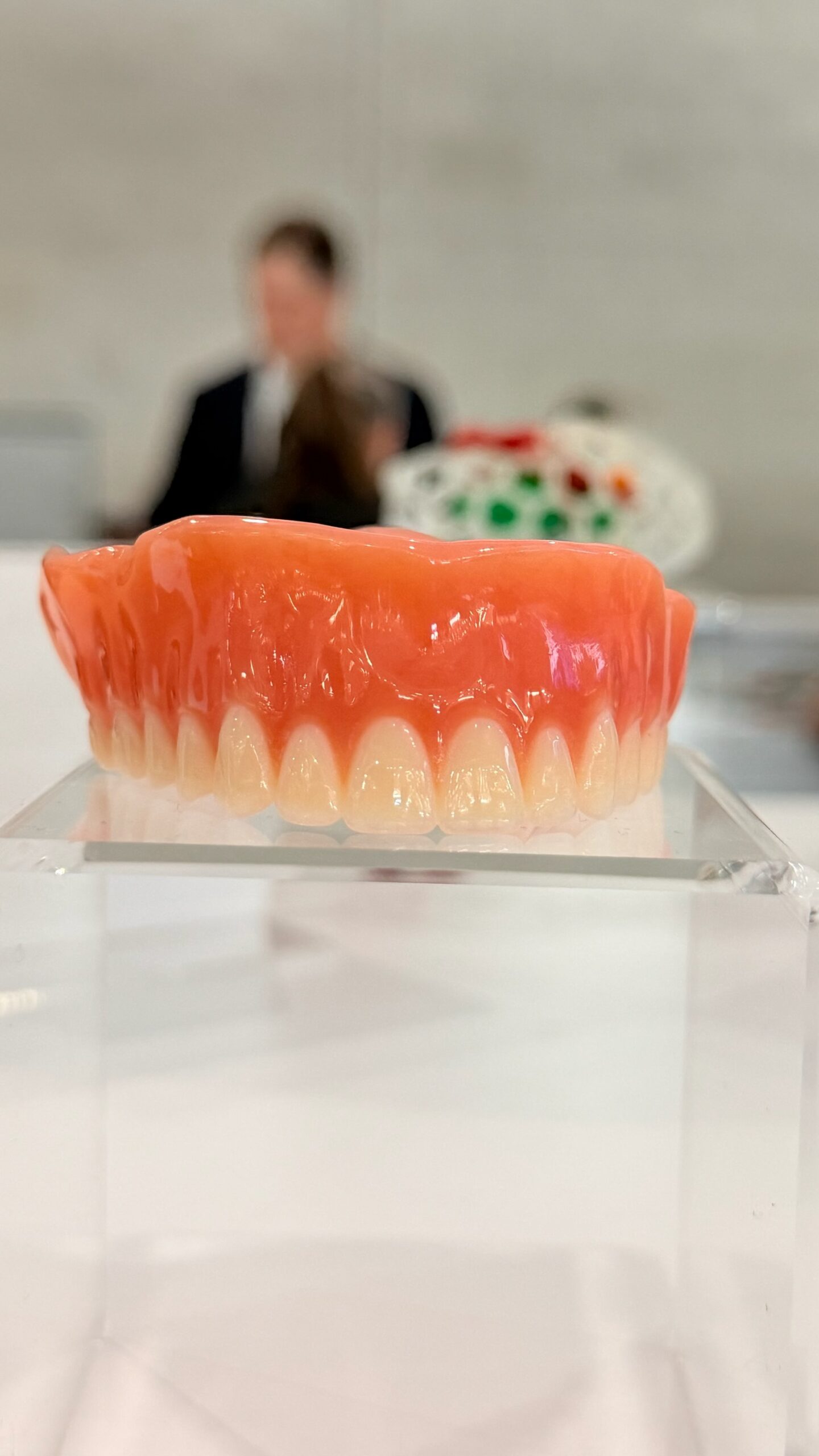
According to “3D Printing for Dentistry 2025: Market Study and Forecast” by AM Research, the dental 3D printing market generated $5.2 billion in revenue in 2024—that’s nearly one third of the total additive manufacturing (AM) market.That number is expected to nearly double by 2033, to $9.6 billion.So if you hadn’t already realized, this is a major application for our industry.
At RAPID+TCT 2026, I spoke to Negar Movahed, Global Director of Product Lines – Dental at Stratasys, to discuss the company’s leading AM dental solution.Stratasys Dental’s flagship product is its monolithic, polychromatic TrueDent 3D printed denture solution, which she told me is the company’s “first Class IIa medical device.” Stratasys booth at RAPID+TCT 2026.TrueDent, PolyJet, & GrabCAD Traditional dentures come in two parts: the base, or gingiva, and the teeth, and the process to make them is “quite labor intensive.” Lab technicians use an adhesive to adhere the teeth to the base and often have to perform manual characterization of the dentures, so there’s a “little artistry” involved as well.
When dental technicians started using vat 3D printing to make dentures, it wasn’t an immediate fix, because, as Movahed explained, “it’s still limited to spot color.” “In traditional and DLP workflows, the base and teeth are produced separately, often in different materials and single shades, and then they are bonded together,” she told me.“What you get with TrueDent is one resin, in multiple shades of Cyan, Magenta, Yellow, and White.The shade variation and internal structures are created digitally.
The gingiva and teeth print together in a single build as a unified structure, which removes the bonding interface, a common failure point in conventional dentures.Under functional load, like biting into something hard, those bonded teeth can de-bond over time.With a monolithic print, you eliminate that concern.” I’d say this makes PolyJet and TrueDent worth their weight in gold…teeth.
Stratasys booth at RAPID+TCT 2026.We talked a little about GrabCAD, which Movahed said is much more than a slicing software.Not only does it enable users to automatically nest their parts and manage their full 3D printer fleets, but they can also automatically add “characterization to the TrueDent denture” in the software as well.
The newest capability is TrueVoxel, “our next-generation aesthetics” for bringing lifelike 3D printed dentures to the market.As the adorable orphans in Annie sing, you’re never fully dressed without a smile, but what if it’s not fully your smile? When you wear partial dentures, your other existing teeth are still visible, and if the dentures don’t match, it can make people self-conscious.“With TrueDent, you can very naturally match the adjacent dentition,” Movahed explained.
“Also, thanks to the accuracy and consistency of the technology, the denture also integrates very well with the metal framework in partial applications, resulting in a more stable and durable final prosthesis.” TrueDent dentures with metal frame at Stratasys RAPID+TCT 2026 booth.Stratasys Dental Workflow Movahed said that DLP printers can print, at max, around 15-20 denture bases, and of course in a separate build than the teeth.Then the techs still have to do all the manual labor to post process, characterize, and assemble.
In terms of scaling the workflow, she said that “PolyJet really shines, because you can print 32 complete multi-shade arches in one build.” “So, you design everything in exocad or 3Shape software, and it gets imported into GrabCAD.From there, you digitally select shade and characterization for each case, then you send it to print.32 dentures are printed, you take off the support material with an automated waterjet, and then you follow up with the validated workflow.
And then it goes into polishing and done.” L-R: Debbie Holton, Negar Movahed, Matthias Himmelsbach at AMS 2026.Movahed said that Stratasys is building automation “into every step of the process,” with additional software capabilities coming in the next year that will support this direction.This is really important, given the current labor shortage in the dental market.
“With our solution, our goal is to bridge that labor shortage shortage.But in addition to that, we’re making more improvements and advancements to help labs scale,” she said.It’s just like she said on our “3D Printing for Dentistry” panel at AMS 2026: automation is required when you’re scaling Stratasys Dental serves everyone from “mom and pop labs that just cannot hire new talent” to huge labs automating everything with robots.
“I think what really sets us apart versus other solutions that are out there is the level of aesthetics PolyJet delivers,” Movahed said.She also told me that the company is actively working on an interesting launch for 2027, “which is also going to contribute to the aesthetics value proposition that we offer.” Safety First TrueDent is the company’s first Class IIa medical device, which, as Movahed explained, means “more rigorous audits and third party evaluation of our technical file.” “One of the things that I always talk about is Stratasys being a 3D printing company in the medical device world, so we are very conservative,” she said.“We don’t just choose the top three biocompatibility tests.
When the toxicologist gives us a list of biocompatibility tests, we don’t even think about the price.We say, yes, we’re going to do them.We care about the patient’s safety.
So we want to make sure that we’re addressing all of those issues, especially with photopolymers going into patients’ mouths.” Stratasys booth at RAPID+TCT 2026.Movahed also told me that one of the company’s surgical guide materials for PolyJet 3D printing, MED610-DSG, is a Class 1 medical device that is now also a TPO-free material.Since all Stratasys resins come in a closed cartridge that is loaded into the printer material bay, this is just an added safety feature.
“So that’s another difference compared to DLP workflows,” she told me.“The user never actually handles uncured resin, as our parts are considered fully cured during the print.” Partnerships I mentioned that I’d visited the PostProcess Technologies booth at RAPID earlier, and had spoken with PostProcess CEO Jeff Mize about the company’s post-processing partnership with Stratasys.Movahed told me that through its Post-Processing Partnership Program, Stratasys is now “open to validating post-processing as part of our validated workflow.” “More automation will be an integral part of our launches next year,” she said.
“Partnering with automation companies as it comes to post-processing, or auto polishing.And when I say we validate every single step of the workflow, that’s exactly what I mean.” Additionally, Stratasys is opening up its PolyJet dental 3D printing platforms to strategic partnerships with resin manufacturers, which is a very new thing for the company.“It’s not just everybody on the market, but trusted companies that really know photopolymers, and really know medical devices,” Movahed explained.
Stratasys already has a few partners that it’s working with on the next applications.Final Thoughts It sounds like there will be a lot of exciting things happening for Stratasys in the near future.Movahed said the company has been “very active in global registrations” and is working to expand into APAC and Latin America.” There are also a lot of software updates coming to enable dental production across our platforms, and the next generation of TrueDent.
“As we’re developing our next generation of TrueDent, we’re confident that we will capture a sizable portion of the market, by solving real user pain points from aesthetics to mechanical performance,” she said.“We already meet the fundamental accuracy requirement, delivering dentures with a highly consistent fit directly out of the printer.In traditional and DLP workflows, additional clinical or lab adjustments are often required, which can introduce variability.
With PolyJet, material is deposited drop by drop, enabling very high resolution and repeatability.This helps reduce the need for downstream adjustment steps and supports a more controlled, consistent outcome.” Stratasys booth at RAPID+TCT 2026.Movahed told me that when Stratasys launched TrueDent three years ago, the company “took the denture market to the next level.” Now, the message Stratasys is sending to the market is that they’re open for partnerships, and that they’re working on the next generation.
“Looking ahead, we believe our solution will be very difficult to match end-to-end.” Featured image courtesy of Negar Movahed, Stratasys.All other images courtesy of Sarah Saunders, 3DPrint.com.Subscribe to Our Email Newsletter Stay up-to-date on all the latest news from the 3D printing industry and receive information and offers from third party vendors.
Print Services Upload your 3D Models and get them printed quickly and efficiently.Powered by FacFox Powered by 3D Systems Powered by Craftcloud Powered by Xometry 3DPrinting Business Directory 3DPrinting Business Directory
Read More