Last Wednesday, I survived two of the deadliest earthquakes in the history of Venezuela.Back-to-back earthquakes measuring Mw 7.2 and Mw 7.5 rocked northern Venezuela just 39 seconds apart from each other, taking the lives of thousands of people.Part of the reason why I'm not one of them is an often-overlooked feature on Android phones that worked like a charm right when I needed it most.
How my Android phone saved my life A few seconds matter a lifetime By every measure, last Wednesday was a pretty regular and, frankly, unremarkable day for me before the earthquake.I had just gotten back from university classes around six in the evening, tired and hungry, with no appetite for cooking.I was going to take the elevator down from my apartment on the 11th floor of my building, drive to the McDonald's a few blocks away, pick up some food, and call it a night.
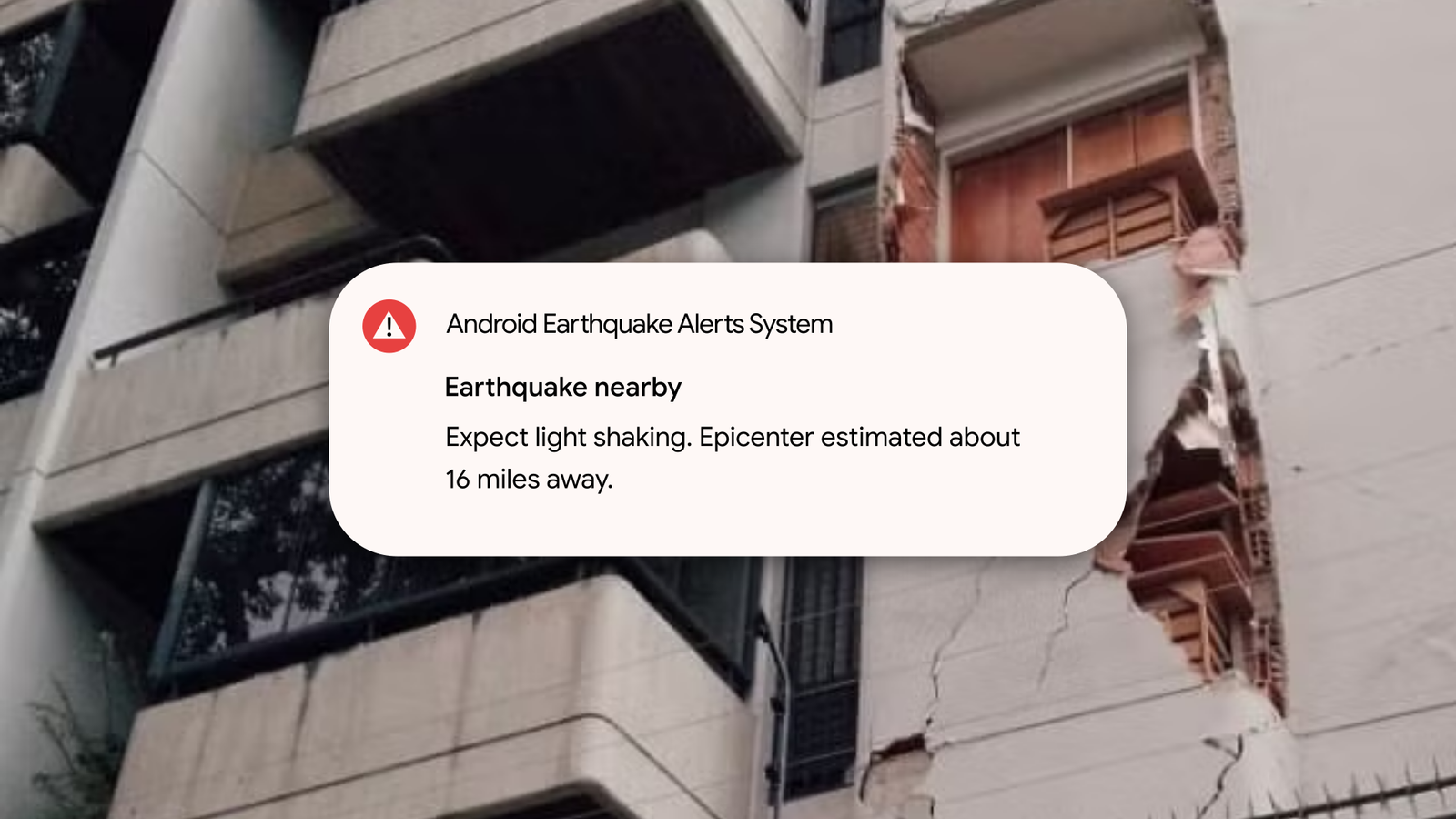
I grabbed my keys, walked to the hallway, pressed the button, and waited.Then my phone screamed at me.I normally keep my phone fully silenced, but the alarm bypassed my volume/notification settings, and it was also the kind of alarm that sounds like a civil defense siren shoved directly into your skull—it blares continuously so you don't mistake it for a notification sound or a call.
When I pulled out my phone, a full-screen notification was letting me know that an earthquake was incoming, magnitude 6.1, epicenter in Morón, in Carabobo state.It was also telling me to drop, take cover, and hold on.This is the first time I've gotten one of these alarms.
Here in Venezuela, we sporadically get a few tremors here and there, rarely exceeding magnitude 4.I knew enough to take it seriously, though.Those initial magnitude readings from early alerts are almost always an underestimate—the final measured number tends to climb once seismologists process the full data.
And Carabobo is far enough from Caracas that I had maybe fifteen to twenty seconds before the shaking would reach me.So I really didn't stop to think.I turned around, rushed back into my apartment, and threw myself under the sturdiest table I could find.
What followed were probably the two longest minutes of my life.I could feel the ground angrily roar, and my building wiggling back and forth.The power went out, things fell off shelves, bottles fell from my cabinet and shattered, and I could hear the glassware—a full set I'd had for years—meeting the floor piece by piece.
When it finally did stop, I sat there for a moment in the ringing silence, looking around to see what was damaged.But I was fine, and so was my apartment all in all.The building had come through without any major structural damage.
While evacuating the building, I learned that the elevator I was about to take had been knocked off its rails.As of the time I write this, it's still out of service, sitting useless in its shaft.No one was trapped inside when it happened.
That much is certain, and it matters enormously.Here's the thing I keep coming back to, though: I could have been in it.I had pressed the button, I was waiting for it to come to my floor, and it was just seconds from opening its doors in front of me.
If that alert had come thirty seconds later, or if I had simply decided to ignore it—something people do, sometimes, when their phone makes noise at an inconvenient moment—the story I'd be telling right now would be a very different one.That notification came in clutch, and I'm extremely thankful for it.Why Android's earthquake alerts work so well The physics and crowdsourcing behind a life-saving system The key thing to understand about earthquake alerts is that they work because of physics.
When a quake begins, it generates two types of seismic waves: P-waves (primary waves) and S-waves (secondary waves).P-waves travel faster but cause minimal damage.S-waves are slower but carry the destructive energy that collapses buildings and knocks people off their feet.
The window between when P-waves are detected and when S-waves arrive is exactly what Android's system exploits.Google's Android Earthquake Alerts System, which the company first launched in California in 2020 before expanding it globally, works on two parallel tracks.The first is a partnership with national seismological agencies, which feed real-time earthquake detection data directly into Google's infrastructure.
When an agency detects a tremor above a certain threshold, Android phones in the affected region receive an alert almost instantaneously.The second track was the lifesaving one here, though.Google actually turned every Android phone with an accelerometer into a miniature seismograph.
When a phone detects shaking consistent with seismic activity, it anonymously reports that data to Google's servers.If enough devices in the same geographic area report similar motion at the same time, the system triangulates the event and broadcasts an alert—no government agency required.Google Pixel 10 Pro Brand Google SoC Google Tensor G5 Display 6.3-inch Super Actua, 20:9 RAM 16 GB RAM Storage 128 GB / 256 GB / 512 GB with Zoned UFS / 1 TB with Zoned UFS Battery 4870mAh The Pixel 10 Pro offers an upgrade over the base model with the powerful Google Tensor G5 chip, more RAM, and more storage (if you need it).
See at Amazon $999 at Best Buy $999 at Google Store $999 at AT&T Expand Collapse Through a mesh network of hundreds of thousands of Android phones, it can find the epicenter and predict an initial magnitude accurate enough to tell you whether it's a nothingburger or something where you actually need to take action to protect yourself.The result is a layered, redundant system that doesn't depend on any single point of failure.In Venezuela, official seismic monitoring infrastructure is extremely under-resourced, and FUNVISIS, the national seismological agency of Venezuela, doesn't have a partnership with Google.
So this crowdsourced layer suddenly became especially critical.When my phone buzzed and the screen lit up with that unmistakable red alert, I didn't stop to question whether it was a false alarm.The sound is distinctive enough, and the context clear enough, that your body just acts.
Those fifteen to twenty seconds of advance notice aren't much, but they're the difference between standing in the open when the S-waves hit and being braced in a safer position.It saved countless lives, not just mine Many of Venezuela's earthquake survivors have Android to thank Venezuela isn't typically the first country that comes to mind when discussing seismic risk, but it sits along the South American Plate boundary and has experienced significant earthquakes throughout its history.Wednesday's earthquakes were actually the fourth and second-worst earthquakes that have rocked the country to date, but since it all felt like one continuous, mega-destructive earthquake due to both of them being so close, the whole thing could very well sit at number one.
In the hours following the earthquake I experienced, social media in Venezuela was filled with accounts from people describing nearly identical moments to mine: a phone buzzing, an alert sounding, and a few precious seconds to react.Some ducked under tables.Others ran out of apartment buildings or shopping malls before the shaking became severe, or barely made it out as their buildings collapsed on top of them.
These kinds of things are exactly what Google designed this system for, and the fact that they're happening organically in a country like Venezuela speaks to how effectively the system has scaled.This kind of distributed benefit is part of what makes Android's earthquake alert infrastructure so impressive.Unlike many safety systems that require investment in local infrastructure or government coordination, the Android network is self-reinforcing: the more Android phones there are in a region, the more accurate and faster the crowdsourced detection becomes.
Venezuela has a high smartphone penetration rate, and Android dominates the market here just as it does across Latin America.And that market reality, which usually gets discussed in terms of advertising or app revenue, turned out to have meaningful implications for public safety for a change.A region full of affordable Android handsets is also a region with a dense seismic sensor network.
The iPhone's implementation needs to improve Apple has the hardware, but is missing the ambition Apple's approach to earthquake alerts is best described as dependent.Rather than building its own detection infrastructure, iOS relies on government-issued wireless emergency alerts—the same system used for AMBER alerts and severe weather warnings.In the United States, this works reasonably well because FEMA and state agencies have mature, well-funded WEA infrastructure.
But outside of a handful of well-resourced countries, the picture changes considerably.In Venezuela and much of Latin America, that government infrastructure is inconsistent at best and absent at worst.The technical disparity is more than just a policy gap.
Android has built an active, hardware-level detection layer baked into its platform.Every Android phone with an accelerometer is constantly and passively contributing to an earthquake detection mesh.Apple's iPhones have accelerometers too—the company has used them impressively for crash detection and fall detection, which is amazing.
But Apple has not chosen to apply that same hardware capability to seismic detection at a network level.That's a huge oversight, and it's one that leaves iPhone users in seismically active regions meaningfully less protected than their Android-using neighbors.Users with iPhones didn't get an alert at all, which meant that many found out about the earthquake when they started to feel the ground shaking.
The frustration here isn't that Apple can't do this—it's that Apple clearly has the hardware and the engineering talent to build something comparable, and simply hasn't prioritized it.Apple has been expanding country-by-country earthquake notification partnerships, and in some regions, like Japan and parts of Europe, iPhone users do receive alerts.But the coverage is fragmented and contingent on local government agreements that Apple has to negotiate individually.
Google built a system that doesn't depend on those agreements by making the phones themselves the detection mechanism.Until Apple makes a comparable architectural commitment, there will remain a meaningful gap in earthquake preparedness for hundreds of millions of iPhone users in vulnerable regions around the world.Earthquake alerts save lives Earthquake alerts work.
They saved my life, and the evidence suggests they've saved countless others in Venezuela.Android has built something that delivers when it matters—infrastructure that counts when seconds are all you have.The gap between Android and iOS on this is a problem Apple needs to fix.
If you want to help out, you can donate here.All the money goes directly towards affected families and rescue efforts.If you want to help out in other ways, you can shoot me an email as well.
Read More