For more than two decades, lithium-ion batteries have powered almost everything around us.They are inside smartphones, laptops, electric vehicles, drones, and even many medical devices.Batteries have improved a lot over the years.
But they can still overheat, use expensive materials like cobalt, and are becoming harder to improve.Instead of developing a completely new battery, researchers at the California Institute of Technology (Caltech) are focusing on the one we already use.Their idea is to redesign its inside with 3D printing.
And the team’s work focuses on one of the battery’s most important components: the cathode.A Different Way to Build a Battery Most lithium-ion batteries today are built with flat, layered electrodes.It is a design that has worked well for years because it is pretty easy to make.
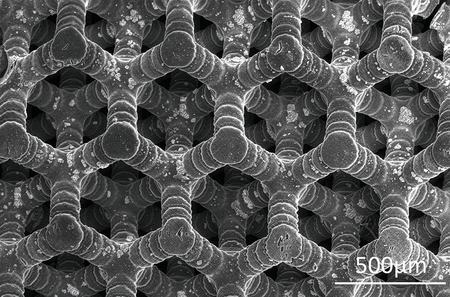
But the Caltech team is doing things differently.Instead of making a flat cathode, they designed and 3D printed one with a tiny, carefully engineered structure.So instead of moving through a flat layer, lithium ions can travel through a more complex 3D network.
The researchers say this could help the battery store and deliver energy more efficiently.That’s important because every time a battery charges or discharges, lithium ions have to travel between the electrodes.If that trip is shorter and smoother, the battery can work better.
“If you make a battery that is 3D architected instead of planar, every lithium ion is going to have an active surface available to it as it’s transporting through the electrolyte,” says Julia Greer, Professor of Materials Science, Mechanics and Medical Engineering at Caltech, whose lab has been working to improve Li-ion batteries.Julia Greer, the Ruben F.and Donna Mettler Professor of Materials Science, Mechanics and Medical Engineering and executive officer for applied physics and materials science at Caltech.
Image courtesy of EAS Communications Office/Caltech According to the researchers, those extra surfaces give the ions more places to move, helping the battery transfer energy more efficiently than a traditional flat design.The findings were published in the paper, “Structure–Transport Relationships in Microarchitected LiFePO4–Carbon Li Ion Battery Electrodes,” in ACS Energy Letters.The work was supported by the Defense Advanced Research Projects Agency (DARPA), NASA’s Jet Propulsion Laboratory through its President’s and Director’s Research and Development Fund, and Caltech.
Goodbye to Cobalt One of the biggest changes is the material.The new battery component does not use cobalt, a metal found in many of today’s lithium-ion batteries.Cobalt is expensive, supplies are limited, and mining it has raised environmental and human rights concerns.
Battery companies have spent years trying to reduce or replace it, and this research could help make that possible.The team also changed how that battery component is made.Instead of traditional manufacturing, they used a 3D printing method called hydrogel infusion additive manufacturing (HIAM) process, which was developed in Caltech’s Greer Lab.
Here, HIAM was used to build a small, highly detailed structure.Creating the same design with conventional manufacturing would be extremely difficult.So rather than inventing a new battery material, the researchers found a new way to shape an existing one using 3D printing.
Changing the shape of the component changes how the battery works.The new 3D design gives lithium ions more room to move through the battery, which could help it charge and discharge more efficiently while keeping the same basic lithium-ion chemistry.Schematic of the hydrogel infusion additive manufacturing process for LFP/C composite electrodes and representative images of the resulting lattices.
Image courtesy of ACS Energy Lett.2026, 11, 6, 4392-4400.The work is still at the research stage.
And there is no indication that these batteries are ready for mass production, and many challenges remain before manufacturers could adopt a completely new electrode architecture.Scaling any new battery technology from the laboratory to millions of products is a long process that often takes years.However, the study points to a growing trend across advanced manufacturing.
Instead of using additive manufacturing only to make battery housings, tooling, or production equipment, researchers are increasingly using 3D printing to redesign the battery itself.Microscope images (top) and a diagram (bottom) showing the 3D-printed battery electrode developed by Caltech researchers.Credit: Sun et al., ACS Energy Letters (2026).
Image courtesy of ACS Energy Lett.2026, 11, 6, 4392-4400.Demand for better batteries continues to grow as electric vehicles, AI data centers, renewable energy systems, and everyday electronics all need more power and longer battery life.
Much of the attention has focused on new battery chemistries, but the Caltech team’s work points to another possibility, improving today’s lithium-ion batteries by changing how they’re designed.If the concept can be scaled beyond the lab, 3D printing could give researchers a new way to rethink battery design without replacing the technology that already powers millions of devices.Subscribe to Our Email Newsletter Stay up-to-date on all the latest news from the 3D printing industry and receive information and offers from third party vendors.
Print Services Upload your 3D Models and get them printed quickly and efficiently.Powered by FacFox Powered by 3D Systems Powered by Craftcloud Powered by First Mold Powered by Xometry 3DPrinting Business Directory 3DPrinting Business Directory
Read More