The US needs more companies like Printerior, based in the St.Louis area.The additive manufacturing (AM) services provider and supplier of polymer feedstock, whose founders bootstrapped their way to growth beginning with the very minimal proceeds from a startup competition they won in college, optimizes the integration between all of its capabilities to keep costs low and to grow at a pace aligned with the growth of demand for 3D printed parts (if you want to know more, Joris Peels interviewed co-founder and CEO Trent Esser on the 3DPOD a couple of years back).
One key factor in the company’s growth is that, like many companies founded during the pandemic, Printerior had to pivot almost immediately.They’d intended to be a services provider right off the bat, but the nature of the AM industry during COVID led the founders to realize it made more sense to supply filament instead.As they grew the filament business with recycled materials, the number of printers they acquired for materials testing grew in parallel.
Growth happened quickly enough that soon some of their filament customers realized Printerior had more print capacity than they did.They started asking if they could order parts from the company.In addition to simply being an interesting story, this background matters because Printerior just announced that they’re launching a line of recycled pellets for LFAM users.
This follows the launch earlier this year of the company’s brand Circdal, which sells architectural components supported by a circular supply chain.When Printerior calls it “a full range” of pellet materials for LFAM, it means there are 9 pellet grades ready to ship, 15 more formulations ready to order on demand, and dozens more combinations the company is ready to compound for customers on request.Aside from all the options that have now been added to the domestic US supply of AM feedstock, this is a big deal because of what I mentioned about the relationship between the company’s print services business and its feedstock supply capacity.
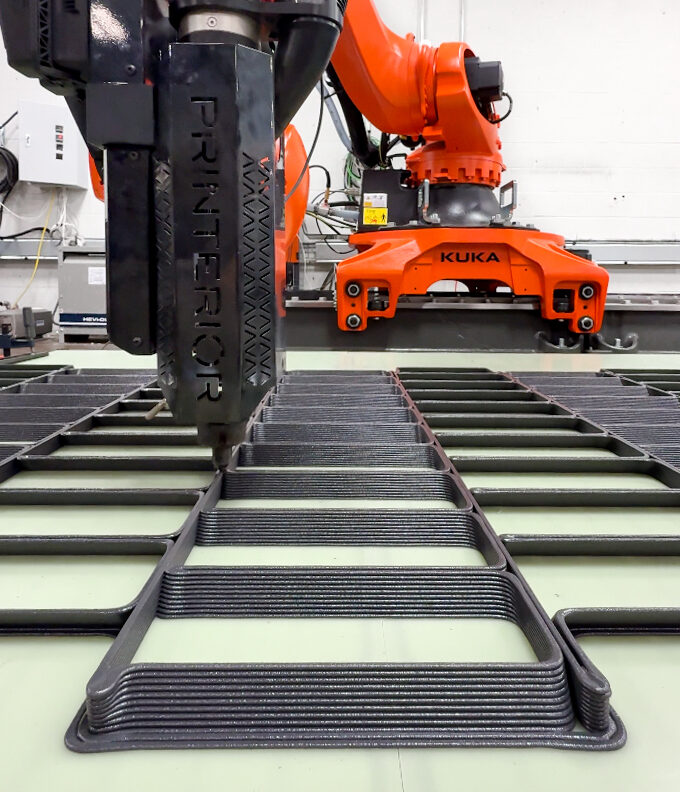
Printerior’s 3D printing materials and large-format robotic additive manufacturing process.According to Printerior, it can currently produce up to a million pounds of material a year.So far in 2026, over 250,000 pounds of material have gone into the parts produced for the company’s print services.
So first off, the launch of the recycled pellet line tells us that the company has so much capacity in excess of its own needs that it’s expecting big growth on the horizon for LFAM.Many other signs this year have told us the same thing (the proliferation of drone boats, for instance), but Printerior’s numbers provide a tangible data point to back that up.Additionally, it reinforces something I wrote about a couple of weeks ago in the context of a post about Arkema and Carbon: the persistent geopolitical chaos in the Middle East that now appears to be one of those forever situations that the US has let itself grow too accustomed to means that if you don’t have a domestic source of recycled polymer lined up, pretty soon you might be having difficulty sourcing polymer at anything but what the tech industry calls “surge pricing”.
Finally, referring back to what I said about the US needing more companies like Printerior: the recycled pellet launch could be a positive sign that this is exactly what’s happening.What exactly do I mean by “companies like Printerior”? The bootstrapping and methodical growth philosophy I mentioned at the beginning is part of it, but even more fundamentally I just mean small- and medium-sized contract manufacturers enabled by AM know-how.That is, the existence of a large domestic supply of cheaper feedstock, combined with the accelerating technical maturity of processes including LFAM, should catalyze the emergence of a bunch of new businesses with real opportunities for success.
They won’t have the profile of VC darlings boasting potential for ten-thousand-percent returns, but in any case the US would do better with a far smaller number of that sort of company (something that’s sure to happen in any case, before they’re replaced by an equal number of startups making similar promises).What US manufacturing needs is a generation’s worth of companies content to grow at an organic pace, while building long-term relationships with satisfied customers and setting aside enough profit for sustainable reinvestment.It may seem odd that recycled pellets could be a meaningful factor in contributing to such a trajectory, but it shouldn’t be so surprising in an age of material scarcity and supply chain dominance.
Images courtesy of Printerior Subscribe to Our Email Newsletter Stay up-to-date on all the latest news from the 3D printing industry and receive information and offers from third party vendors.Print Services Upload your 3D Models and get them printed quickly and efficiently.Powered by FacFox Powered by 3D Systems Powered by Craftcloud Powered by First Mold Powered by Xometry 3DPrinting Business Directory 3DPrinting Business Directory
Read More