I find file formats, archives, and audio/video storage media fascinating.In my experience, how they work, what they do, and why they were created are usually built around fascinating stories or interesting research and development.I've been using CDs for as long as I can remember, and it's likely that either you have, too, in some form or another (or maybe not).
Either way, CDs are becoming popular again alongside other types of physical media.They’re so different and limited compared to modern storage media, which I find fascinating.So I figured I'd channel my inner Vic Sage and try to answer the question: how much data does a CD actually hold, and how much data were we actually storing when the CD-R craze hit? A single CD typically holds 700 MB of data But CD storage is more limited than we actually remember So right out of the gate, I’ll tell you that a CD typically holds 700MB of data.
Usually.There’s a bit more to it than that.CD storage is really fairly nuanced.
Audio works differently from data.Professionally produced discs follow the Philips Red Book standard, while CD-Rs follow the Orange Book.Basically, music storage on most CD-Rs is between 74 and 80 minutes (650 - 700MB if we’re talking about data).
Then you have the higher capacity ones that can hold an “impressive” 800MB (about 90ish minutes of audio).But here’s the kicker: anything over 700MB isn’t fully compatible with established CD standards and might not always work.It also matters how you use the disc.
If you're making a music disc (not an MP3 disc, but a mix/album/demo CD), for instance, you're actually considering how much time you're going to use on the disc.Most discs cap out at 80 minutes.Here in the United States, music discs and data discs are marketed as separate things, largely because of copyright shenanigans from the mid-90s, like the Audio Home Recording Act of 1992.
Data CDs have a feature where they use extra bytes per sector for error correction (it’s called ECC).Audio CDs don’t use most of it because the human ear is pretty forgiving when it comes to dropped bits of data.Although a single disc could hold a certain capacity, there’s an entire community dedicated to finding ways to stretch that capacity or store the data in different ways to increase it.
It was called overburning, and you’d need a special program like Nero Burning ROM to do it.Even for those of us who lived through the time and messed around in the hobby, there are still some fun surprises out there.Related The 450x storage leap: Why jumping from 1.44MB floppies to 650MB CDs changed PCs forever The 650MB miracle: How the CD-ROM's microscopic lasers fueled the 90s PC revolution Posts 51 By Sydney Butler Recordable discs weren’t as reliable as we believed Disc rot and degradation are problems we’re facing today For the entire time I've used them, I've never really trusted CD-RS for long-term storage.
It turns out they don't actually last very long.Poor quality manufacturing is the biggest culprit, and the wrong kind of metal layer can cause problems, too.If a disc happens to have a gold reflective layer, it usually doesn't have a lot of issues.
Silver and silver alloys, though, like to corrode a little bit (and kill the disc in the process).Unfortunately, CD-Rs can suffer from disc rot as well, which is when CDs degrade and become unreadable, or to put it another way, it kills your disc.Poor storage, humidity, and even light exposure can cause discs to “rot.” Factors like disc quality and how you label them also matter, with both DVDs and CDs.
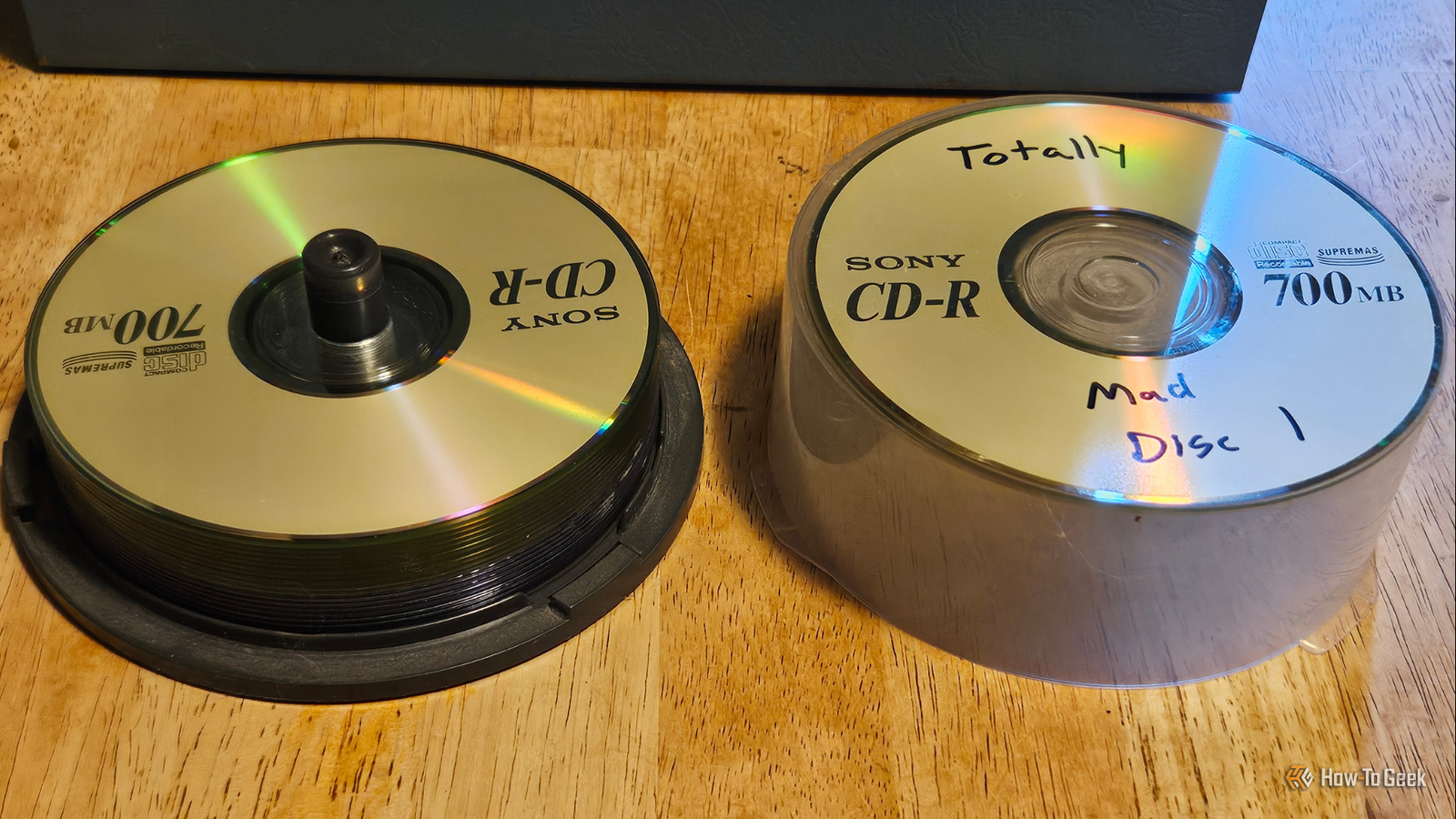
They're not a perfect medium, and, oh yeah, the dye in CD-Rs can also degrade, so maybe you don't want to put anything important on one of them the next time you pull out the old CD burner.How much data and music a stack of CD-Rs can hold isn’t very much With the help of a calculator and a disk analyzer, we can visualize the data We know what one typical disc can hold.So how about an entire stack of them? I have a 50-CD spindle of the 700MB/80 min.
discs.So, basic math says that’s about 35,000MB.So, 35GB.
I just used a calculator to figure that out, no fancy tools required.Visually, 35GB of data is a little more than a typical consumer-grade USB stick (I’m talking about those cheap 32GB ones here as a frame of reference).Heck, most USB sticks nowadays have way more data capacity.
I ran Disk Analyzer on a 500GB MicroSD card, my laptop hard drive, a USB drive, and a physical CD-R I burned recently, just to demonstrate how much of a drop in the bucket 35GB actually is.It’s kind of crazy to visualize it that way.If we’re talking about time, you get 4,000 minutes, which is roughly 66.6 hours.
That’s almost the equivalent of Frank Zappa’s entire pre-1992 discography.I should know.I’m a nerdy Zappa fan, and I went through an entire 50-disc spindle burning backup copies of my CDs so I wouldn’t wear out the originals back in the day.
When DVD-R came around, it changed things significantly for home storage (at least for me).With 4.7 GB per disc, it offered a world of archival possibilities.I know that doesn't seem like a lot today, but it made a difference when I first got into digital archiving.
Nowadays, I use several different methods to store data, but none of them use CDs or DVDs.Related Please stop buying vinyl when CDs exist Vinyl records have a long, storied history for music lovers—unfortunately, they're also inferior.Posts 196 By Nick Lewis Physical storage media isn’t dead, it just smells funny I still have a few spindles full of blank CD-Rs and DVD-Rs, along with a couple that are full of who-knows-what? I still use them for backups of some of my music collection (or, more accurately, I haven't made the time to copy them to a different storage medium yet), but I plan to ditch them at the first available opportunity.
Although overburning sounds like an interesting topic to explore, perhaps I’ll dive into that with some of the remaining discs I have.It’s never too late to get into overburning CDs, even if modern hardware might not be able to do it properly.Verbatim CD-Rs Verbatim CD-R Blank Discs 700MB 80 Minutes 52X Recordable Disc for Data and Music - 100pk Spindle Frustration Free PackagingSee at Amazon Expand Collapse
Read More