Lenders often start with one system to process applications, add another to manage repayments, and bring in a third to handle collections.Each tool might work fine on its own.Trouble starts in the gaps between them: shifting records between disparate systems leads to double entry, mismatched balances, and delayed reports that get harder to untangle as a portfolio grows.ContentsWhy Three Separate Systems Create One Data Reconciliation ProblemKeeping One Clean Record From Application to ApprovalCarrying Verified Loan Terms Into Servicing Without Manual Re-EntryBringing Collections Into the Same Data ModelWhat Changes When the Systems Share Data?How to Evaluate an Integrated Lending SuiteFrequently Asked QuestionsWhy do data reconciliation errors happen so often in lending operations?How does a shared-record lending platform handle third-party integrations compared to a bundled suite?How does shared servicing data reduce compliance risk in collections?Which baseline metrics show whether lending system consolidation improved data quality?Closing the Data Gaps Across Lending OperationsLending data reconciliation is the recurring effort to align borrower, loan-term, balance, and payment-status records across separate origination, servicing, and collections databases.
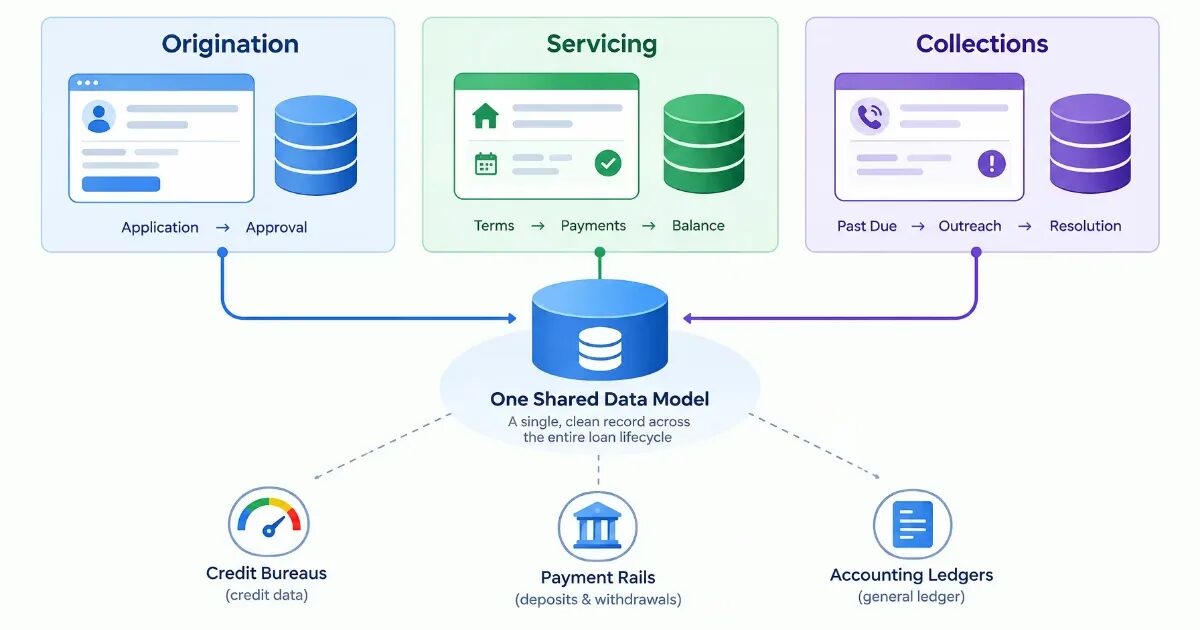
Running all three stages on one shared data model eliminates internal re-keying while retaining API connections to external credit bureaus, payment rails, and accounting ledgers.According to the vendor’s product documentation, Finspectra’s Prizm platform takes a different approach by bringing loan origination, servicing, and collections into one connected lending environment.Teams read and update the same underlying borrower and loan records across the full credit term without passing static exports from one department to the next.TL;DR – Key Takeaways for Data & Lending Leaders The root data problem: Most operational delays in lending trace back to data reconciliation, where origination, servicing, and collections store separate borrower records that drift out of sync.System integration gaps: Industry survey benchmarks cited in this article highlight poor integration between systems and applications as a persistent efficiency problem for banking leaders.Shared-record architecture: Running origination, servicing, and collections on one shared data model removes internal re-keying while retaining API connections to credit bureaus and payment rails.Governance boundary: Consolidating databases doesn’t replace financial controls.Reliable portfolio data still depends on validated payment feeds, role permissions, audit trails, and regular ledger reconciliation before and after migration.Why Three Separate Systems Create One Data Reconciliation ProblemSpecialized lending tools usually enter an organization at different growth stages instead of through a single architectural plan.
A lender adopts an origination system to keep up with rising application volume, introduces servicing software to track repayments, and adds a collections platform once overdue accounts demand dedicated queues.Each system maintains its own database.Friction starts the moment those systems have to exchange state.In a typical disconnected workflow, an approved application might still require manual re-entry into the servicing ledger.A borrower payment cleared on Friday afternoon can sit in a batch job while collections records still show the loan past due on Monday morning.
Support representatives end up switching across three screens just to piece together an account’s history.Those handoffs introduce four recurring data and operational risks: Duplicate data entry: Staff enter the same borrower and contract fields into multiple systems, raising the chance of transcription errors and mismatched terms.Delayed account state: Downstream teams make credit, billing, or outreach decisions using balances and statuses that have already changed upstream.Limited portfolio visibility: Managers struggle to pull one consistent view of loan performance without first reconciling departmental spreadsheets.Higher maintenance overhead: IT teams must maintain separate vendor schemas, batch sync scripts, version upgrades, and access controls.Fragmented stacks also multiply copies of sensitive borrower data and expand the number of handoff interfaces through which that information travels.In an analysis of fragmented lending tech stacks from Baker Hill citing KPMG’s 2025 banking survey, 93% of banking executives identified data privacy and risk as a top data-modernization challenge.Every extra database copy and batch transfer makes data lineage, access control, and retention rules harder for engineering and compliance teams to govern and audit.More Read Is Blockchain The Answer To Blockchain Security Problems? Revenue, Supply & Demand: Effects of the 2011 Hard Drive Shortage What Are You Contributing to the Big Data Revolution? Facebook Analyzes Big Data, Concludes World is Smaller ggplot2 for Big Data Industry reports cited by the author point to the same integration strain.
As cited from Cornerstone Advisors’ 2026 banking research, 69% of surveyed banks identified poor integration between systems and applications as a technology efficiency challenge, compared with 62% in the prior year’s survey.Reviewing bank readiness in that same research cycle, Cornerstone Chief Research Officer Ron Shevlin offered a blunt reminder for institutions chasing automation on top of fragmented stacks: “There is no meaningful AI strategy without a credible, prioritized data strategy.”How many software applications a lender owns matters far less than whether those applications share clean, consistent records.Time pressure at month-end makes this data reconciliation gap even harder to manage.Guidance on financial data reconciliation from Safebooks notes that compressing financial close timelines force finance teams to report faster while transaction volume and complexity make manual reconciliation practically impossible.
Rushing lending data reconciliation to meet a tight close deadline increases the risk of missing critical balance discrepancies across origination, servicing, and general ledger reports.Figure 1: How borrower and account data move across a disconnected three-tool stack versus a shared-record lending architecture.Keeping One Clean Record From Application to ApprovalLoan origination covers application intake, document collection, identity verification, credit assessment, underwriting, and final approval.In the author’s operational observation, when those activities run across disconnected tools, borrower data starts fragmenting before a single dollar is disbursed.An integrated lending suite keeps these steps attached to shared records and configurable workflows.
Intake fields pass directly into underwriting without repeated typing.Credit bureau pulls and verification checks stay linked to the same application ID, while document management tools keep income proofs and disclosures tied to the underwriting file.The industry has spent decades making borrower information easier to obtain and lending decisions faster.Credit reporting, digital verification, banking connections, loan origination systems and automated underwriting have transformed both ends of the process.
Artificial intelligence promises to accelerate them again.Gerald Green in Mortgage Lending Risk Grows in the Data-to-Decision GapAccording to Finspectra’s product description, Prizm’s origination capabilities include multi-channel application capture, credit scoring integrations, configurable routing workflows, and centralized document management.For operations and risk teams, the practical gain is record consistency.Lenders can apply standard decision rules to routine applications while routing exceptions to an underwriter with the full intake trail intact.Workflow automation still requires tight controls.Credit decisions must follow the lender’s risk policies and applicable lending regulations, while complex borrower files still call for human judgment.
Carrying Verified Loan Terms Into Servicing Without Manual Re-EntryOnce a loan gets approved and funded, the data challenge shifts from evaluating an application snapshot to maintaining a living account ledger over the full repayment term.Servicing teams track principal balances, calculate interest and fees, post payments, manage amortization schedules, and send borrower notices.When servicing runs independently of origination, staff often have to recreate contract fields that already exist upstream.A connected platform is designed to carry approved loan terms and verified borrower details straight into servicing workflows to reduce manual boarding handoffs.According to Finspectra’s platform overview, Prizm’s servicing module provides payment tracking, full account histories, automated notifications, repayment adjustments, and portfolio reporting.Take a common servicing event: a borrower asks to modify their repayment schedule.
On a shared record, authorized staff can review the original loan terms, apply an approved schedule change, and preserve a clear audit log without exporting files between departments.In practice, that continuity directly improves downstream analytics.When account state stays aligned, finance and risk managers can measure repayment performance without spending month-end close reconciling conflicting exports.Banking supervisors have emphasized this principle for over a decade: under Principle 3 of the Basel Committee’s BCBS 239 risk data standards, “Risk data should be aggregated on a largely automated basis so as to minimise the probability of errors,” with institutions expected to work toward “a single authoritative source for risk data per each type of risk.” Integration by itself doesn’t guarantee clean servicing numbers.
As a practical operational baseline, lenders still need dependable payment processing feeds, field-level data validation, clear exception queues for partial or returned payments, and scheduled general-ledger reconciliation, as detailed in Solvexia’s guide on loan reconciliation.Bringing Collections Into the Same Data ModelCollections sits downstream of every prior step, meaning recovery teams depend on data generated across the entire loan lifecycle.Staff need exact payoff balances, cleared payment histories, delinquency aging, and logs of earlier borrower communications.When those records sit in separate databases, collections specialists spend hours hunting down account context, or risk contacting a borrower over an installment that has already posted in the servicing tool.An integrated suite connects collections queues directly to live servicing records and prior interaction logs.In Finspectra’s product description, Prizm supports configurable delinquency and hardship workflows, prioritized workload queues, compliance checks, and post-collection transaction posting.
When an account turns past due, a configured rule can flag the file and route the follow-up task so authorized staff review complete payment and outreach history before taking action under lender policy.Record continuity in servicing and collections carries regulatory weight as well.For mortgage servicers specifically, federal Regulation X servicing standards (12 CFR § 1024.38) require policies ensuring the “timely transfer of all information and documents in the possession or control of the servicer” in a form that preserves accuracy, while BCBS 239 sets risk-data-aggregation principles for large banking organizations.
Automated collections workflows must enforce statutory contact restrictions, consumer protection rules, and documented hardship procedures using current account data.What Changes When the Systems Share Data?Moving to an integrated lending suite is less about trimming vendor count for its own sake and more about removing translation errors between loan lifecycle stages.When origination, servicing, and collections operate on shared records, lenders see four practical shifts:Consistent borrower and loan records: Shared tables remove the routine chore of reconciling duplicate customer IDs and mismatched balances across departmental databases.Fewer manual handoffs: Configured workflows move loan state from approval to active servicing and delinquency review without repeated staff re-entry.Clearer portfolio visibility: Risk and finance leaders can analyze underwriting cohorts alongside live repayment and recovery performance in one business intelligence reporting layer.Simpler integration management: Consolidating overlapping internal systems reduces the number of brittle point-to-point sync jobs and vendor upgrades IT teams must maintain.According to Finspectra’s documentation, Prizm is built on Salesforce so origination, servicing, and collections workflows can run inside the Salesforce data environment.At the same time, the vendor notes that it supports API integrations with external tools for lenders that keep established credit bureaus, payment processors, general ledgers, and specialist verification services.A shared platform never eliminates every integration requirement.
As an operational rule of thumb, the goal is to stop spending engineering time syncing internal loan stages that belong in the same database, which makes essential external connections easier to govern.How to Evaluate an Integrated Lending SuiteMoving from separate point tools to one lending suite takes deeper scrutiny than comparing feature checklists.Data architects and lending leads should trace where account records stall or drift out of sync, then verify whether consolidation solves those specific failure points.Five evaluation criteria deserve close review:Lifecycle coverage: Does the platform natively run origination, servicing, and collections on one shared schema, or are separate databases merely hidden behind a single login?Integration flexibility: Can it connect cleanly via APIs with existing credit bureaus, payment rails, identity tools, and accounting ledgers that must stay in place?Workflow configuration: Can operations teams adapt underwriting rules, repayment structures, and delinquency queues to different loan products without custom code rewrites?Data governance: Are role-based access permissions, immutable audit trails, retention rules, and data quality checks clearly defined?Implementation requirements: What historical data migration, schema mapping, staff training, customization, and ongoing support will cutover demand?Lenders should also capture baseline metrics before migration begins.Measuring application-to-funding cycle times, manual touch rates, monthly reconciliation discrepancies, servicing cost per loan, and collections cure rates gives leadership hard evidence of whether consolidation is paying off.Frequently Asked QuestionsWhy do data reconciliation errors happen so often in lending operations?Most lending stacks are assembled in stages, leaving origination, servicing, and collections on separate databases with different field rules and update schedules.
Whenever loan terms, payment statuses, or hardship flags move via manual re-entry or overnight batch files, timing lags and mapping mismatches produce conflicting numbers across departments.How does a shared-record lending platform handle third-party integrations compared to a bundled suite?In the author’s observation, some vendors package acquired origination and servicing tools behind a single sign-on screen while still syncing separate databases underneath.A shared-record platform stores borrower, contract, and transaction data in one governed schema with unified permissions and audit logs.It doesn’t eliminate all third-party integrations: lenders still rely on external APIs for credit bureau reports, KYC identity checks, ACH or card payment processing, and general-ledger accounting, while removing redundant internal syncs between loan stages.How does shared servicing data reduce compliance risk in collections?Collections teams depend on accurate payoff balances, cleared payment timestamps, prior contact logs, and active hardship or modification terms.
Working directly from live servicing records without waiting on delayed batch exports lowers the risk of contacting borrowers over already-paid installments or missing an approved repayment arrangement.Which baseline metrics show whether lending system consolidation improved data quality?Baseline metrics that show whether lending system consolidation improved data quality include tracking duplicate data entry, manual re-entry rates, and mismatched balances across origination, servicing, and collections databases.Teams can also benchmark regular general-ledger reconciliation discrepancies, audit trail errors, and reporting delays before and after migration to verify cleaner portfolio records.Important Note: Lending regulations, consumer protection rules, and risk-reporting standards vary by charter and jurisdiction; platform and data-governance decisions should be evaluated alongside qualified compliance and legal counsel.Closing the Data Gaps Across Lending OperationsThree separate tools can serve a lender well when loan volume is small and each tool solves an isolated problem.Once portfolios scale and external integrations multiply, keeping independent databases in agreement turns into an operational burden of its own.An integrated lending suite addresses that problem by connecting origination, servicing, and collections through shared records and governed workflows.
How much value a lender realizes depends on clean data migration, reliable upstream validation, and how well the platform fits its credit products and regulatory duties.For technology and data leaders planning their next lending stack investment, the practical question comes down to record continuity: do your systems carry one trustworthy loan record across its entire term, or do they force your teams to reconcile the gaps by hand?
Read More