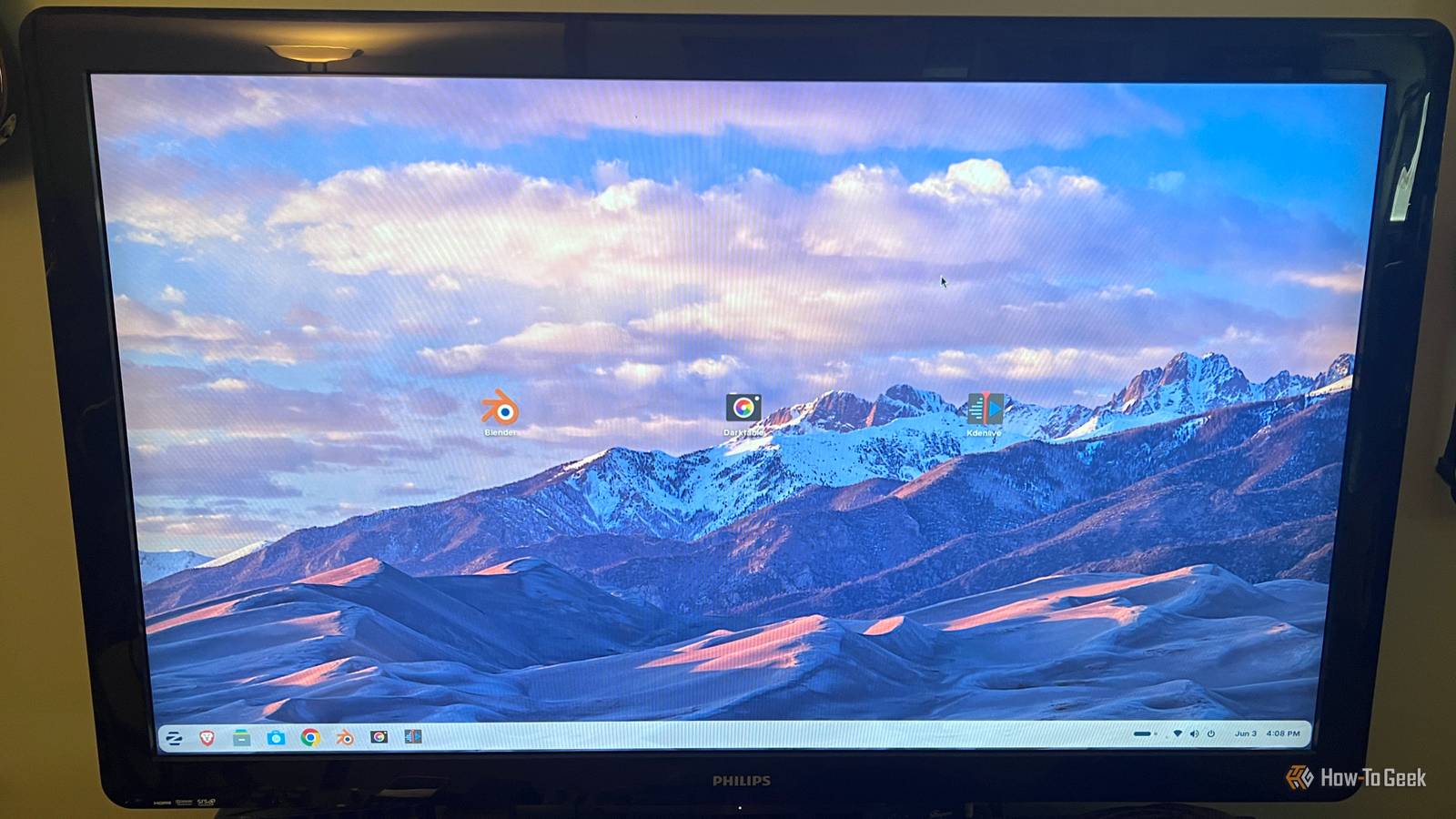
I'm primarily a Windows user, and I don't see that changing anytime soon.But like a lot of people, I had a few perfectly good Windows machines that couldn't officially upgrade to Windows 11 despite having no obvious performance problems.They weren't broken, slow, or useless.
They had just fallen on the wrong side of Microsoft's requirements.So I installed Zorin OS on a couple of them, mostly as a way to keep decent hardware from becoming e-waste.The result was better than I expected.
These older PCs suddenly felt useful again, and Zorin made the jump from Windows feel less awkward than I assumed it would.That got me wondering about something more specific: could I actually use a Linux machine for personal and work projects, especially for creative tasks? That's where I expected the answer to be a polite "sort of." I assumed photo editing, video work, and 3D projects would still send me back to a Windows PC or my Mac mini pretty quickly.Instead, I found these free Linux apps that made creative work feel far more practical than I expected.
Kdenlive made video editing feel surprisingly normal It’s not Premiere Pro, but it’s more than a basic clip trimmer Kdenlive is a free, cross-platform, open-source video editor, and it was one of the first apps that made creative work on Zorin OS feel realistic to me.It gives you a proper timeline, multiple video and audio tracks, transitions, titles, effects, color tools, proxy editing, and plenty of export options.In other words, it does the things I actually need a video editor to do without immediately pushing me back to Adobe Creative Cloud.
Related Windows isn't the best operating system anymore Operating systems are now a commodity, and Windows is a bad pick.Posts 112 By Dibakar Ghosh That doesn’t mean Kdenlive is a full Adobe Premiere Pro replacement.Premiere still has the edge for deep professional workflows, After Effects integration, collaboration, plugins, and overall polish.
But that’s not the question most people need to answer.For YouTube videos, social clips, simple explainers, family projects, and basic work edits, Kdenlive covers a lot of ground without a subscription or a giant learning curve.Darktable gave me a real photo workflow without the bill It’s powerful, but it doesn’t try to hide the learning curve Darktable is a free, open-source photography app built for organizing and editing raw photos.
That makes it feel less like a simple photo editor and more like the kind of tool you use when you want control over exposure, contrast, color, lens corrections, noise reduction, sharpening, and non-destructive edits.I already use GIMP on my Windows machine, so I wasn’t looking for another basic image editor.What made Darktable interesting is that it gives Linux a more serious photo workflow for organizing and developing raw images, product shots, family photos, and article images where a basic editor starts to feel limiting.
Darktable doesn't feel as friendly as Lightroom.There is definitely a period of adjustment.The interface can be intimidating, and some tools use photography terms that can take a little time to learn.
Lightroom still has the edge if you want a smoother cloud workflow, mobile integration, AI-assisted tools, and a more polished experience.But if the goal is to edit serious photos on a Linux machine without paying for another subscription, Darktable makes that feel a lot more practical than I expected.Adobe Lightroom Whether you need automatic adjustments, deep controls, or artistic presets, Adobe Lightroom makes it easy to edit your photos.
And now, Lightroom supports video editing! See at adobe Expand Collapse Blender is overkill in the best possible way I don't need all of it, but that’s part of what makes it impressive Blender is a free, open-source 3D creation suite, and it is easily the most powerful app on this list.It can handle modeling, animation, rendering, visual effects, compositing, motion tracking, and even video editing.I don't do a great deal of video editing myself beyond family videos and the occasional side project, so I'm not pretending I need everything Blender can do.
What surprised me is that a Linux machine can run something this deep without feeling like I'm settling for a cut-down creative tool.That depth is also why Blender can be intimidating.It's not as approachable as opening a simple editor and trimming a few clips, and it’s not a direct replacement for every Adobe app.
Creative Cloud still has the advantage if your work depends on Photoshop, After Effects, Premiere Pro, shared libraries, cloud collaboration, or a familiar commercial workflow.But Blender changes the equation because it gives Linux users access to a serious creative tool that can grow with them.Even if I only scratch the surface, it makes the idea of using Linux for creative work feel much less limiting.
DaVinci Resolve DaVinci Resolve combines editing, color correction, visual effects, motion graphics, audio post production and now photo editing all in one software tool.See at Blackmagic Design Expand Collapse Linux creative work is no longer the compromise I thought it was I'm not pretending Linux can replace every paid creative app for every person.There are still good reasons to use Adobe Creative Cloud, Lightroom, Premiere Pro, After Effects, Final Cut Pro, DaVinci Resolve Studio, or whatever tool already fits your workflow.
But these apps gave me enough capability to treat Zorin OS like a real working machine instead of a fallback computer.They won't replace every paid creative tool in your workflow, but they should make you stop and ask whether you really need to pay for all that software.
Read More