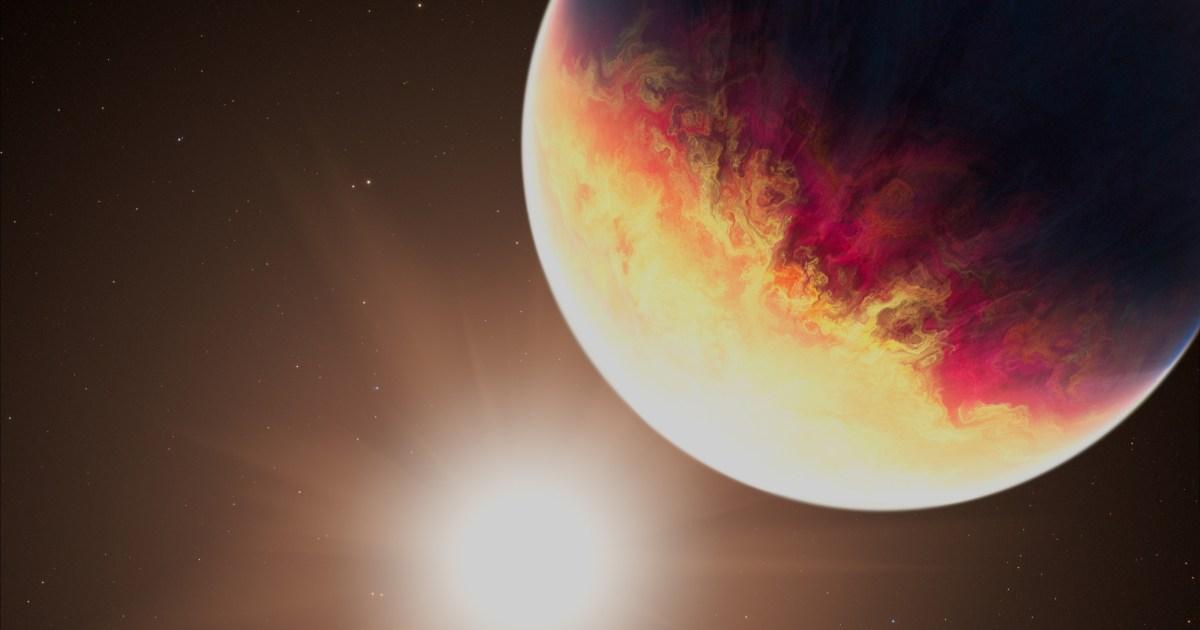
Astronomers have discovered ‘one of the most extreme exoplanets’ ever found in our universe which orbits a star very like our own sun.Using Nasa’s James Webb Space Telescope, they’ve observed a giant planet that gets so roasted by its parent star that it changes its chemical composition once every rotation.The planet, known as HD 80606 b, is around four times the mass of Jupiter and follows a highly elongated orbit around a sun-like star.
Scientists say the planet’s unusual orbit makes it one of the most extreme worlds ever studied.‘Hot Jupiters are already considered some of the most extreme exoplanets we know of, but even among that population, HD 80606 b is one of the most extreme,” said Tiffany Kataria, the study’s principal investigator at Nasa’s Jet Propulsion Laboratory in Southern California.‘We typically think of hot Jupiters as hot gas giants sitting right next to their stars, but this planet’s highly eccentric orbit creates a completely different beast.’ As HD 80606 b approaches its star, observations from Webb show its temperature rises dramatically, increasing by around 1,100F (610°C).
Previous research has suggested that such rapid temperature fluctuations can alter an exoplanet’s atmospheric chemistry and cloud formations in real time.Researchers believe the planet’s dynamic environment provides an ideal opportunity to study these processes using Webb’s advanced instruments.Up Next Laura C Mayorga, co-investigator and exoplanet astronomer at Johns Hopkins Applied Physics, said: ‘Observing a planet like HD 80606 b is actually very efficient because its unusual orbit, with the corresponding swings in temperature and chemical composition, allow us to gather data under varying conditions in just hours and apply those findings to other hot Jupiters or more conventional exoplanets.’ The team measured the planet’s temperature and atmospheric composition using spectroscopy, a technique that splits light into its component colours to reveal details about an object’s chemical makeup, temperature, movement and physical properties.
Researchers used Webb’s Mid-Infrared Instrument (MIRI) to observe HD 80606 b before, during and after its closest approach to its star, known as periastron.During this phase, the planet also passed behind its star from Webb’s viewpoint in an event known as a secondary eclipse.The observation campaign took years to plan because of the planet’s highly elliptical 111-day orbit, as well as restrictions on when and where Webb can observe, which depend on Earth’s position around the sun.
Trending Now British Charlie Kirk wannabe beaten up debating people in Manchester UK 24 hours ago By Barney Davis Missing teenager found in Ecuador 'after being trafficked from the UK' Finland lifts ban on nuclear weapons in face of growing threat from Russia Woman's body only discovered when smell got so bad neighbours raised concerns Although scientists are still analysing the extensive dataset, they say the observations have already revealed significant findings.‘Webb has shown that the planet’s increase in temperature was even more extreme than we anticipated based on Spitzer data,’ said Kataria.‘Spitzer did amazing work on this exoplanet, and now Webb is building on that legacy by enabling us to drill down to distinguish specific chemical signatures like methane and carbon dioxide, which is just amazing progress,’ said Ryan Challener, co-author of the study and a research associate at the Cornell Center for Astrophysics and Planetary Science.‘There’s so much to learn from this one dataset here — we really are just getting started deciphering what Webb has to tell us.’ The research team presented preliminary findings from the study on Tuesday at the 248th meeting of the American Astronomical Society in Pasadena, California.
MORE: Giant potato-shaped UFO sighting revealed in new batch of government files MORE: Mystery of strange ‘little red dots’ discovered in space may have finally been solved MORE: Nasa’s ‘Son of Concorde’ hits 713mph and breaks the sound barrier for first time Comments Add as preferred source News Updates Stay on top of the headlines with daily email updates.This site is protected by reCAPTCHA and the Google Privacy Policy and Terms of Service apply.Your information will be used in line with our Privacy Policy HomeNewsTech Related topics James Webb Space TelescopeNasaSpace Astronauts told to shelter on spacecraft after air leaks are found on ISS Tech June 5, 2026 By Josh Milton NASA's 'Son of Concorde' hits 713mph and breaks the sound barrier for first time Tech 6 days ago By Rory McKeown
Read More