6K Additive (ASX: 6KA), a U.S.supplier and manufacturer of metal powders for additive manufacturing (AM), has been very busy lately.I caught up with CEO Frank Roberts and Chief Marketing Officer Bruce Bradshaw at RAPID+TCT 2026 in Boston to hear what the company has been up to after going public on the Australian Stock Exchange (ASX) a few months ago.
Domestic Metal Powder Supply Chain Right before the show began, 6K Additive welcomed Congressman Guy Reschenthaler (PA-14) to its campus in Burgettstown, Pennsylvania.During his tour, Congressman Reschenthaler was able to see the company’s proprietary UniMelt microwave plasma technology up close and personal; having once stood in front of the UniMelt myself, I can tell you that it is an impressive system.6K Additive CEO Frank Roberts and Congressman Guy Reschenthaler (right) in front of the UniMelt.
Image courtesy of 6K Additive.The UniMelt process converts solid scrap, turnings, and end-of-life components into premium metal refractory powders, like tungsten, tantalum, rhenium, and niobium, which are often used for applications in aerospace and defense.Not only is this approach more environmentally friendly, but it also keeps the supply chain in the U.S.
“As a member of the House Appropriations Committee, I am proud to work alongside Pennsylvania manufacturers and suppliers in support of the Department of War.6K Additive is leading the way in cutting-edge technology while creating family-sustaining jobs for hardworking Pennsylvanians and strengthening our local workforce.Their innovation is helping attract and retain critical talent in our region,” Congressman Reschenthaler said.
“From hypersonics to nuclear energy, the materials produced in Burgettstown are keeping America competitive and secure.” Bradshaw told me that they’re really trying to drive home how important it is that 6K Additive’s products are domestic.“One of the things that we think is a message that needs to be heard is, why is that so important? I don’t think people really understand the reliance from a metal powder perspective on China right now.And being domestic has its advantages, but more importantly, there’s a real threat,” Bradshaw said.
He explained that China controls 80% of the world’s ammonium paratungstate (APT), which is the main precursor for making tungsten.Roberts noted that China recently “locked that supply up, which has driven the price through the roof.” So while it’s been a fairly constant theme for several years, everyone is more focused on reshoring than ever now, and ensuring that we don’t rely on China for these critical materials.Non-eroding throat insert for a solid rocket motor nozzle.
Printed by Quadrus using 6K Additive tungsten rhenium powder.Image courtesy of 6K Additive.Unfortunately, just because metal powder is produced in the U.S., that doesn’t necessarily mean it’s a fully domestic product, or that we’re fixing the supply chain problems.
Roberts shared something that “probably doesn’t get talked about much and probably should,” and it honestly made my blood run cold.“In order for a producer to constitute U.S.-produced powder, it basically just has to be melted,” he explained.“So if you look back through the supply chain, and here are the metal powder producers that are supporting North American production…that’s a constant theme, North American production.
Go one step back and ask them, if you’re using plasma atomization or electrode gas atomization, ask them where that bar or wire comes from that supports their process.And it’s likely China.” Bradshaw brought up niobium, for which demand has been growing.He said that 43% of the world’s supply of niobium comes from Brazil, while 31% comes from China.
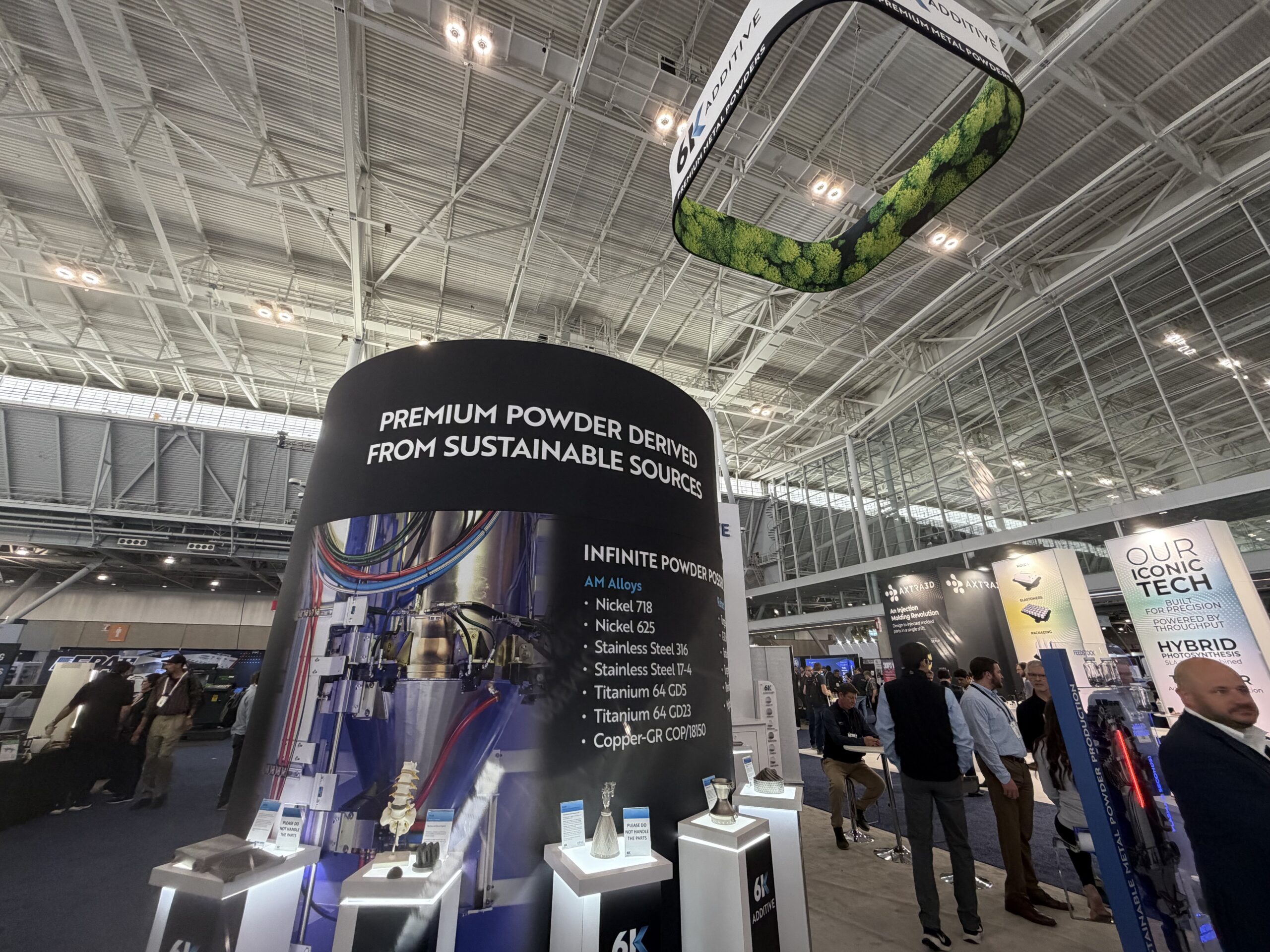
But, 61% of the ownership in those Brazilian companies is China, so it’s basically a wash.6K Additive booth at RAPID+TCT 2026.Image courtesy of Sarah Saunders.
All of the scrap that 6K receives to turn into metal powder comes from U.S.sources, Roberts told me.He brought up the company’s recent $1.95 million Phase II award from the Defense Logistics Agency (DLA) under its Recovering Strategic Value project.
The program will focus on using 6K Additive’s UniMelt process to convert depot scrap into powder, and then getting that powder qualified for defense applications.“There’s a clear focus in Washington, DC on shoring up supply and making sure that it’s truly domestic-based,” Roberts said.“What the DLA is focused on is how do we maximize value? How do we make sure that we’re doing the front end of the sort/segregate, reclaiming that higher value material, and funneling those materials to places like 6K to turn into high-value powder that can then come back and support defense applications?” Roberts also said that for the DLA project, 6K Additive will be partnering with a robotics company “to demonstrate a more streamlined, automated approach to sort and segregate.” In a proof of concept system, the robots will use XRF (X-ray fluorescence) guns for automated alloy detection and sort/segregate, “making sure that the scrap’s flowing into the right bucket.” I have been assured that these robots do not look like the one at the PANAM in Space booth that haunts my nightmares.
Modular Quadruped Centaur at PANAM in Space’s RAPID+TCT booth.Image courtesy of Sarah Saunders.After RAPID, I was nosing around 6K’s website to make sure I hadn’t missed any recent news from the company, and came across an ASX announcement of a modification to a defense agency contract with 6K.
It states that the company “has been awarded a US$1.95 million modification to its existing Phase II contract by a U.S.Defense Agency,” bringing the total value of the award up to $3.9 million.Specifically, this modification focuses on increasing how much scrap tungsten and niobium C-103 alloy will be recovered from “strategic DoD partners” for the contract.
Now, this document doesn’t name any names, but if you connect the dots, it certainly seems like it’s regarding the award I was speaking about with Roberts and Bradshaw at RAPID.If that’s the case, then the government really is doubling down on reshoring the critical metal powder supply.6K Additive booth at RAPID+TCT 2026.
Image courtesy of Sarah Saunders.Growth & Consolidation At RAPID, Roberts and Bradshaw reminded me that the company recently had the official groundbreaking for an expansion to its global headquarters and manufacturing campus near Pittsburgh.This five-fold increase in production capacity is thanks to a $23.4 million Defense Production Act (DPA) Title III grant, the completion of its IPO, and a $27.4 million loan from the Export-Import Bank of the United States (EXIM).
Roberts told me that the focus of the expansion is expanding powder production, so 6K will be adding more UniMelts.But the main goal is consolidation, so the company is also bringing over an atomizer from California.More specifically, it’s bringing over the atomizer it purchased from Uniformity Labs.
“The reactive metals, like titanium and niobium, you can embrittle them in a hydrogen furnace cycle.That makes them easy for us to crush down and size to spheroidize in our UniMelt,” he explained.“Nickel alloys don’t behave the same way.
You can’t really take big pieces and easily crush them down and make small pieces that we could spheroidize.” Atomizers can produce broad particle size distribution (PSD), and 6K’s sizing technology then shifts the large and small particles “back into the size for laser powder bed fusion.” These go through the UniMelt to be spheroidized, and 6K then sells the atomized powder, and upcycles the scrap from the atomizer as well.“Last year when we were on the journey to public listing, we did a pre-IPO round in July, and that allowed us to really start ramping that unit operation in California.We closed the funding and listed in December, and ever since then, it’s been a nice ramp of powder flowing through both atomization and UniMelt,” Roberts said.
“Converting our pipeline is our key.” This move really supports the company’s growth story.6K Additive Burgettstown Campus – illustrative future expansion plan.Image courtesy of 6K Additive.
Bradshaw showed me the above picture, pointing out that the white buildings—an alloy warehouse, dedicated melt building, pre- and post-processing production facility, and a refractory—are what’s being added to the campus.6K currently has four UniMelts operating onsite, but by the time construction is over, it will be operating six, as well as two atomizers.This will increase their volume by five times, going from 200 metric tons to 1,000 metric tons.
Roberts said that 80% of the expansion will be online by the end of 2026, with the rest of it following the next year.6K Additive leadership team officially breaking ground for the expansion.Image courtesy of 6K Additive.
It seems like 6K Additive is going in just one direction these days, and that’s up.Subscribe to Our Email Newsletter Stay up-to-date on all the latest news from the 3D printing industry and receive information and offers from third party vendors.Print Services Upload your 3D Models and get them printed quickly and efficiently.
Powered by FacFox Powered by 3D Systems Powered by Craftcloud Powered by Xometry 3DPrinting Business Directory 3DPrinting Business Directory
Read More