Physical AI: What Data Do You Need to Train a Robot?Recognizing an object doesn’t tell a robot how that object will behave when touched.Consider a hypothetical task: pushing a small box to a marked position.Identifying the box is only part of the problem.
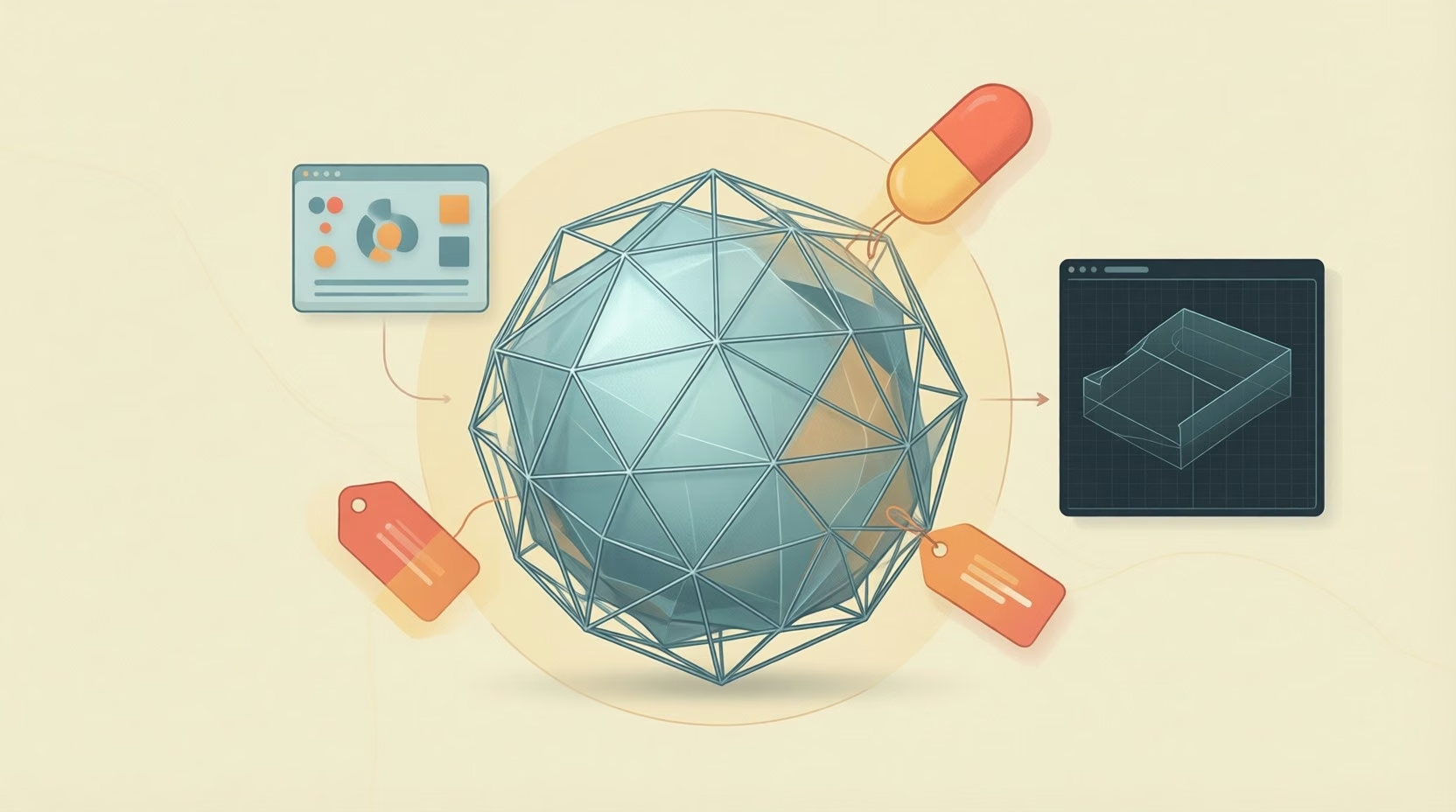
Training also needs a representation of its shape, its contact surfaces and its physical behavior.For physical AI, the data must support interaction as well as perception.Contents3D Geometry and Object StructurePhysical PropertiesSemantic InformationUsing Simulation Data to Train Physical AIWhy Simulation-Ready 3D Data MattersFrequently Asked QuestionsIs a visible 3D mesh enough for physics simulation?Can a robot learn entirely in simulation?Match the Data to the InteractionTraining a robot for physical interaction requires 3D geometry, physical properties and semantic information relevant to the task.Simulation also needs assets that connect visible shapes with collision geometry and physics settings.
These inputs let a training environment represent contact and movement, but successful simulated behavior still needs validation against real-world conditions.Geometry describes shape and the surfaces used for collision.Physical properties describe mass, inertia and contact behavior.Semantic labels identify interaction-relevant attributes.3D Geometry and Object StructureA visible model and a collision model serve different purposes.NVIDIA’s Isaac Sim documentation explains that a robot’s URDF visual tag describes a link’s visible mesh and material.Its collision tag describes the geometry used by the physics engine.
For the box-pushing example, the important distinction is between what the simulator displays and the geometry it uses to calculate contact.Asset structure also affects how that data can be maintained.NVIDIA describes a layered arrangement that shares geometry, materials and metadata while keeping physics-specific data separately configurable.Collision filtering and PhysX joint settings can be edited without changing the base geometry.
Large repositories expand the available shapes.The Objaverse 1.0 paper introduced more than 800,000 3D models with descriptive captions, tags and animations.That provides substantial geometric and visual variety; the dataset’s size alone doesn’t establish that a particular asset contains the physics settings a training task needs.Physical PropertiesShape doesn’t specify mass or inertia.
NVIDIA’s URDF explanation lists both as properties defined for each robot link, alongside visual and collision descriptions.In the hypothetical pushing task, geometry identifies where contact occurs; physical parameters help determine the resulting movement.Those parameters may be generated during asset preparation.Physicl says its processing derives friction, mass and collision properties automatically from raw inputs.
A derived value is an input to the simulation, not proof that the simulated object will behave identically to its real counterpart.More Read How a Specialized Marketing VA Improves Campaign Analytics Gathering Data Can Be Vital for Your Personalized Financial Plan The Profound Impact Of Data Logging On International Logistics Redefining Remote Work and Ensuring Productivity with Big Data How Businesses Are Using AI to Make Smarter, Faster Decisions This limitation affects training directly.A study of simulation-to-real transfer explains that modeling errors can produce strategies that succeed in a simulator but fail on the physical system.An agent can learn the simulator’s particular behavior, including its inaccuracies.
Semantic InformationSemantic information records what an asset or attribute means for interaction.Physicl’s example includes the fields “Graspable: false” and “Interactive: door.” These describe different things: one indicates a graspability attribute, while the other identifies a door interaction.Neither field supplies a mass value or a collision surface.For dataset preparation, the practical question is whether a label expresses the interaction the task needs.
A door label doesn’t itself specify how the door moves.Semantic information supplies meaning; geometry and physical properties supply separate parts of the simulation representation.Using Simulation Data to Train Physical AISimulation starts with assets the environment can use.Isaac Sim accepts robot assets arriving as meshes, STEP files, URDF or MuJoCo XML Format files and imports them into OpenUSD using USD Asset Structure 3.0.
Importing establishes the asset representation before inspection, filtering or tuning; it doesn’t establish that every physical parameter is accurate.Simulation offers abundant training data and alleviates certain safety concerns, according to the dynamics-randomization study.The researchers varied simulator dynamics during training so the learned policies could adapt to different physical behavior.They tested the approach on a robotic-arm object-pushing task.Policies trained exclusively in simulation maintained similar performance on a real robot, moving an object to a target from random initial configurations.
That result supports dynamics randomization for the demonstrated task.It doesn’t establish that any imported asset, or any robot task, will transfer successfully without physical testing.Why Simulation-Ready 3D Data MattersNot every 3D model is useful for training robots.
Large collections like Objaverse offer many shapes and visuals but often lack consistent physical properties needed for simulation.To fill this gap, some companies, such as Physicl, provide 3D assets that include physics data and are ready for simulation.These assets include details like mass, collision meshes, friction values, and semantic labels for graspability and interactivity.
This extra information helps simulated objects behave more like real ones, giving robots better environments to learn physical tasks.Frequently Asked QuestionsIs a visible 3D mesh enough for physics simulation?No.NVIDIA’s URDF documentation distinguishes visible meshes from collision geometry and separately defines mass and inertia for robot links.Appearance alone doesn’t specify those properties.Can a robot learn entirely in simulation?It can for some demonstrated tasks.
The cited object-pushing study transferred simulation-trained policies to a real robot using randomized dynamics.Its result doesn’t guarantee transfer across other tasks.Match the Data to the InteractionStart with one defined action, such as pushing the box.Check that the asset supplies usable contact geometry, relevant physical parameters and meaningful interaction labels.
Then evaluate whether the simulated behavior transfers to the physical task.A complete-looking model and a successful training run answer different questions; neither alone establishes real-world performance.
Read More