Additive friction stir deposition (AFSD) has a lot of promise, but when it comes to expanding its adoption, AFSD also faces even more challenges than does the broader AM industry.Part of this has to do with its lower level of technical maturity compared to technologies like PBF, DED, etc., and part of it has to do with the barriers to adoption.Of course, those two challenges are related.
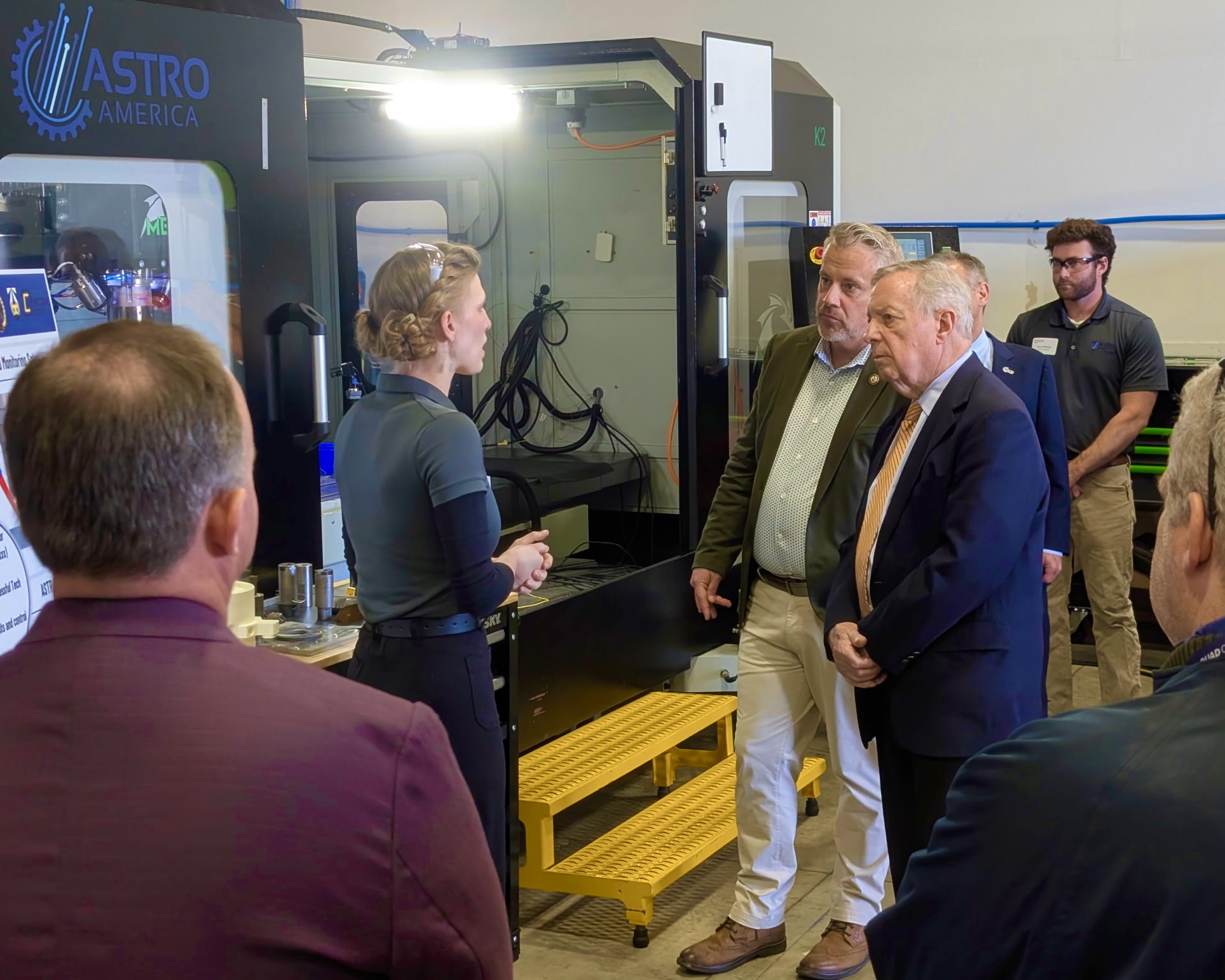
This has opened up an opportunity for the Applied Science and Technology Research Organization (ASTRO) America to, in turn, unlock greater opportunity for US businesses to adopt AFSD.ASTRO just hosted retiring US Senator Dick Durban (D-Illinois) and US Representative Eric Sorensen (IL-17) at its facility in Moline, Illinois, part of the Quad Cities metropolitan area that spans both Iowa and Illinois (Moline is part of Sorensen’s district).In addition to honoring Durban’s decades of public service and highlighting what ASTRO has already done to sow the seeds of AFSD adoption since January 2023, at a 5,500 square foot facility near QC International Airport, the event also celebrated ASTRO’s plans for the future.
L-R: Zak Scott, Advanced Manufacturing Engineer, ASTRO America; Jacob Swanson, Deputy General Manager, ASTRO Midwest; U.S.Sen.Dick Durbin (D-Ill.); U.S.
Rep.Eric Sorensen (IL-17); Neal Orringer, President and CEO, ASTRO America; and Noah Barnhill, Vice President and General Manager, ASTRO Midwest.Thanks to a $20 million investment, ASTRO will open a 25,000 square-foot facility in February of next year.
The Center for Solid State Manufacturing will be in Milan, Illinois, a town neighboring Moline.The major advantage of this particular locale is that it’s close to the US Army’s Rock Island Arsenal, where ASTRO has been managing a $95 million Other Transaction Authority (OTA) Agreement that it was awarded in 2022, centered around the Jointless Hull Large Format Tool.The latter, developed by a team of partners including Illinois-based Ingersoll Machine Tool, has been referred to as “the world’s largest 3D printer” and has been instrumental in stimulating growing interest in the potential of AFSD.
In the next phase of ASTRO’s work surrounding AFSD, the organization will leverage everything that it’s already learned in order to bring AFSD closer to the point where it can be a direct contributor to US military sustainment.ASTRO has already demonstrated that it’s capable of achieving that sort of objective with regard to other AM technologies.It has helped accelerate metal 3D printing adoption in the US southeastern region, in support of increasing domestic production of solid rocket motors (SRMs); it has stood up an advanced manufacturing facility in Guam to enable localized production for US Navy submarines in the Indo-Pacific; and it has launched a unique small business fund that aligns the Pentagon and other US government entities with US businesses and private capital.
US Senator Dick Durban (D-Illinois) This is a formula for building the foundation to revitalize US manufacturing capacity that seems to work quite well, and a big reason for that is that ASTRO is geographically optimized for the strengths of the four regions that it has a presence in thus far (in addition to the Midwest, Southeast, and Guam, the fourth is the Mid-Atlantic region).As I wrote in my second post about AM and US national competitive advantage, industrial clusters are the key to accelerating innovation, and ASTRO has an unusually sophisticated understanding of the relationship between clusters and digital manufacturing ecosystems.The US Army, for instance, needs more organic capacity for producing ground vehicle systems, which explains ASTRO Midwest’s focus on AFSD: the technology is viewed as being especially synergistic with efforts to supplement the US forging and casting supply chains, a necessity in order to revive the domestic US auto industry.
Similarly, in Florida, a hub for aerospace/defense and the commercial space industry, ASTRO Southeast focuses on applications relevant to US hypersonic goals.As I explained in my post on industrial clusters, a broad push for reshoring can only succeed if it’s tailored to drawing upon the geographically-defined remaining pockets of strength comprising the US manufacturing sector.Other industries hoping to emulate how the US defense sector is using AM and other advanced manufacturing processes to bring their manufacturing supply chains closer to the customer should pay attention to what ASTRO is doing.
Every country that’s aiming to reshore needs something along the lines of an ASTRO, and the US could use one such organization for each of the main sectors that are part of its reshoring goals: one for energy, one for semiconductors, one for medical, etc.Outside of the US, Mobility goes Additive (MgA) is a good example of another organization which has been doing similar work over an even longer timeframe than ASTRO.If you want to get started learning about MgA, Joris Peels just wrote about attending their 10th annual meeting.
AFSD is precisely the sort of technology whose path to commercialization requires joint action by public and private interests.This isn’t about getting government to throw money at a problem: rather, it’s about soliciting comprehensive input from private industry on the challenges it’s facing, maintaining channels that enable constant feedback which allow public sector customers to keep pace with technological change, and filling the gaps in R&D funding that need to be filled in order for a national industry to remain competitive.If ASTRO keeps up its momentum, we shouldn’t be surprised to see AFSD start to become a viable option for manufacturers in the years ahead.
Images courtesy of ASTRO America Subscribe to Our Email Newsletter Stay up-to-date on all the latest news from the 3D printing industry and receive information and offers from third party vendors.Print Services Upload your 3D Models and get them printed quickly and efficiently.Powered by FacFox Powered by 3D Systems Powered by Craftcloud Powered by First Mold Powered by Xometry 3DPrinting Business Directory 3DPrinting Business Directory
Read More