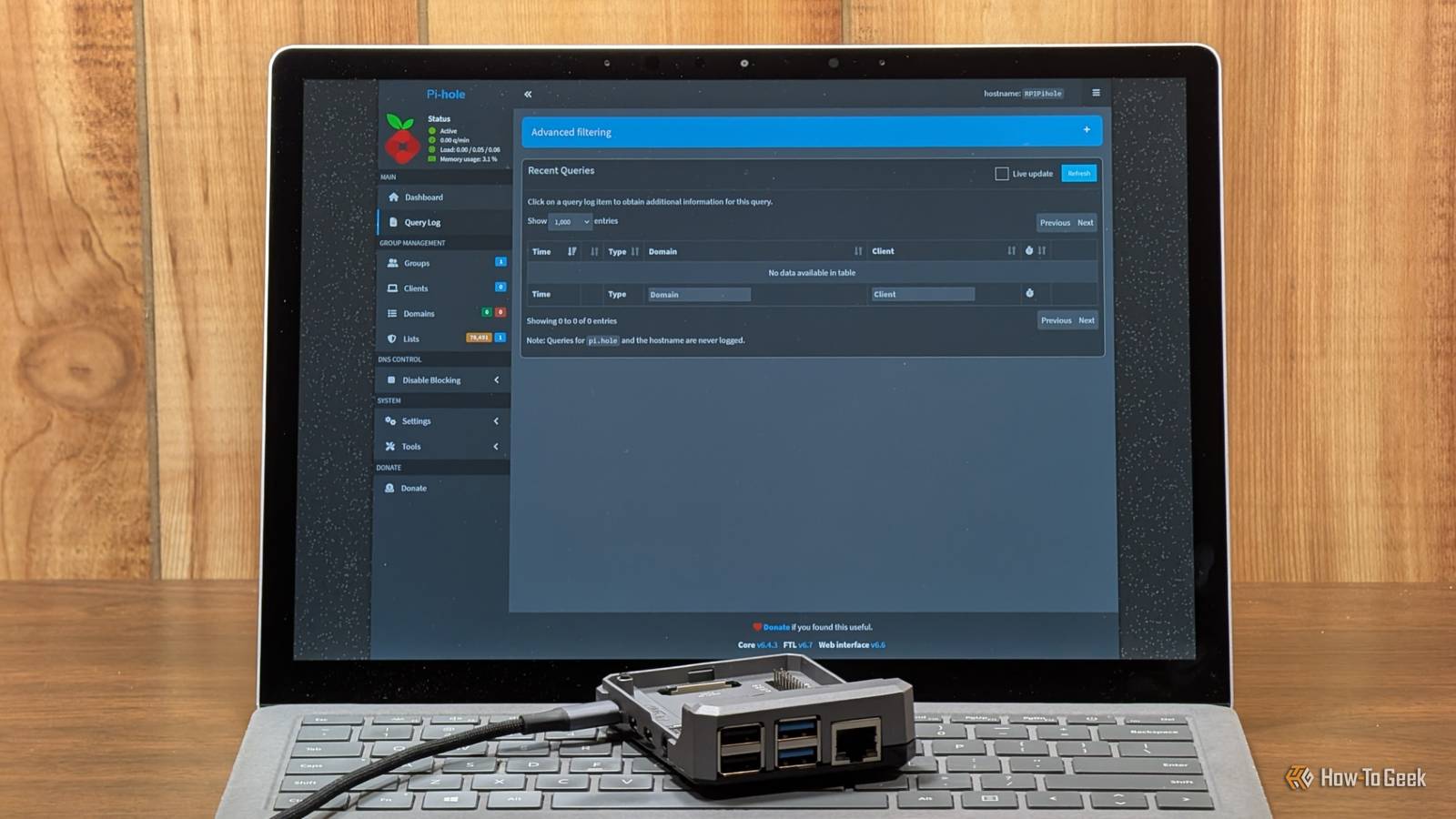
You might have deployed Pi-hole to stop all tracking on your network, but it actually can't do that.Pi-hole is a fantastic tool, and it can definitely block trackers from working on your network, but it's not a perfect solution—here's why.Pi-hole only decides which domains your devices can reach Pi-hole doesn't actually know what your devices are sending to those domains Some people think that Pi-hole is a magical blocking system that just blocks anything and everything bad—and it be that to an extent, but not out of the gate.
You see, Pi-hole only blocks things at a DNS level that it's told to block.So, if there's an ad network or tracker that is using a domain not in the Pi-hole block list, then that ad or tracker will get through.Not only that, but Pi-hole doesn't actually know what information devices are sending to and from a domain.
So, maybe there's a smart device in your home that's making tons of calls to a server.Are those calls bad? Pi-hole doesn't know.All it knows is "The device at 192.168.0.192 made 423,000 DNS calls today." It has no idea what those calls consisted of, what content was received or transmitted, or why the calls were made.
At its core, Pi-hole is primarily an allow or deny list that your network uses to determine if a domain should or should not be reachable.Related I ditched Google's DNS for a $20 Raspberry Pi, and I stopped handing my web history to third parties You don't need Google's 8.8.8.8: how to build a private DNS server for $20 Posts 12 By Nick Lewis Not all tracking uses a separate tracking domain Sometimes it's not possible to block tracking With Google and many other services, tracking is done through dedicated tracking domains or subdomains.This is convenient if you've set up a Pi-Hole, because you can block Google trackers without blocking Google itself.
However, some services don't separate trackers from the actual service.This means that you either let the trackers through, or you block the service entirely.YouTube is somewhat like that.
A lot of block lists for YouTube will actually stop portions of YouTube from functioning.When I first deployed Pi-hole, my YouTube watch history stopped updating until I made some very specific changes to my Pi-hole setup.Other times, tracking is a fundamental part of the workflow of a platform, and you simply can't block it still use the platform.
In the scenario above, YouTube still worked, it's just certain parts of it didn't.However, when I was working on building my SaaS and integrating PostHog, I had a lot of issues because Pi-hole was blocking core PostHog functionality from my network.This blocked tracking, which I was fine with, but it also blocked me from accessing PostHog itself.
I eventually decided to unblock PostHog so I could continue my development.I know, I was blocking a service I planned on using, but that's just how it goes sometimes.Analytics are crucial when building online tools in 2026, like it or not.
Some devices could be configured to bypass Pi-hole entirely A manufacturer can hard-code DNS servers into the device's firmware Pi-hole only functions when a device uses it for its DNS server.I run Pi-hole on my network as the exclusive DNS server on my router.However, I can set the DNS servers on my MacBook to 1.1.1.1 or 8.8.8.8 and bypass Pi-hole entirely.
This same principle can be applied to other devices on your network.While rarer, it is entirely possible for a manufacturer to hard-code a specific DNS server into their device's firmware so the device always uses that server, not your router-provided DNS.Doing this means that the device will essentially bypass Pi-hole entirely on your network, so any block lists you might have on the network simply won't apply to that device.
Pi-hole isn't the end-all be-all privacy layer many think it is It's just one piece of a very big puzzle Close Pi-hole is a fantastic starter project for network privacy, but it's not the end-all be-all security tool that everyone thinks it is.Pi-hole is easy to bypass on a network, and it's only the beginning layer of security.A well-configured firewall is far more protective than Pi-hole is, but it's much more difficult to set up.
A firewall is truly one of the best ways to protect your network, as nothing can conceivably bypass it on the network like can be done with Pi-hole.But, if you're looking for a good beginner project, start with Pi-hole before diving into a fully configured firewall.It'll save you a lot of headache and teach you a lot along the way.
Deploying Pi-hole is just the start I ran Pi-hole long before I got a network with a proper firewall.Now that I have a network with a proper firewall, I've still yet to set it up.Firewalls can really complicate things, but Pi-hole is simple and easy to use.
So, on my network, Pi-hole is my main blocking source.I know it's not perfect, but it's what I have and I'm okay with it.
Read More