One of the best vehicles I ever drove was my 2016 Fiat 500X, a small and spartan crossover built on the Jeep Renegade platform.The 2.4-liter Tigershark MultiAir engine and nine-speed automatic were an efficient combination, a nice perk for some of the longer highway drives I was taking back then.I had my 500X during my time on FCA’s (before Stellantis) national auto show team, where I traveled city to city with my colleagues to represent the brands, including Fiat, at auto shows across the country.
During my auto show days, we had what were called “Fiat Up” markets, a fancy way to say auto shows in areas of the country where Fiat had a stronger presence.For example, the Orlando and Tampa auto shows were deemed “Fiat Up” markets because convertibles like the 124 Spider were a natural fit for Florida weather.In our auto show lineup, we didn’t include the Fiat 500L because it was the least popular.
It also wasn’t the best-looking vehicle either.But that would pale in comparison to an attendee I was speaking with at the Jacksonville International Auto Show in February 2017, who pulled out his phone, scrolled to his photos, and exclaimed: “Get a load of this Fiat!” That Fiat I was to get a load of? The notorious Multipla.The first Fiat Multipla Not the ugly one The original Fiat Multipla was based on the 1955 rear-engine 600, one of the now-famous tiny cars that paved the way for widespread vehicle ownership across Europe following World War II.
As the name implied, the Multipla was the “multi-purpose version,” debuting at the Brussels Motor Show in January 1956.While it had the same 21.5-horsepower four-cylinder as the 600 sedan, the Multipla resembled a minivan with its three rows and seating for up to six.Advertisements at the time showcased it as the ideal family vehicle for picnics and camping.
But that’s not the “ugly” Multipla, the one that sometimes gets described as a carnival funhouse on wheels.The unsightly one is the version manufactured between 1998 and 2010.While the Multipla received a redesign in 2004 with more traditional styling, it’s still at the center of debates over the ugliest cars of all time.
13 feet and six adults An accidental icon is born The new Multipla was to retain the pragmatic flair of the original 1956 version, albeit under an ambitious objective.Fiat’s then-managing director, Paolo Cantarella, gave the design team a nearly impossible brief as more European families embraced the idea of a minivan: create something that could fit six adults and their luggage with a footprint no longer than four meters, or about 13 feet.To compare, the five-passenger 2026 Toyota RAV4 is about 15 feet long.
The 2026 Subaru Forester Hybrid, which also seats five, is just over 15 feet long.A somewhat larger example is the 2027 Kia Telluride, which can seat seven with second-row captain's chairs.It’s 16.6 feet long.
For the Fiat Multipla, the task was to essentially do more with less room.To achieve this, designer Roberto Giolito and his team abandoned the traditional 2+2+2 seating layout (two seats in three rows, common in modern six-seat SUVs).Fiat designers needed to focus on width rather than length in order to maximize space.
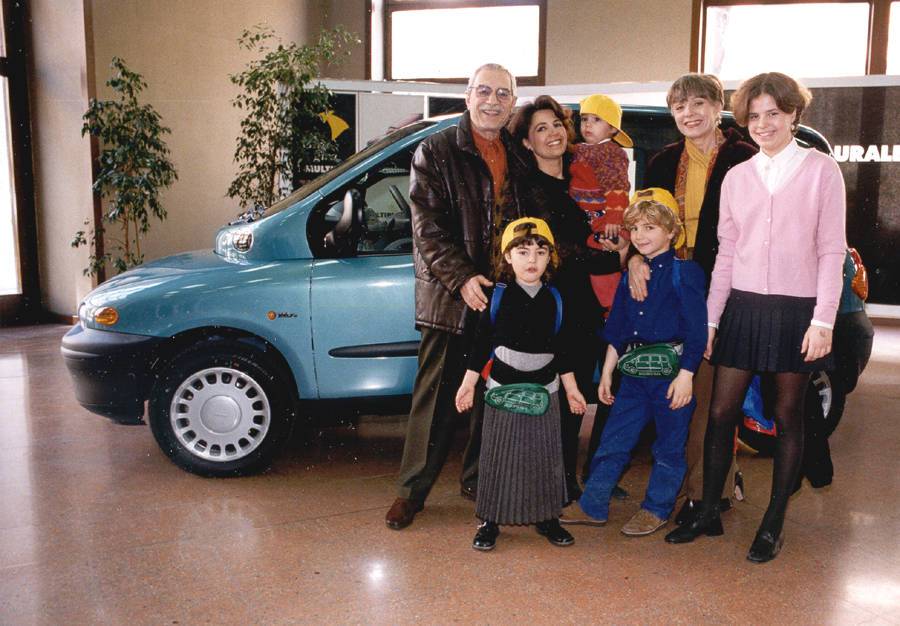
At just over six feet (73.7 inches) wide, the Multipla was significantly broader than a Renault Scenic or even a BMW 7 Series of the same era.This enabled the Multipla’s 3+3 seating arrangement, with three seats across the front and three in the back.Stellantis Heritage created the Fiat Multipla 6x6 in 2023 to celebrate the vehicle's 25th anniversary, a unique one-off designed by Giolito in honor of the original 1998 model.
The 6x6 name doesn't refer to six-wheel drive, but rather to six distinct characters drawn by Giolito in 1998 to illustrate how the Multipla could accommodate a number of passengers and their personalities.The Explorer/Driver: Leading the group.The Child: Dreaming of racing in the front center seat.
The Attractive Woman: Applying makeup while on the go.The Manager: Working on a laptop to meet a deadline.The Monk: Engaged in spiritual reading for further enlightenment.
The Rebel: 1970s-era hippie relaxing in the back.Regardless of who was sitting where, the near-perpendicular side glass was chosen to help the Multipla feel less claustrophobic, especially for longer trips.Even the infamous split-headlight cluster was an ergonomic and safety-centric solution, despite it looking like an arrangement of six eyeballs, seven if you count the upper center Fiat logo.
In terms of safety, the combined upper and lower lights provided maximum illumination at a distance at night, while still illuminating the immediate area ahead of the vehicle.In terms of ergonomics, the headlight arrangement was a clever way to bypass a traditional hood, which the design team determined would have restricted passenger space.Related Before touchscreens became the standard, BMW, Saab, and Lexus got it right Better than a generic tablet glued to the dashboard.
Posts By Carl Anthony Blank and flexible canvas Flat load floor increased utility Minivans, or vehicles styled like them, are often on the receiving end of jokes, and the Fiat Multipla certainly lends itself to Rodney Dangerfield-style quips and one-liners.However, the Multipla's award-winning technical innovations are there, hidden under that face only a mother could love.The Multipla used a high-strength steel space-frame structure, allowing for a completely flat floor.
Since it lacked a traditional center console and transmission tunnel, the interior was effectively a blank canvas.This type of design layout and the idea of a flat floor (sometimes called a “flat load floor” in automotive industry parlance) are selling points for consumers.Crewcab trucks and SUVs with a rear flat load floor offer more cargo space and easier storage of that cargo while traveling.
In a similar vein, a flat floor design is often more comfortable for rear seat passengers.With the Fiat Multipla, you could expand the total cargo space to 67 cubic feet by removing the rear seats, a generous figure given the Multipla’s smaller stature.Behind the rear seats, the Multipla offered 15.2 cubic feet of space.
The 2026 Hyundai Venue is roughly the same length as the Fiat Multipla, at a little over 13 feet.By comparison, the 2026 Venue offers 18.7 cubic feet of space with the rear seats upright and 31.9 cubic feet with them folded down.Granted, with modern-day crossovers, you don’t remove the rear seats, and the Multipla did have a height advantage over the Venue (67.5 inches to 61.6 inches), but it underscores just how much the tiny Multipla could offer in terms of flexible cargo space.
Meanwhile, the front-middle seat, set back slightly to accommodate the center console, was an obvious place for children to plop down (like we did growing up in the Midwest with regular-cab trucks that had bench seats).Given the Multipla’s family hauling intentions, the placement of the front-middle seat was likely a good marketing angle at the time.Buyers had two primary four-cylinder powertrain options: a 1.6-liter 16-valve gasoline engine with 105 horsepower and 109 lb-ft.
of torque or a 1.9-liter JTD turbo-diesel delivering 104 horsepower and 148 lb-ft.of torque at 1,500 rpm.The Multipla included in this exhibition is a bipower-engine type that uses regular gasoline or methane or both.
Methane fuel produces no benzene or particle emissions and reduces carbon dioxide emission by twenty-five percent.The same engine runs on both fuels with two separate tanks and separate routing systems.The driver can switch between methane and gasoline, but the car also does it automatically in cold starts or when the methane has run out.
~ The Museum of Modern Art, New York, Different Roads: Automobiles for the Next Century exhibition, 1999.Psychotic cartoon duck Cult status earned During its production run from 1998 to 2010, over 400,000 Multipla minivans were produced.Its first two years on the market were its best for sales, followed by a drop-off throughout the early 2000s.
Although the Multipla did well enough in Italy, the wider European car-buying public didn't embrace it.Subscribe to our newsletter for bold car stories Discover more automotive oddities and design lessons—subscribe to our newsletter for in-depth features on bold car design, engineering trade-offs, and the stories behind cult classics like the Fiat Multipla.Get Updates By subscribing, you agree to receive newsletter and marketing emails, and accept our Terms of Use and Privacy Policy.
You can unsubscribe anytime.As seen in the gallery above, Fiat eventually reworked the design in 2004 in favor of a more conventional, if not boring, look.There was another small sales spike in 2004 following the redesign, but it wasn’t enough to sway a wider audience.
And it’s in this way the Multipla will forever receive criticism on two fronts: one for styling once likened to a psychotic cartoon duck, and second for not being committed to something people may have eventually warmed up to.As some enthusiasts have noted about the 2004 redesign, the Multipla only became ugly once it tried so hard not to be; once its peculiar, unapologetic quirks were tamed, any allure it had was lost.Yet, the Multipla didn't fade away, despite being a frequent flyer on "ugliest car" lists.
Instead, it became a cult classic within the automotive world, a four-wheeled version of or for collectors and enthusiasts.The Multipla’s presence in the Museum of Modern Art’s Different Roads exhibition in 1999 cemented its future status as an important, even if polarizing, piece of industrial and automotive art.What the Fiat Multipla shows us today While the Multipla’s design can be an easy target, the copy-paste SUV and crossover formula of today deserves equal criticism.
At least the Multipla isn’t that.It would stand out in a crowded grocery store parking lot against a sea of nondescript SUVs.While Fiat may have its struggles (i.e., “Fix It Again, Tony”), it’s one of the world’s longest-standing automakers, having its articles of association filed on July 11th, 1899, in Turin for the Società Anonima Fabbrica Italiana di Automobili—Torino.
The 500 city car was instrumental for the European economy following World War II, its minimalist styling gaining international acclaim.At the 2025 Detroit Auto Show, one of the most unique vehicles on display was a 1962 Fiat 500, featuring a front-end logo inspired by historic Italian architecture.The Multipla serves as a reminder that bold experimentation is sometimes the cost of true innovation.
It shows that supposed failures can achieve a legendary status.True, automakers should not produce cars with such outlandish and over-the-top designs, but more should embrace the blatant and unconcealed faculty that gave the Multipla its lasting signature.Sometimes, it’s better to be remembered, even if it’s for being an odd duck, than to be invisible.
Odd duck the Multipla is.Invisible it is not.
Read More