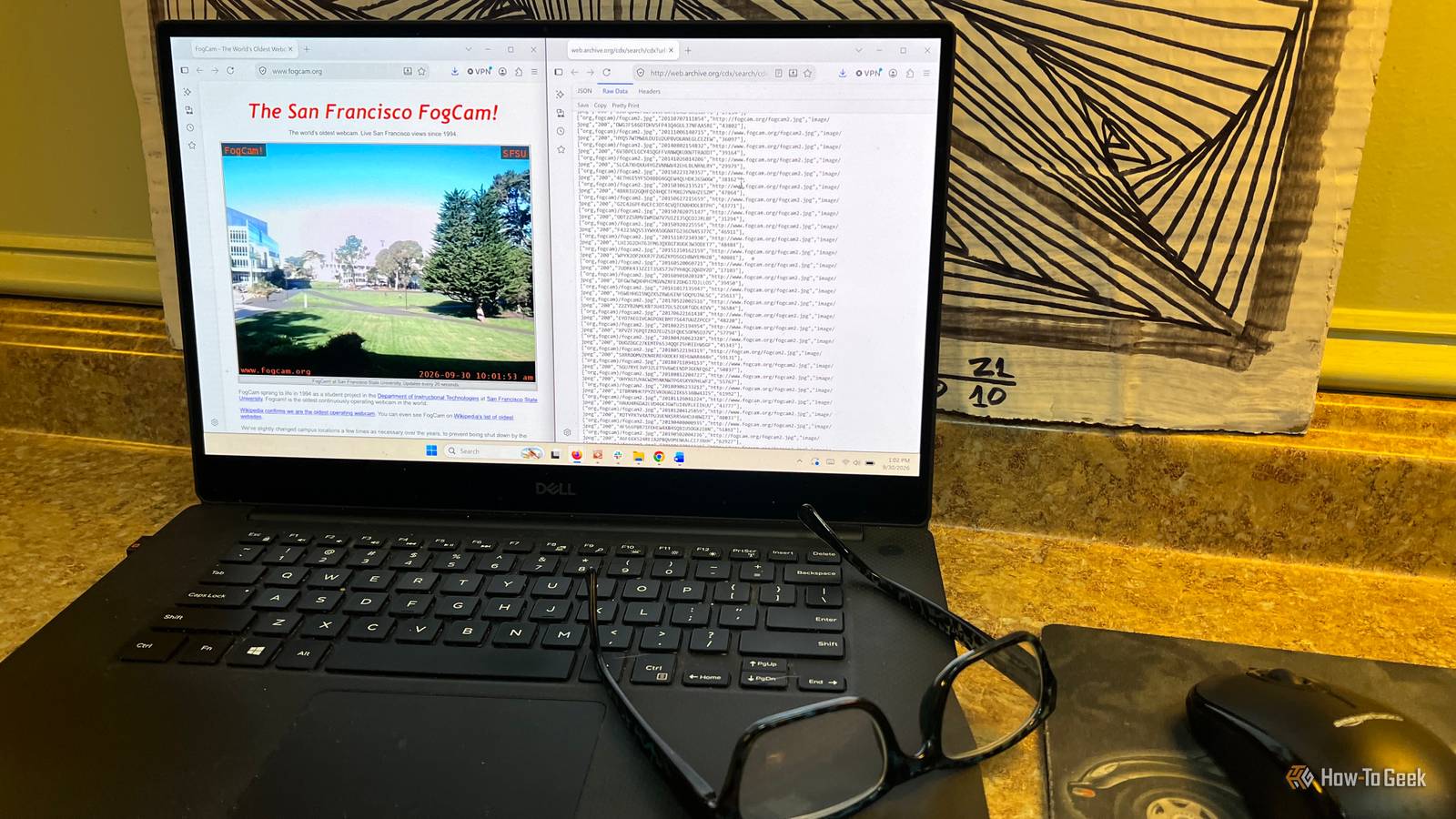
FogCam is a long-running project at San Francisco State University.It began in 1994 and has shown live views from different parts of the campus over the years.What makes it special is that it’s the world's oldest continuously operating webcam.
Now you'd think having a webcam running for decades would create a giant visual record of the campus, but that's not the case.Unlike a security camera or photo archive, FogCam mainly serves up the current image, overwriting the previous one each time it updates.This explains why neither the project creators nor San Francisco State University preserved a complete visual history.
So essentially, unless someone saved a copy of the image, all the previous frames were effectively lost.Or so it was thought...The Wayback Machine saved photos FogCam itself didn’t The crawler sometimes captured the image itself For those of you who aren't familiar with it, the Internet Archive is a site that crawls websites across the web and saves snapshots of pages and files it encounters.
FogCam was no different.Over the years, the archive captured snapshots from the FogCam website along with the actual image being served at the moment.Those images and captures weren't just sitting there in a pretty archive ready to be viewed.
Instead, they were scattered across the calendar within the Wayback Machine.It's also worth mentioning that not every image was saved because that's not what the Internet Archive does.Sometimes those images were just duplicates from the last time the site was crawled.
The thing to think about here is that these images survived independently of the live FogCam page, and while they weren't just sitting there for someone to click through, all someone had to do was search the Internet Archive’s underlying index.One intrepid Redditor searched the Internet Archive’s index for every surviving image The CDX index exposed the captures one by one The underpinnings of the Wayback Machine are an index of pages and files that were captured by its crawlers.This index is known as the CDX index, and it records details such as the URL, capture time, file type, status code, and file digest.
Instead of browsing archived pages through the Wayback Machine one at a time, you can search the CDX for a specific file.That's exactly what one Redditor did with FogCam.They searched the CDX index for fogcam2.jpg to find every archived copy the Internet Archive had recorded.
The results listed archived images from across the years.These results didn't require clicking through the Wayback Machine manually.It was just raw data showing each instance where fogcam2.jpg was archived.
Once the timestamps were visible, anyone could open the archived JPEGs directly and start piecing together FogCam’s surviving visual history.They recovered 85 snapshots spanning 21 years The surviving frames turned into a visual timeline Close After removing all the duplicate captures, the Redditor was left with 85 unique FogCam images.Those surviving frames reached from October 2005 all the way through June 2026, covering nearly 21 years at San Francisco State University.
It's clearly not a complete record, but it's enough to show pieces of FogCam's history that otherwise seemed lost in time.Some years are represented by only a few captures, while later years have many more.It doesn’t feel like a traditional photo archive where everything is neatly organized by date.
Instead, it feels more like someone found a box of old snapshots with pieces missing in between.The images also show how FogCam itself changed over the years.As the camera moved to different locations around the San Francisco State campus, the view changed with it.
That keeps the collection from being dozens of identical webcam shots.Looking through the surviving frames, you get little glimpses of the campus at different points in time rather than one unchanging image.The same technique can uncover other lost web files I tried the same search on another constantly changing image FogCam isn’t the only webcam that keeps updating the same image file.
The USGS Shishaldin volcano webcam, for example, serves its latest image as a file called current.jpg.Every time the webcam updates, that same file name points to a new image.The screenshot here shows the current Shishaldin view, but older versions may still exist in the Internet Archive if its crawler happened to capture that URL at different times.
That’s where the CDX index becomes useful.Instead of looking for an old webpage, you can search for the exact current.jpg file and see whether the Wayback Machine saved earlier versions of it.The same idea can work with images, PDFs, downloads, or other files that were repeatedly replaced at the same URL, which makes CDX useful for finding things that appear to have vanished from the modern web.
The web forgets less than it seems What I like about this is that the FogCam photos are really just one example of what might still be hiding inside the Wayback Machine.The CDX index gives you another way to look for files that seem long gone, especially when a site keeps replacing the same image, document, or download at one URL.You may not find everything, but sometimes a file that looks lost to time is still sitting in the archive waiting for someone to know where to look.
Read More