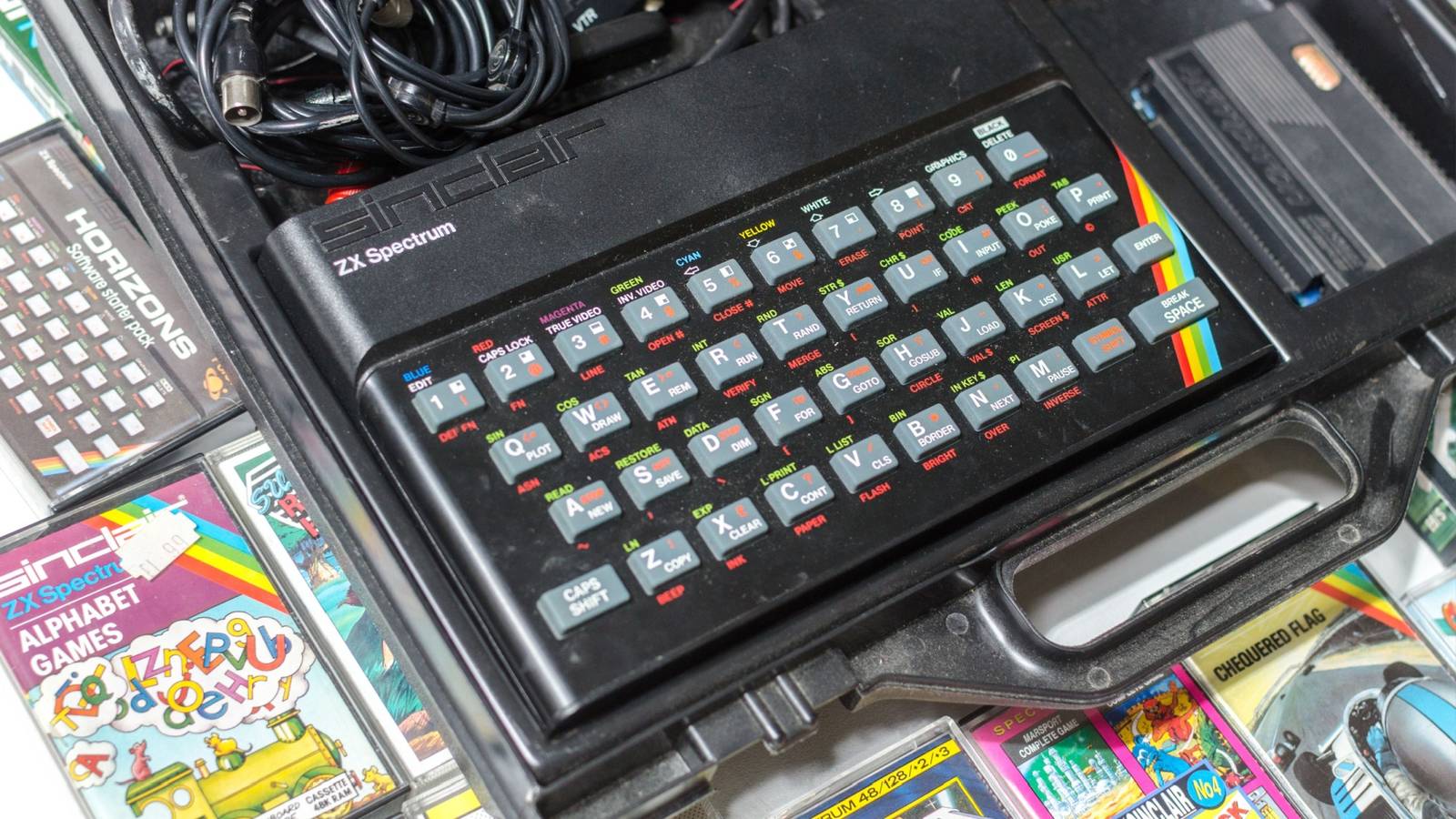
There was a time when saving a computer program sounded like a modem arguing with a fax machine.Before floppy drives were crunching and grinding away in our homes, the humble cassette was an affordable and effective way to sell, store, and record data.When “storage” literally sounded like storage One of the very first computers I ever encountered in my life was my uncle's ZX Spectrum.
I clearly remember watching him play video games, but mostly I remember how long it took to load up even a single simple game.He'd insert a game cassette, type in a "load" command and then press play.In what seemed like an age later, the game would be ready to go, and he'd spend a few hours watching pixelated blobs bleep and bloop across the screen.
Data you could hear, rewind, and fast-forward These were just standard audio cassettes.If you pop it into a cassette deck, you should hear a hiss of rising and falling tones.A little like the noise and old-school modem makes.
In the end, any medium that holds digital data simply needs to represent ones and zeros somehow.On a CD there are pits and lands, on a hard drive platter there are magnetic fields of varying strengths, and on an SSD there are memory cells that have trapped charges representing digital bits.If you wrote a program in a language like BASIC and saved it to a tape, it felt pretty much the same as recording music from the radio or dubbing from another tape.
Even better, if you were lucky enough, you could dub a tape and make a copy of it.Wait, wouldn't that make piracy super easy? Yes! But, of course, software developers came up with all sorts of ways to prevent this, usually by creating elaborate codebooks that can't be photocopied.The thing is, although the data on the tape was digital, the medium was analog.
It was a sound wave on a reel of tape.When things went wrong, the fix felt like sorting out issues with an analog audio system rather than a digital computer.Maybe the volume wasn't turned up enough, or your tape heads needed cleaning, or the tape itself has become stretched, and now the data are distorted.
Cassette storage is mechanical, fragile, and very different in vibe to a floppy disk, much less a modern SSD with its trillions of microscopic transistors.Magazines as software distribution platforms I have fond memories of getting floppies or CDs with my computer or gaming magazines over the years.PlayStation demo discs, PC magazine discs with free software.
It was awesome.But, in the early days of home computers, this wasn't the only way to distribute software.Instead, a magazine could simply print the code for an application or video game on its own pages.
The programs of the time were small enough to fit on a few pages of a magazine, especially if you made the print tiny and packed in lots of columns.I guess spending an hour or two painstakingly typing in computer code was a fun way to pass the time.When you were done, unless you felt like doing it all over again, you could save the code to a blank cassette.
Error correction was human-powered One neat thing about the source code for a program being given away in the pages of a magazine was that you would learn something about programming even if you didn't want to.I remember my dad buying me a book of BASIC games that I had to copy over to our IBM PC clone, and it soon occurred to me that I could just change the code to make the game behave differently, or to cheat.Subscribe to our newsletter for retro computing insights Explore more by subscribing to the newsletter for deeper dives into the era of cassettes, magazine-printed code, and early storage tech—stories, preservation tips, decoding tricks, and context that bring retro computing history to life.
Get Updates By subscribing, you agree to receive newsletter and marketing emails, and accept our Terms of Use and Privacy Policy.You can unsubscribe anytime.Sometimes, if you make a mistake, debugging will teach you something as well, but in some cases even copying the code perfectly didn't work.
Yes, there were misprints and errors too, so a future issue might have a correction, or someone in the community (even yourself) would find the problem and simply fix it.Early digital storage felt more “analog” than today Thinking back to a time of which I personally only experienced the end days, it seems that the line between analog and digital wasn't quite so clear as it is now.The computer was digital at its core, but everything about it, the controllers, the tape deck, and, of course, the CRT screen was analog.
Your software came as sound waves or as dots of ink on paper, and working with that data felt less like the future and more like being a sound engineer or copying someone else's homework.At least you don't have to manually type in the code for games today.Heck, even a (by today's standards) "simple" game like has tens of thousands of lines of code.
That's a of magazines.
Read More