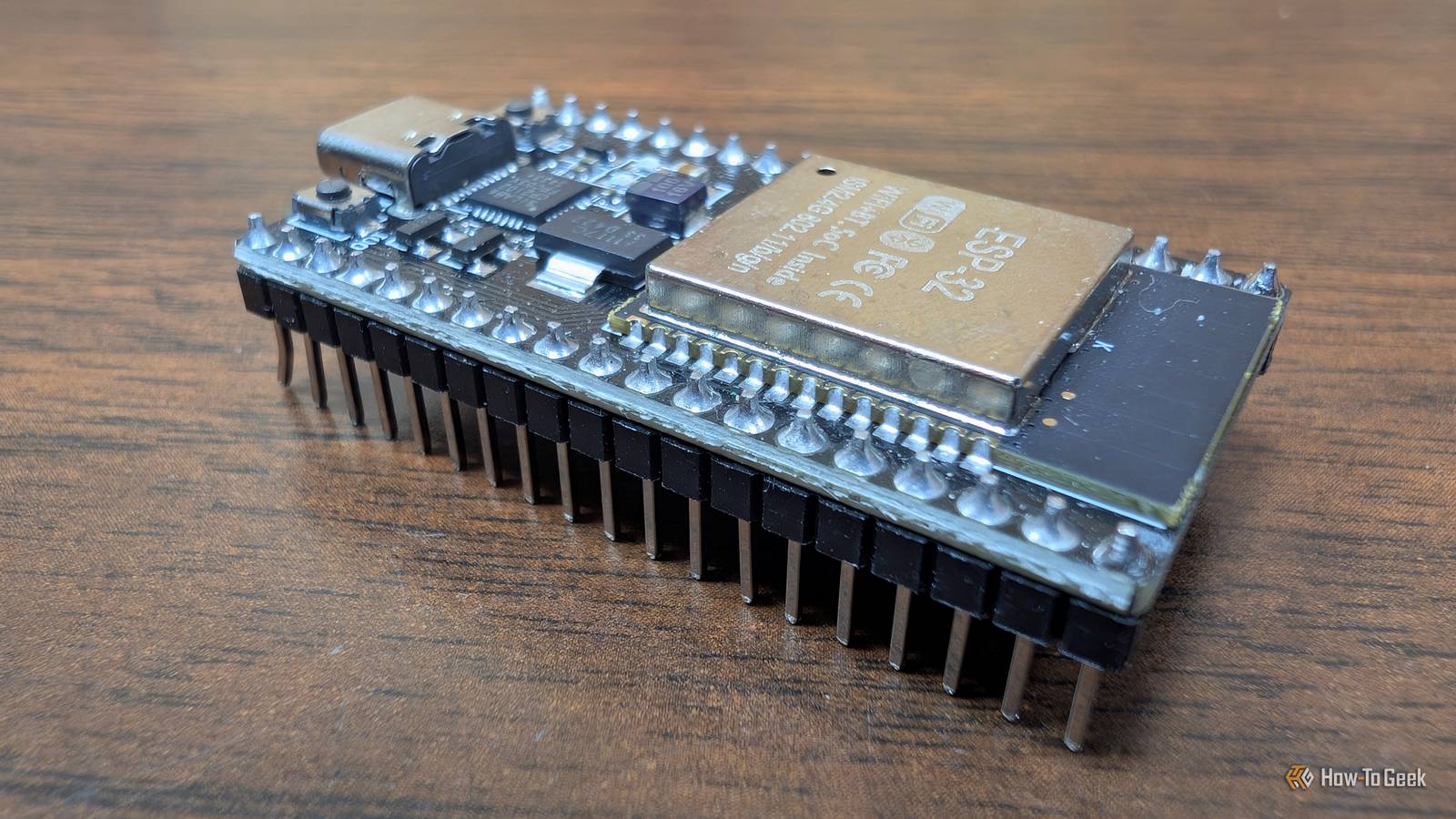
An ESP32 development board can cost just a few dollars, making it a popular choice for DIY projects such as building your own smart home devices.The cost of the ESP32 itself doesn't tell the whole story, however.There are often additional costs that can be easy to forget.
Add How-To Geek on Google Add as Preferred Source Follow on Google Discover USB cables and power supplies An ESP32 can't do anything without electricity An ESP32 on its own can't do anything; it needs power in order to work.All you need is a power adapter and a USB cable.When I bought my first few ESP32 devices to set up as Bluetooth proxies, I managed to find enough old power adapters and USB cables for my needs, but as I added more ESP32 devices, I eventually started to run out.
I've reached the point where all my spare adapters and cables have been put to use.This means each time I buy a new ESP32 board I also need to buy something to power it with.It's also important to check what USB connector your ESP32 uses; some cheap boards still use Micro-USB while others use USB-C.
Related Here's how I build my own smart home devices without writing a single line of code ESPHome sweet ESPHome.Posts By Adam Davidson The sensors that make ESP32 projects useful An ESP32 can only do so much on its own Close There are several things you can do with an ESP32 without buying any additional hardware.The Bluetooth proxies that were the first ESP32 project I set up use the ESP32's onboard Wi-Fi and Bluetooth, so no other hardware is required other than the power accessories already discussed.
That's not true for every ESP32 project, however.The beauty of ESP32 boards is that you can connect a whole array of sensors and more to them, to build your own custom devices.Some of these sensors can be fairly cheap, but others are definitely not.
For example, I bought some cheap soil moisture sensors and connected them to some ESP32s to alert me when my plants need watering.The sensors were only a few dollars each.If you want to build a reasonably accurate air quality monitor, however, then the sensors you need will end up costing far more than the ESP32 that you hook them up to.
Breadboards, jumper wires, and other components You need a lot of things to connect two things esp You can buy an ESP32 board and a sensor, but that's still not enough to create a working device.You need some way to connect them.For my soil moisture sensors, for example, I needed jumper wires to connect the sensors to the pins of the ESP32.
A breadboard is an easy way to experiment with building an ESP32 device without the need for any soldering.It's a reusable board with metal connectors built into it.You can push wires from your sensor into the holes of the breadboard and then connect the breadboard to the ESP32 to test how it works.
Breadboards and wires aren't expensive at all, but they're products that are easy to overlook.This means that the cost of everything you need to build your project may be a little higher than you thought.Cases and mounting hardware Bare boards aren't ideal ESP32 boards are a lot of things, but beautiful isn't one of them.
I still have some Bluetooth proxies around my home that are bare boards with power cables hanging out of the back of them, and my wife is not happy about it at all.Exposed electronics are also vulnerable to accidental damage.Leaving a lot of bare boards around your home just isn't the best idea.
The best course of action is to put the boards in some kind of enclosure.If you have a 3D printer, you can print your own enclosures for your specific boards and projects, although you'll then need to factor in the cost of filament.If you don't have a 3D printer, you can buy project boxes online that will do the job.
You also need to consider other hardware such as screws, spacers, brackets, adhesive strips, and other tools to mount your devices or keep them in place.Again, the costs aren't huge, but they all add up.Soldering equipment and other tools Not every project can use plug-in connections One of the reasons why people are put off experimenting with ESP32 boards is because they assume that there will be a lot of soldering involved.
To the uninitiated, this can seem like something that is far too complicated to take on.However, there are a lot of ESP32 projects that you can do without needing to touch a soldering iron.Eventually, you may want to build a project that involves soldering components.
It's a useful skill to have, and it's not as scary as it can seem at first.If you do decide to try soldering, then you'll need to invest in a soldering iron, solder, and you may need to get hold of other accessories such as a stand, solder wick, wire strippers, a multimeter, and more.These tools can serve you well, but the initial cost can end up setting you back much more than the ESP32 board you're using for your project.
Cheap boards don't always mean cheap projects ESP32 boards are great for projects precisely because they cost so little.However, you may find that the cheap board is a fraction of the final cost of your project.It's always worth factoring in the other costs before you start.
Read More