Last year, Autonomous Resource Corporation (ARC) became the surprising owner of Desktop Metal’s (DM’s) assets following the bankruptcy of the one-time additive manufacturing (AM) unicorn, an acquisition that cost ARC just $7 million.ARC announced a grand vision behind its plans for the salvaged IP, aiming to rebuild DM’s core tech into the basis for R&D as a service and contract manufacturing work.The even grander vision behind that project is ARC’s development of ARCNet—what the company calls “The Operating System for Autonomous Distributed Manufacturing”—and an AI model called ADAM (Autonomous Discovery and Advanced Manufacturing), which learns from the data ARCNet generates.
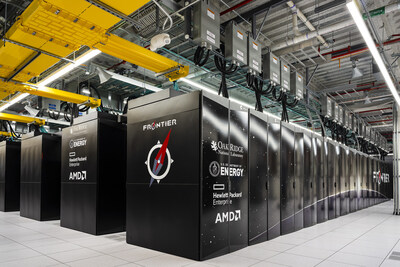
With such ambitious aims in mind, ARC would presumably need access to rare infrastructure in order to deliver the goods; like, say, the sort of world-class supercomputer one could only find at a US national laboratory.It turns out that’s precisely what ARC now has access to, thanks to a partnership with Oak Ridge National Laboratory (ORNL) that the company just announced, in a project called Exascale Foundry.Through the partnership, ARC gains access to ORNL’s Peregrine AI software, which will be integrated with ARC’s production nodes via ARCNet.
ARC will also have access to tech developed at ORNL’s Manufacturing Demonstration Facility (MDF), a unique capability of the US Department of Energy (DOE) designed to accelerate qualification of materials critical to defense supply chains.Along those lines, the first research project for Exascale Foundry surrounds high-temperature nickel superalloys used in binder jetting of turbine components for autonomous aerospace engines.In a press release about ARC’s partnership with ORNL on the Exascale Foundry project, the associate laboratory director for National Security Sciences at ORNL, Moe Khaleel, said, “ORNL’s advanced manufacturing and computing capabilities are uniquely positioned to help accelerate the transition of laboratory-proven technologies into production-scale defense manufacturing.
Partnering with ARC ensures we are transitioning our research into real production outcomes.” Bryan Wisk, CEO of ARC, said, “The United States faces an urgent need to rebuild its manufacturing capacity for critical defense components.By combining ORNL’s world-leading computational, materials science, and manufacturing capabilities with our autonomous production infrastructure, we can compress manufacturing and qualification timelines from years to months and deliver manufactured parts at the volumes the warfighter needs.” ORNL’s MedUSA wire-arc additive manufacturing machine.I’ve been writing for years about how public-private partnerships are the future of the AM industry, and in fact, such partnerships seem to be the basis for the future of the entire global economy.
As this example of a public-private partnership illustrates, AI is among a handful of the most important drivers of that state-of-affairs.Building national AI ecosystems and, ultimately, a global AI ecosystem, is such a capital-intensive task that enterprises or governments acting individually could never hope to accomplish it.Additionally, the social implications of a world run by AI-powered operating systems have such potential for widespread disruption that the shift calls for unprecedented acts of cooperation between governments and corporations, and between various public-private alliances.
There isn’t really a good model to turn to in order to figure out how to do all this.Interestingly, given the involvement of ORNL in the current topic of discussion, the Manhattan Project is probably the closest historical precursor, but the analogy falls apart here as well, because of the shift in relative power dynamics between the government and private industry in the post-WW2 era.(That is, the government was much more powerful vis-a-vis private industry in the 1940s; private industry is now in the driver’s seat.) Above all, then, the world needs corporations with actual social vision, which is in many ways a terrifying prospect, but in 2026, there are so few prospects that aren’t terrifying.
If nothing else, as a starting point, a corporation in 2026 aiming to harness physical AI needs to have some sufficient understanding of the total global system within which it’s aiming to operate.There may be very little precedent for what ARC is trying to do, but they at least seem to be passing the test of treating the current moment with all its deserved complexity and seriousness.More companies in manufacturing—above all, in the US—would gain from putting similar levels of thought behind their actions.
Images courtesy of ARC Subscribe to Our Email Newsletter Stay up-to-date on all the latest news from the 3D printing industry and receive information and offers from third party vendors.Print Services Upload your 3D Models and get them printed quickly and efficiently.Powered by FacFox Powered by 3D Systems Powered by Craftcloud Powered by Xometry 3DPrinting Business Directory 3DPrinting Business Directory
Read More