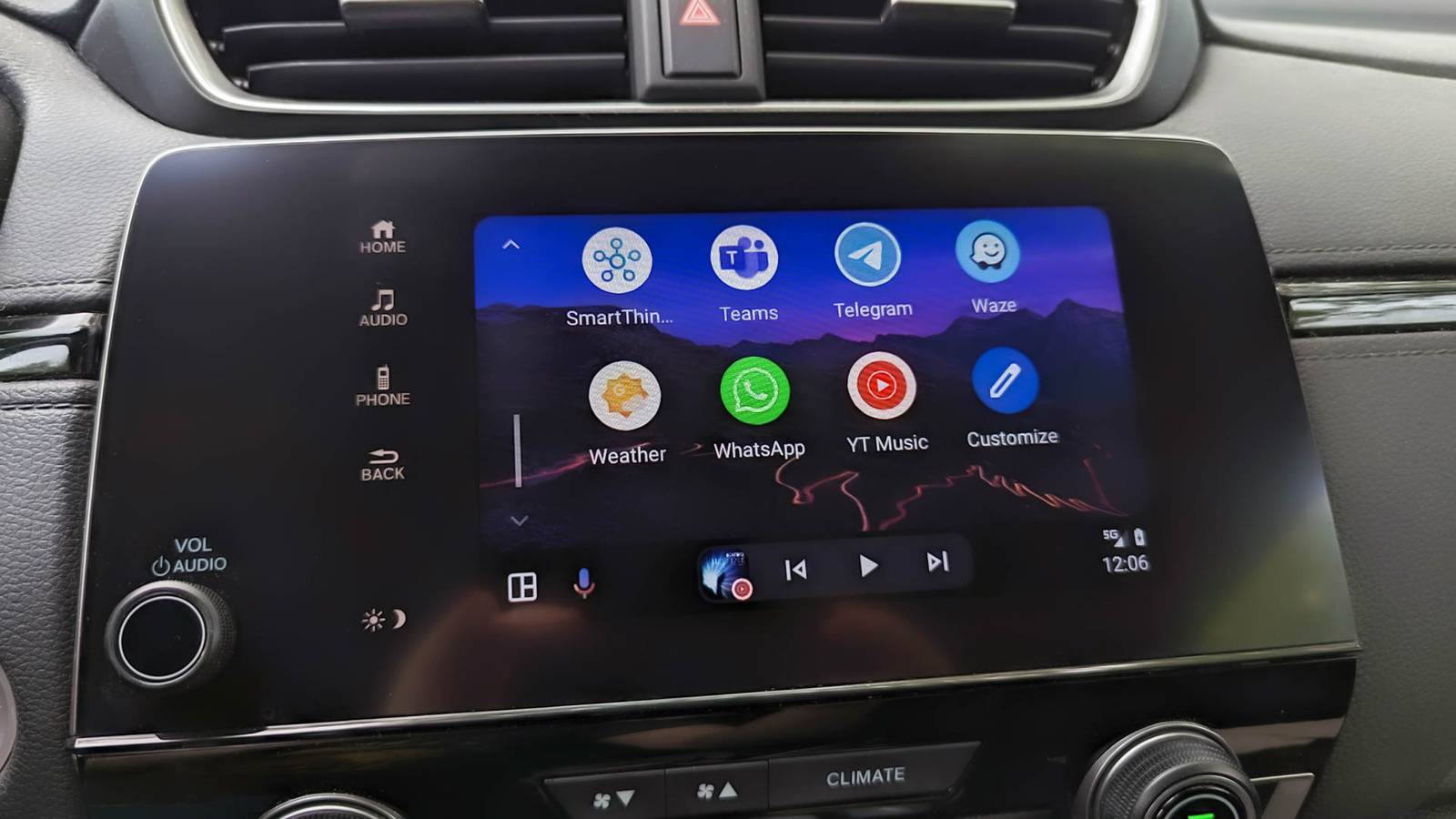
Android Auto is the same Android that's running on your phone, but with a very limited interface.That's the point, of course, but you'd be surprised by how many Android apps are actually supported by Android Auto.Here are four apps you might typically think of as phone apps, but work as full-fledged Android Auto apps as well.
Zoom Get videoconferencing In the era of remote work and constant connectivity, Zoom has become a ubiquitous presence on our smartphones and personal computers.Yet, the idea of engaging in a video conferencing call while operating a motor vehicle seems entirely counterintuitive and highly dangerous.The developers behind Zoom recognized the persistent need for mobile professionals to stay connected during their commutes and created an Android Auto integration that prioritizes driver safety without sacrificing essential communication features.
Naturally, the video component of the application is entirely disabled when connected to your car's dashboard—I really doubt your car has a webcam.Instead, Zoom for Android Auto operates strictly as a highly streamlined, audio-only conferencing tool that integrates with your vehicle's existing microphone and speaker system.The primary advantage of this integration lies in its ability to organize and simplify your daily meeting schedule while on the road.
When you connect your phone to your car, the Zoom interface on the dashboard clearly displays your upcoming calendar events and scheduled calls.Rather than dangerously fumbling with your smartphone to find meeting links, copy complicated passcodes, or navigate the standard mobile app interface while driving, you can join a conference call with a single, deliberate tap on your car's infotainment screen.Once you are in the meeting, the dashboard interface remains remarkably uncluttered, displaying only the most critical controls needed for the call.
The prominent mute and unmute buttons are easily accessible, allowing you to quickly silence background road noise or chime into the conversation without taking your eyes off the road for more than a split second.Discord Stay on the loop with your gaming communities Discord is another app that has cleverly adapted its platform for Android Auto by stripping away the visual clutter and focusing entirely on safe, voice-driven communication.You will not see your server lists, custom emojis, or image uploads on your car's dashboard.
Instead, the Android Auto version acts as an intelligent, hands-free conduit for your most critical notifications and direct messages.When you receive a direct message or a direct mention in a server while driving, Discord utilizes Google Assistant to manage the interaction safely.A discreet notification appears on your screen, and you can prompt the voice assistant to read the incoming text aloud through your car's audio system.
This allows you to stay in the loop with your most active communities or coordinate plans with friends without ever needing to look down at your phone screen.More importantly, the integration allows you to participate in the conversation entirely through voice dictation.After the assistant reads a message, you can seamlessly dictate your reply aloud, which Discord then accurately transcribes and sends back to the chat channel.
This transforms a highly visual, text-heavy platform into a completely hands-free communication tool.Quiz 8 Questions · Test Your KnowledgeAndroid AutoTrivia ChallengeThink you know Google's in-car platform inside and out — put your Android Auto knowledge to the test!HistoryFeaturesConnectivityAppsSafetyBegin 01 / 8HistoryIn what year did Google officially launch Android Auto to the public?A2012B2016C2015D2013Correct! Android Auto made its public debut in 2015, launching alongside compatible vehicles and as a standalone phone app.Google announced the platform at Google I/O 2014 but rolled it out to users the following year.Not quite — Android Auto launched in 2015.
Google revealed it at Google I/O 2014, but actual public availability for both cars and the companion phone app came in 2015.Continue 02 / 8ConnectivityWhat was the primary connection method Android Auto required when it first launched?ABluetoothBWi-Fi DirectCUSB cableDNFC pairingCorrect! When Android Auto launched, a USB cable connection between your phone and the car's head unit was mandatory.Wireless Android Auto came later and requires specific hardware support on both the car and the phone.Not quite — the original Android Auto required a physical USB cable connection.Wireless connectivity was added later and isn't universally supported even today, requiring compatible hardware on both ends.Continue 03 / 8FeaturesWhich voice assistant is natively integrated into Android Auto for hands-free commands?AAmazon AlexaBBixbyCSiriDGoogle GeminiCorrect! Google Assistant was the built-in voice assistant for Android Auto until it was replaced by Gemini in late 2025.The correct answer is Google Gemini.
Since Android Auto is a Google product, it naturally uses Gemini for voice commands — though Google Assistant was the default until 2025.Continue 04 / 8AppsWhich of the following app categories is NOT officially supported on Android Auto?ANavigationBSocial media browsingCMessagingDMusic streamingCorrect! Android Auto deliberately restricts social media browsing and similar visually complex apps to keep drivers focused on the road.Only categories like navigation, audio, and messaging apps with simplified interfaces are permitted.Not quite — social media browsing is not supported on Android Auto by design.Google restricts app categories to those that can be used safely while driving, such as navigation, audio streaming, and simplified messaging.Continue 05 / 8FeaturesWhat minimum version of Android is required to run Android Auto on a smartphone?AAndroid 8.0 OreoBAndroid 9.0 PieCAndroid 6.0 MarshmallowDAndroid 10Correct! Android Auto requires Android 9.0 Pie or higher to function.
Google set this baseline to ensure the platform has access to the permissions framework and APIs introduced in Marshmallow.Not quite — Android Auto requires Android 9.0 Pie as the minimum version.This ensures compatibility with the permission model and system APIs that Android Auto depends on to function properly.Continue 06 / 8HistoryWhat happened to the standalone Android Auto phone app in 2022?AIt was rebranded as Google Drive ModeBIt was discontinued and replaced by Google Assistant Driving ModeCIt merged with Google MapsDIt became a paid subscription serviceCorrect! Google discontinued the standalone Android Auto phone app in 2022 and replaced it with Google Assistant Driving Mode for phone-screen use.The car-display version of Android Auto remained separate and continued operating normally.The correct answer is that the standalone phone app was discontinued and replaced by Google Assistant Driving Mode.
This change affected only the phone-screen experience — the version that projects onto your car's head unit remained intact.Continue 07 / 8SafetyWhich feature does Android Auto use to help prevent distracted driving by limiting phone interaction?AAirplane Mode enforcementBScreen lock during motion detectionCA simplified, large-button interface optimized for glanceabilityDMandatory two-second delay on all touch inputsCorrect! Android Auto uses a purpose-built simplified interface with large buttons, limited app categories, and high-contrast visuals specifically designed for quick glances while driving.This reduces cognitive load compared to using a standard smartphone.Not quite — Android Auto's primary safety mechanism is its simplified, glance-friendly interface with large controls and restricted app categories.It doesn't lock the screen or enforce airplane mode, but rather redesigns the UI to minimize distraction.Continue 08 / 8ConnectivityWhich of the following smartphones was among the first to support Wireless Android Auto without a USB cable?ASamsung Galaxy S8BGoogle Pixel 3COnePlus 7 ProDLG G7Correct! The Google Pixel 3 was one of the first phones to officially support Wireless Android Auto, announced alongside compatible 2019 vehicles.
Google naturally prioritized its own Pixel lineup for early access to this convenient feature.Not quite — the Google Pixel 3 was among the first phones to support Wireless Android Auto.Google rolled out wireless support starting with its own Pixel devices and select 2019 model year vehicles before expanding compatibility more broadly.See My Score Challenge CompleteYour Score/ 8Thanks for playing!Try Again Home Assistant Your home needs you Finally, managing a comprehensive smart home ecosystem is traditionally a task reserved for a dedicated tablet or a highly detailed smartphone application.Home Assistant, known for being one of the most powerful and complex open-source smart home platforms available, involves intricate dashboard layouts, endless automation scripts, and granular control over hundreds of connected devices.
Bringing this level of complexity to a car's dashboard would be overwhelmingly distracting, but the Android Auto integration of Home Assistant brilliantly simplifies the experience.It focuses purely on the actions you need most while physically transitioning between your home and your vehicle.Instead of trying to mirror your complex home dashboard, the Android Auto application allows you to curate a specific, simplified menu of designated "driving favorites." These appear as large, easily tappable icons on your car's touchscreen that represent single actions or predefined routines.
For example, as you pull into your neighborhood, you can tap a single button on your dashboard to effortlessly open your smart garage door, unlock the front door, and turn on the entryway lights.Conversely, when you are rushing out the door in the morning, a "leaving home" button on your car's screen can instantly arm your security system, turn off all the interior lights, and lower the smart thermostat.This integration essentially turns your car's infotainment screen into a mobile extension of your smart home's physical control panels.
It completely eliminates the need to pull out your phone while sitting in your driveway or rely on sometimes spotty voice commands to trigger important home automations.Libby Take your local library on a road trip Reading a book while driving is, for obvious reasons, a big no-no.However, that doesn’t stop your "to-be-read" pile from growing.
Libby, the popular platform for accessing your local library's digital collection, has adapted its interface for Android Auto to bridge the gap between your bookshelf and your commute.While the phone version of Libby is a visual catalog of eBooks and magazines, the Android Auto version focuses entirely on audiobooks.The nice thing about Libby’s integration is how it handles the "discovery" phase of borrowing.
Rather than forcing you to browse through thousands of titles or type in search queries while at a red light—which would be both frustrating and dangerous—the dashboard interface focuses exclusively on your "Shelf." This means that any audiobook you’ve already borrowed or placed on hold on your phone is instantly synced and ready to play the moment you start the engine.Deals Smart Home & Gadget Deals: Save on Home and Car Tech Unlock discounts on smart home gadgets, in-car infotainment accessories, and practical everyday tech.Browse deals on devices, accessories, and subscription offers to save on upgrades that streamline your drive and home routines.
Deals Explore Smart Home & Gadgets Deals Once you select a title, the interface is stripped down to the bare essentials.Large, high-contrast buttons for skipping back or forward fifteen seconds, pausing the narration, and adjusting playback speed in 5% increments take up most of the screen.It effectively removes the friction of finding "something to listen to," replacing the aimless playlists of Spotify with the progress of your latest literary find.
Vivaldi (Android Automotive) A whole browser right in your car When you think of apps best suited for a car dashboard, a full-fledged web browser is likely the last thing that comes to mind.However, Vivaldi has successfully integrated its highly customizable browser directly into the Android ecosystem, offering a surprisingly robust experience for drivers.Most people assume that browsing the internet from the driver's seat is inherently dangerous, and Vivaldi addresses this head-on with strict safety protocols.
The app only functions when your vehicle is completely parked.The moment you shift into drive, the browsing session is immediately suspended, ensuring that there are absolutely no visual distractions while you are actively navigating the roads.You might be thinking right now, "Why do I need a browser in my car?" For many reasons, actually.
Whether you are waiting in a parking lot to pick up a friend, sitting through a lengthy delay at a ferry terminal, or spending thirty minutes at a fast-charging station for your electric vehicle, Vivaldi transforms your dashboard display into a comprehensive entertainment and information hub.You can access your synced bookmarks from your desktop or smartphone, read the latest news articles, check your web-based email, or even stream high-definition video content from platforms like YouTube or Netflix.Furthermore, the interface is carefully optimized for the unique aspect ratios and touchscreens of modern vehicle infotainment systems.
The controls are large and intuitive, preventing the frustrating experience of trying to tap tiny, unoptimized web links on a screen that is sitting at arm's length.Pretty neat.
Read More