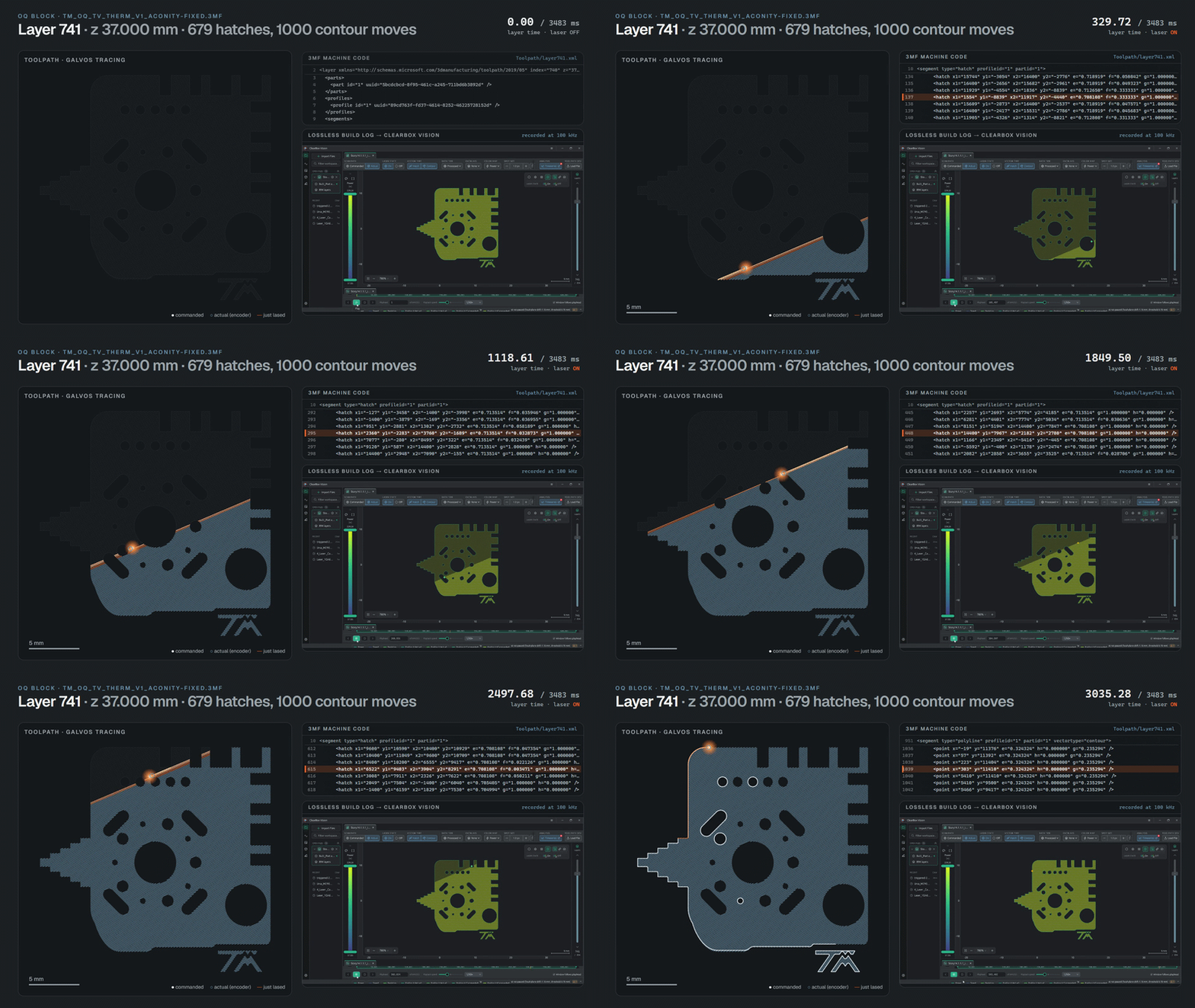
The 3MF Consortium has released version 1.0.0 of the 3MF Toolpath Extension, an open, machine-independent format for describing toolpath data in additive manufacturing.The first release is built around laser powder bed fusion (LPBF) and also covers other layer-based laser processes and multi-axis deposition.The specification has only just been ratified by the Consortium membership, but it is not a new or untested proposal.
It is the result of roughly seven years of development, and the format has been run on industrial LPBF systems in serial production throughout that period.Version 1.0.0 formalizes a format that has already been proven at industrial scale, rather than introducing one that machine builders and users will be the first to try.Per-vector power modulation for one LPBF layer across two lasers with overlapping scan fields, with the corresponding 3MF Toolpath XML.
Animation courtesy of 3MF Consortium.The Problem: Build Files Tied to Each Machine Industrial build files, especially in LPBF, are written in formats specific to each machine builder.The toolpath is generated in one software environment, translated into a proprietary build format, and in that translation it usually loses its connection to the part geometry.
This limits which software a machine can accept, complicates traceability, and means that inspection and simulation tools must be written separately for each format.The Toolpath Extension defines a single representation of what the laser does, stored in the same 3MF package as the geometry it was generated from.Every segment references the build item it belongs to, so the toolpath remains attributable to the part.
Ratified Now, Tested for Years Work on the extension began within the Consortium in 2019, led by Consortium Technical Director Alexander Oster, with machine builders, scanner and laser control manufacturers, software developers and research institutions contributing.Each revision was tested against real build jobs on production equipment, which is why the first published version addresses the requirements of serial production rather than a minimal starting subset: multi-laser synchronization, microsecond timing, power modulation below the vector level, and build files large enough to require streaming.Open implementations already exist alongside the specification, including a 3MF-to-EOS toolpath repository, giving developers working code to test against from day one.
What the Extension Specifies Process parameters.Toolpath profiles carry laser power (W), marking and jump speed (mm/s), focus offset, and spot radius (mm).These parameters are programmable: a profile defined once can be repeated across any number of segments and layers, and numeric values can be ramped along a vector rather than held fixed.
Machine-specific parameters, such as vendor scan strategies or dynamic focus control, can be added through namespaced extensions without breaking compatibility.Point-by-point modulation.Modifiers allow a parameter such as laser power to vary per hatch or along a vector, as a constant, linear, or piecewise-linear profile.
Each modifier declares its value range in the profile, so a machine can confirm at load time that it can execute the file, for example, that no vector exceeds 200 W, without reading the layer data.Timing.Wait times before and after each segment are specified in microseconds, with optional producer estimates of marking and jump time.
Multi-laser builds.Laser sources and their scan fields are declared once.Sync groups define explicit barriers where lasers must wait for one another; otherwise, segments on different lasers may run in parallel.
Random layer access.Each layer is stored as a separate part in the package, so software can open any single layer directly without parsing earlier layers.Inspection, simulation, and machine controllers can work on one layer of a large build in isolation.
Scalable packaging.The per-layer structure also lets large builds stream to the machine.Build-ready files use the .build.3mf naming convention.
Planar toolpaths cover LPBF, laser sintering, and stereolithography.The specification also defines 3-axis toolpaths for non-planar deposition, such as directed energy deposition and extrusion, and 6-axis toolpaths with full tool orientation for robotic systems.Hatch vectors with linear power modulation (168 to 280 W) from a 3MF build file on a POWDERBED Core 1 scanner and laser controller.
Image courtesy of Aagaard AM ApS.Industry Perspectives “The 3MF Toolpath Extension is a great step forward for the entire industry, as it establishes a common foundation for innovation and quality assurance in additive manufacturing,” said Alexander Bockstaller, Product Line Manager Data Preparation Software at EOS GmbH Electro Optical Systems.“As a founding member of the 3MF Consortium, we welcome the new standard and see it as a natural complement to our open software architecture, combining the benefits of standardization with the performance, reliability, and process expertise that define EOS technology.” “I see the 3MF Toolpath Extension doing for LPBF what G-code did for CNC,” noted Hunter Taylor, CTO of Tailored Alloys LLC.
“A non-proprietary toolpath format for LPBF will enable inspection to begin before the build, because digital inspection tools will no longer need to be built for machine-specific formats.Removing the file format barrier between slicer and machine will also unlock innovation by letting users leverage rapidly evolving toolpathing solutions.I believe this will be the single most impactful development in LPBF over the next ten years, if machine makers rapidly and fully adopt the format and all of its advanced capabilities.” Availability and ISO Standardization The 3MF Toolpath Extension v1.0.0 is available as a PDF at 3mf.io, and the working specification is maintained on GitHub.
3MF became an ISO standard in 2025.As with the core 3MF specification and its existing extensions, the Consortium intends to add the Toolpath Extension to the ISO/IEC 25422:2025 3D Manufacturing Format (3MF) specification suite.Future revisions are planned to add volumetric and field-driven parameter assignment, building on the 3MF Volumetric Extension, so that process parameters can follow fields defined in the design rather than being set per vector.
Machine builders, software developers, and end users interested in implementing the extension, or in contributing to future revisions, can contact the Consortium through 3mf.io.Explore the 3MF Toolpath Extension → Subscribe to Our Email Newsletter Stay up-to-date on all the latest news from the 3D printing industry and receive information and offers from third party vendors.Print Services Upload your 3D Models and get them printed quickly and efficiently.
Powered by FacFox Powered by 3D Systems Powered by Craftcloud Powered by First Mold Powered by Xometry 3DPrinting Business Directory 3DPrinting Business Directory
Read More