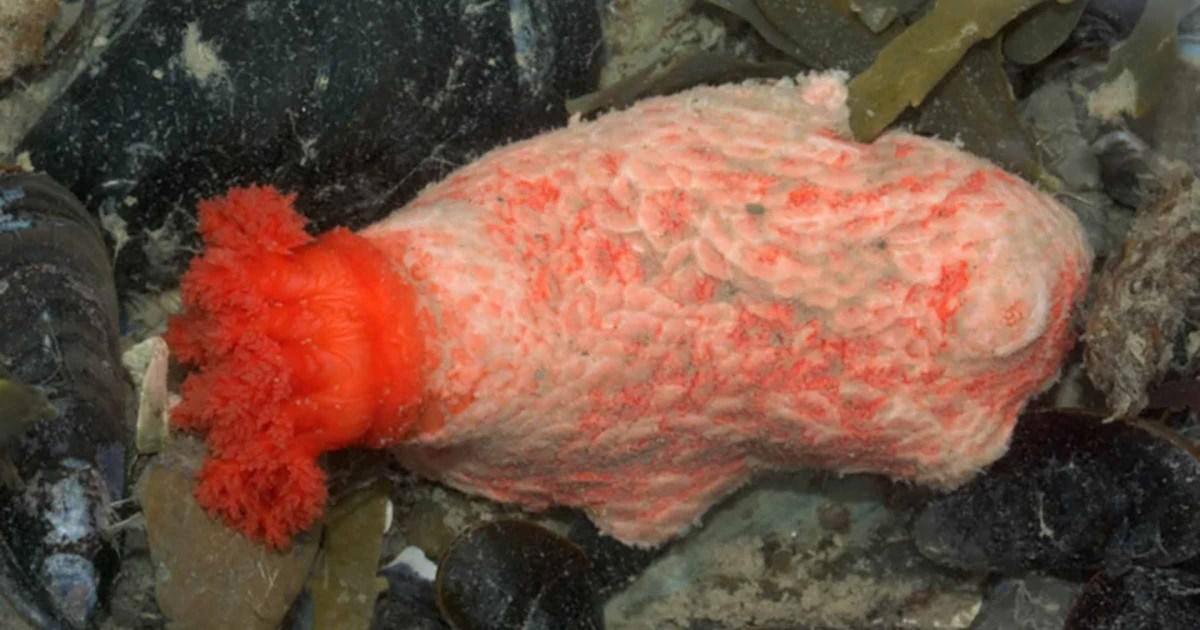
If you told a guy in the 1760s – when the average lifespan was 38 – that you were 82, he’d probably think you could live forever.But Canadian scientists may have accidentally discovered something immortal – a discarded chunk of sea cucumber.A relative of starfish and sea urchins, sea cucumbers are blobs that creep across the ocean floor on tentacle-feet, gobbling up algae and plankton.
Three years after scientists amputated bits of a scarlet sea cucumber, known to experts as a Psolus fabricii, the tissues refused to die.The severed tube feet and tentacles have sat inside a tank of natural running seawater, slowly growing and healing.Marine biogeochemist Rachel Sipler from the non-profit, Bigelow Laboratory for Ocean Science, said the sample is a ‘real-life zombie’.
‘We haven’t grown a new, complete sea cucumber yet, but we are seeing pretty stunning growth and diversification of cells literally years after this tissue was removed,’ she said.‘It’s like a lizard that loses its tail.We know some lizards can grow new tails; we’re talking about whether the tail can grow a new lizard.’ What is going on? When humans lose a chunk of flesh, it dies and decays. Same goes for lizards and sea cucumbers, even though they can regenerate lost limbs.
This isn’t so with scarlet sea cucumbers, found in the cold waters of the Arctic and North Atlantic Ocean, however.Instead, the tentacles that these klutzes of the ocean lose when they get into scrapes or bump into things keep living, according to a recently published study in Science Advances.Sipler and her team at Memorial University of Newfoundland scooped up a discarded tube foot – a tiny limb used for movement and feeding.
Follow Metro on WhatsApp to be the first to get all the latest news Metro’s on Whatsapp! Join our community for breaking news and juicy stories.They placed the samples in seawater, which is crawling with bacteria and organic matter.Unexpectedly, they found that the lost pieces of tissue were repairing their wounds and that their immune cells were springing into action.
The tentacles, which showed no signs of rot, even responded to tactile stimuli, suggesting the preservation of the animal’s neural network.The researchers realised that these slivers of sea cucumbers were feeding off the organic material in the water, despite having no mouth or digestive system.They were even soaking up the amino acids – which cells string together to form proteins – in the seawater.
And they were still doing it three years later, long after the study had wrapped up, the team discovered.The researchers said that this is the first time a tissue sample has survived and thrived in a natural setting.‘Our findings challenge conventional perceptions of tissue immortality,’ they concluded.
Why is this a big deal? Immortal cells are nothing new – scientists have made them using animal and human stem cells, which are blank canvases that all tissues and organs in your body are created from.But these immortal cells can only be kept alive in highly controlled and clean environments – keeping cells inside a tissue section is even harder.Trending Now Google wants to release 32,000,000 infected mosquitoes into the wild Tech 2 hours ago By Josh Milton Moment dying student is arrested despite saying 'I've been stabbed, I can't breathe' London Tube strikes - full list of affected lines and exact time they will start Brothers facing life in jail after inheritance row uncovered a murder Yet the researchers found a slab of Scarlet sea cucumber could live ‘indefinitely’ in dirty seawater.
This species even seems to be unique compared to other sea cucumbers, whose appendages usually decay within three or so months.Sipler added: ‘Here is this species that has this groundbreaking ability, and we had no idea.‘It’s a reminder how much is yet to be discovered in the marine environment and how important it is to protect these resources that may hold really valuable knowledge for us.’ Get in touch with our news team by emailing us at [email protected].
For more stories like this, check our news page.MORE: One in four chippies and takeaways found to be selling meat from undeclared animals MORE: Rollercoaster riders end up stranded 100ft above near-verticle drop after glitch MORE: Giant nightmare clown puppet appears at police station – and no one knows why Comments Add as preferred source News Updates Stay on top of the headlines with daily email updates.This site is protected by reCAPTCHA and the Google Privacy Policy and Terms of Service apply.
Your information will be used in line with our Privacy Policy HomeNewsTech Related topics AnimalsNorth Atlantic OceanWeird news
Read More