We’re focused on healthcare and research in today’s 3D Printing News Briefs, including 3D printed prosthetics, patient-specific implants, drug delivery, and more.Read on for all the details! Students from Queen’s University Bringing Accessible Prosthetics to Thailand Queen’s students, including members of the Queen’s Biomedical Innovation Team (QBiT), continue to work on developing and fine-tuning designs for prosthetics that can be created using a 3D printer.(Photo courtesy Burma Children Medical Fund) Almost two decades ago, Queen’s University researchers Eva Purkey (Family Medicine) and Colleen Davison (Public Health) started traveling annually to a clinic in Thailand to help with health workshops and policy reform.
They also started working with NGO Burma Children Medical Fund (BCMF), which helps underserved communities get access to surgical treatment.In 2019, BCMF launched a 3D prosthesis project, and Drs.Purkey and Davison worked with other Queen’s colleagues to get funding and set up a recurring partnership, in which students do 90-day placements within BCMF.
Emese Elkind, a biomedical computing student at Queen’s, started with the program as a summer volunteer, and has now spent the last three years leading a team of engineering students from the Queen’s Biomedical Innovation Team (QBiT) in the design and development of accessible 3D printed prosthetics for migrants running from civil war.BCMF had access to open source prosthetic designs, as well as donated 3D printers, but they didn’t have an open source design for above-elbow amputees.Elkind wanted to solve the problem, and worked with the QBIT team to create a harness system that can independently move the elbow, as well as each individual finger, without using the kind of robotics or electronics that are hard to maintain in resource-limited areas like Burma and Thailand.
Their work has received plenty of recognition and awards at North American engineering competitions, and they donated half of their prize money to BCMF to fund translation services, surgeries, transitional housing, and access to professional design software.Elkind says the experience has been “life changing, and has reshaped the way I think about engineering, where our job isn’t just to make new technology, it’s to solve real problems.” As she prepares to start her master’s program, Elkind is moving to a senior advisory role for the Queen’s and BCMF prosthetics project.CureWith3D Working to Support Personalized Healthcare in India Image: CureWith3D Clinicians these days are better equipped to plan operations with high precision and accuracy ahead of complex surgical procedures, thanks to technologies like CAD engineering, advanced imaging, and 3D printing.
India-based company CureWith3D specializes in 3D printing and digital surgical planning, and reported that it’s working to strengthen its patient-specific healthcare offerings by offering custom 3D printed implants, surgical guides, and anatomical models, and Virtual Surgical Planning (VSP) services, to hospitals, healthcare institutions, and surgeons across the country.CureWith3D works with craniofacial, oncology, maxillofacial, reconstructive, and orthopedic surgeons to develop custom solutions for complex cases, using engineering know-how, radiological imaging, and high-quality additive manufacturing (AM) to fabricate drilling and surgical guiding guides, anatomical models for pre-op planning, and patient-specific implants.Its VSP services enable surgeons to simulate surgical outcomes and finalize designs before the surgery even starts.
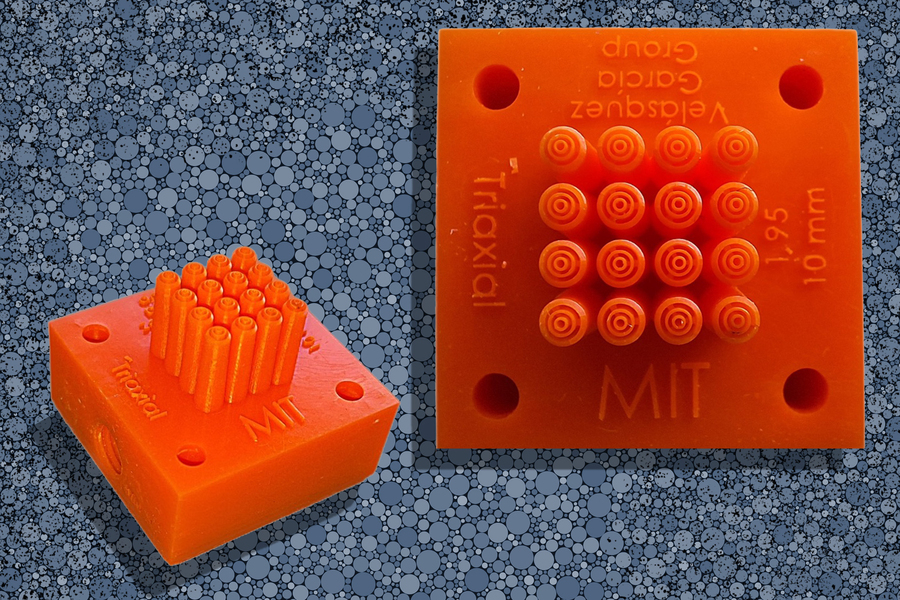
“As personalized medicine continues to evolve, patient-specific technologies are becoming an important part of modern surgical care.Our objective is to collaborate with healthcare professionals by providing engineering-driven solutions that help improve planning, precision, and patient outcomes,” said a CureWith3D spokesperson.MIT Researchers Develop Low-Cost Design for 3D Printed Electronic Nozzles in Drug Delivery A zoomed-in view of the nozzles that emit the three-layered microdroplets.
Credit: Courtesy of the researchers Triaxial electrospray emitters are specialized electronic nozzles that use electricity to dispense three separate liquids from microscopic nozzles, which generates a stream of three distinct fluid layers.These form into multilayered droplets, which can then solidify into layered microparticles.A good application example is a drug delivery nanoparticle, where the outer layer slowly erodes in the person’s stomach, and leaves a second material, which controls the release of the core material that delivers medicine.
However, these are not easy, or cheap, to make, often requiring microfabrication processes inside semiconductor cleanrooms.But a team of MIT researchers used vat photopolymerization to 3D print arrays of these triaxial electrospray emitters, which feature 16 nozzles in a one square centimeter area.The one-step fabrication process can produce complex emitter arrays in just a few hours.
Miniaturization is necessary for electrospray devices, because the voltage required to generate droplets is lower when the emitter is smaller.MIT’s 3D printed devices are just a bit larger than a U.S.penny, and cost-effective as well.
They could one day help streamline and scale production of drug delivery microparticles, seal-healing materials, or biosensors.“We couldn’t make a device like this in a semiconductor cleanroom.This is only possible because they are 3D-printed.
The particles these devices generate, whether they are used for a self-healing composite or to deliver medicine, can have a big impact in many applications.We want to democratize this technology so the benefits can touch many more people,” explained Luis Fernando Velásquez-García, a principal research scientist in MIT’s Microsystems Technology Laboratories (MTL) and senior author of the team’s research paper.“By making such intricate devices more practical, we can empower others to pursue entrepreneurial and scientific advances.” SUSTech 3D Printing Continuous Fiber Composite Honeycombs with Expansion-Forming Process Graphical abstract.
Image courtesy SUSTech researchers.Composite honeycomb structures are lightweight architectures with low density, excellent energy absorption, and unique thermomechanical properties.That’s why they’re often used for things like vibration dampers, insulators, and energy absorbers in civil engineering, aerospace, and automotive applications.
Conventional manufacturing processes, like co-curing, require multiple molds, lengthy procedures, and and high technical requirements, while methods like automated fiber placement are too expensive and not well-suited for fabricating small honeycomb structures.3D printing, particularly fused filament fabrication (FFF) methods, is a good way to make continuous fiber-reinforced composites (CFRCs), and now CFRC cellular structures, like hexagonal honeycombs.But, according to researchers from the Southern University of Science and Technology (SUSTech) in Shenzhen, China, 3D printed CFRC honeycomb architectures have their own issues.
Continuous fibers are often limited to out-of-plane stacking, which makes the structural design process less flexible and can result in “out-of-plane mechanical performance of sandwich structures with honeycomb.” So the team came up with a novel 3D printing method, which gets a little help from an expansion process, to overcome this issue and achieve composite honeycomb structures with tailored continuous fiber orientations.“Compressive tests were carried out to assess the mechanical performance of the CFRC honeycomb structures produced by the proposed method.The experimental results demonstrate that, compared to conventional 3D printing processes (0° fiber filled honeycomb), the expansion-aided method (90° fiber filled honeycomb) significantly improves specific compressive modulus, strength and energy absorption by 126.44%, 198.64% and 32.05%, respectively, with enhanced surface quality, reducing dimensional error by 82.76%.
Furthermore, a predictive model for the out-of-plane compressive strength of CFRC honeycomb structures was developed, showing strong agreement with experimental data.The proposed technique holds considerable promise for the integrated fabrication of lightweight CFRC structures with complex fiber directions and superior mechanical properties,” the researchers wrote in their abstract.You can learn more by reading the team’s research paper here.
Subscribe to Our Email Newsletter Stay up-to-date on all the latest news from the 3D printing industry and receive information and offers from third party vendors.Print Services Upload your 3D Models and get them printed quickly and efficiently.Powered by FacFox Powered by 3D Systems Powered by Craftcloud Powered by First Mold Powered by Xometry 3DPrinting Business Directory 3DPrinting Business Directory
Read More