Metal manufacturing still carries the layout and logic of an older industrial age.Most factories run as a collection of isolated disciplines, each with its own equipment, staff, and data.Additive lives in one section of the building.
Machining is parked somewhere else.Thermal treatment and metrology often require entirely different facilities.This model has persisted across multiple waves of industrial modernization, and with it, the natural limits of what a factory can reliably deliver Those limits are becoming increasingly difficult to ignore.
A different model is beginning to take shape across advanced metals production.Instead of treating a factory as a set of discrete operations, manufacturers are starting to build environments that behave like a single integrated machine.The idea is literal.
Additive, machining, thermal processing, inspection, automation, and data systems are tied together in one coordinated framework that operates from a shared layer of intelligence.The closest analogy comes from the evolution of computing.Early systems kept storage, software, and hardware apart.
The real gains came when those layers were unified into coherent platforms.Manufacturing is approaching a similar point.The bottleneck is no longer the capability of any single tool but the physical and operational distance between them.
At its core, this is a physics problem.Every time a part is moved, fixtured, re-fixtured, or handed off between isolated disciplines, the distance those atoms travel adds cost, variation, and delay.The factories that outperform their peers are the ones that shorten that distance.
They consolidate steps, simplify motion, and design workflows where matter and energy follow the most direct possible path.This is why the traditional model carries structural constraints that no amount of machine-level optimization can solve.Each handoff introduces latency and variation.
Data becomes stuck inside local processes, where it cannot inform decisions upstream or downstream.Optimization tends to focus on improving one step instead of improving the entire chain.And when demand rises, factories often respond by adding more equipment instead of increasing the intelligence that governs the system.
Even well-run operations eventually hit this ceiling.The emerging alternative replaces this fragmentation with a tightly connected production architecture.In this model, each step functions as a subsystem inside a larger machine.
Additive and subtractive processes share a common data layer that updates continuously.Thermal behavior is predicted and managed across the workflow rather than addressed in isolation.Inspection becomes an active contributor to process planning instead of a final checkpoint at the end.
Once these pieces are connected, the factory begins to operate in a fundamentally different way.Decisions sync in real time.Feedback moves freely instead of stopping at the boundaries of a department.
Variation declines.Over time, the environment develops a deeper understanding of its own patterns and uses that insight to improve stability and throughput.Artificial intelligence becomes the conductor that holds this system together.
Models trained on multi-stage data can see patterns that are invisible at the level of a single tool.They can anticipate thermal shifts that influence both additive and machining.They can guide machining allowances based on predicted distortion.
They can adjust process conditions as builds unfold.They can interpret inspection results in ways that refine the next cycle of production.The result is cumulative intelligence.
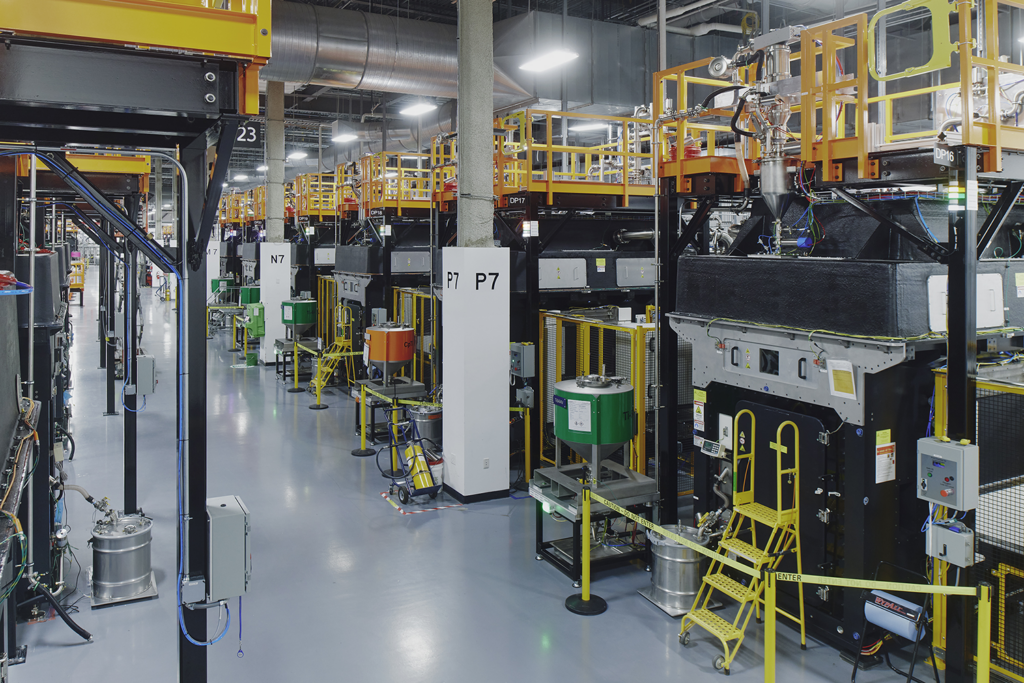
Every completed part strengthens the system.What this looks like in practice is already becoming clear.Production environments that combine dense metal additive capacity, scaled machining, and integrated quality and computational systems are beginning to show the advantages of a coordinated architecture.
At VulcanForms, this model is operating at factory scale, and the improvements in stability, repeatability, and throughput are measurable.The broader industry signals point in the same direction.As part requirements grow more complex and development timelines shrink, manufacturers are recognizing that gains will not come from individual tools running faster.
They will come from systems that work in concert, where data and decision making move freely across the entire workflow.The real divide now sits between two approaches to industrial production.One treats digital tools as enhancements layered onto existing structures.
The other treats the factory itself as a unified machine, designed to learn, adapt, and scale as a coherent system.The companies that move toward this architecture will set the pace for advanced metal production.Those that do not will continue to encounter the same structural limits, regardless of how advanced their individual tools become.
Kevin Kassekert is the CEO of VulcanForms, and brings over 25 years of people-centric, seasoned leadership experience in high-tech and high-volume manufacturing environments with a passion for developing teams and scaling disruptive technology.Prior to joining VulcanForms, Kevin spent over four years as Chief Operating Officer of Redwood Materials where he played a pivotal role in growing the company from a small, young startup to a multibillion-dollar leader in Li-Ion battery recycling, refining, and battery materials manufacturing.Prior to Redwood Materials, Kevin spent seven plus years at Tesla Inc., where he led Global Infrastructure Development (Superchargers, Factories), People (HR, Recruiting, Total Rewards), and Places (Real Estate, Construction, Facility Operations).
Some notable achievements include completion of the nation’s first U.S.cross-country Supercharger network and the design, construction, and operational ramp of the world’s first — and at the time largest — Li-Ion battery Gigafactory in Nevada, U.S.This team then went on to lead the engineering, procurement, and construction of additional Gigafactories and manufacturing facilities located in Shanghai, Berlin, and Austin, TX.
Prior to Tesla, Kevin spent 13 years in the semiconductor industry at Cypress Semiconductor and Silicon Valley Technology Center (SVTC) in leadership roles ranging from production operations to process engineering and product commercialization.Kevin holds a bachelor’s degree in mechanical engineering and a master’s degree in business administration and global management.At Additive Manufacturing Strategies (AMS) 2026, Kevin will participate in a panel on “High Volume Industrial Part Production,” and another about “Leveraging VC for an Industrial AM Future,” both on February 25th.
These sessions are part of the broader AMS 2026 conference, which brings together industry leaders, policymakers, and innovators from across the global AM ecosystem.Learn more and register here.Subscribe to Our Email Newsletter Stay up-to-date on all the latest news from the 3D printing industry and receive information and offers from third party vendors.
Print Services Upload your 3D Models and get them printed quickly and efficiently.Powered by FacFox Powered by 3D Systems Powered by Craftcloud Powered by Xometry 3DPrinting Business Directory 3DPrinting Business Directory
Read More