A recent article revealed that OpenAI is purchasing tens of thousands of Mac minis and Mac Studios to give AI agents dedicated environments to run, make mistakes, and learn.It’s a smart infrastructure decision for agents meant to operate inside a computer clicking, navigating, using software: they need a full computer to practice on.But it got us wondering: is that always the right environment for an agent? Why agents need their own environment An AI agent isn’t a chatbot.
It perceives a situation, takes an action, observes the result, adjusts, and tries again – in a loop that requires a persistent local environment with compute, I/O, and feedback.You can’t outsource the whole thing to a cloud API, because the agent needs somewhere to live and something to interact with.In OpenAI’s situation, the answer is: give it a computer.
That works well when the goal is teaching agents to use software.But software isn’t the whole world.Physical AI needs something different (and surprisingly cheaper) A Mac mini today starts at around $900.
At the scale OpenAI is reportedly operating, the infrastructure bill is substantial.That cost is justified when you need a full computing environment.But what if the agent’s environment doesn’t need to be a general-purpose computer? What if it needs to be a temperature sensor, a camera feed, a production line? At a fraction of the cost, an Arduino VENTUNO Q board can provide a persistent Linux environment for the agent runtime, local AI inference, and direct access to real-world I/O: cameras, sensors, actuators.
The economics of deploying agent environments at scale look very different when each node costs significantly less, and can be embedded directly in the physical context it’s meant to ultimately operate in.What an Arduino agentic environment actually looks like VENTUNO Q is built to combine a Linux-capable MPU with NPU acceleration and a dedicated real-time MCU on a single board.The Linux side is engineered to run the agent – its reasoning, its model, its decision logic.
The MCU side is designed to connect it to the world: motors, sensors, cameras, industrial interfaces.No cloud dependency.No separate controller.
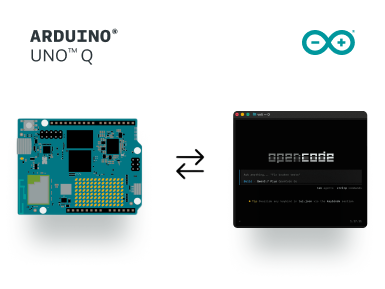
One self-contained unit that perceives, decides, and acts.Arduino UNO Q is structured to extend this further as a low-cost remote node.David Groom demonstrated this clearly leveraging OpenClaw, developing an agent framework on UNO Q designed to enable agents to interact with physical hardware.
By connecting to Arduino shields and accessing additional hardware capabilities, the framework supports physical-world interactions while enabling deployment across multiple units simultaneously, each maintaining its own context and operational role.With these tools, it’s easy to envision a “swarm” model: VENTUNO Q built to serve as a local processing hub, with UNO Q units designed for distributed deployment as remote nodes, all supporting agent-based workflows that interact with physical environments rather than simulated ones.More agents, more learning, lower cost This is where the conversation becomes more interesting than individual compute specifications alone.
Lower deployment costs can make broader deployment economically feasible, creating opportunities for more agent interactions, richer feedback loops, and exposure to a wider range of real-world operating conditions.An agent that has operated across multiple physical environments, each with its own sensors, lighting conditions, and sources of noise, may be exposed to a broader set of inputs than an agent trained exclusively in software simulations.Arduino can give agents something else to learn from: the physical world.
By combining accessible hardware with scalable deployment models, Arduino platforms are designed to support the creation of large numbers of agent-enabled environments for experimentation, testing, and real-world interaction.Ready to build your own agentic environment? UNO Q is available on the Arduino Store, and can be ordered from DigiKey, Farnell, Mouser, Newark, RS Components, Robu.in, and other authorized distributors and resellers worldwide.VENTUNO Q is also available on the Arduino Store or through our official distribution partners: DigiKey, Farnell, Kubii, Mouser, Robu.in, and RS, along with other authorized distributors and resellers.
Read More