When you're trying to get perfect audio at home, it's really easy to spend a ton of money upgrading your main speakers.You might think that a bigger unit or a higher price tag automatically equals better sound quality.That common assumption is honestly the biggest mistake people make in modern home audio setups.
Before you sink even more cash into speakers, you need to consider that your answer may be a subwoofer.Low-frequency sound demands a huge amount of power and cone area, which is exactly what a subwoofer provides.Full-range sound doesn't have to mean big speakers It is a myth that if you want room-filling sound, you have to clutter up your space with huge tower speakers or bulky bookshelf models.
The truth is that physics doesn't care about your speaker size or price tag; most standard loudspeakers really struggle to hit anything below 60 Hz with true power.When your system can't reproduce those lower frequencies, the sound ends up feeling thin or hollow.Even speakers that claim to be full-range can drop off significantly around 50 Hz.
If they physically can't move the amount of air required for deep bass without distorting, your sound is going to feel lacking.Believing big main speakers are the only answer ignores the strict reality of acoustics.Getting low frequencies clean requires massive drivers and serious power, and that's something expensive and difficult for standard passive speaker cabinets to pull off by themselves.
When your traditional speakers try to handle these demanding bass notes, the woofers usually can't keep pace with the tweeters and mid-drivers, which leads to distortion when you crank the volume.Relying on stereo pairs means you are often accidentally inviting intermodulation distortion, which is when the big movements needed for deep bass actually modulate and distort the higher-frequency signals.This kind of strain on the main speakers always thins out the midrange, crushing the clarity of your vocals and instruments.
Adding a subwoofer doesn't just pile on more bass; it actually lets your system bypass those physical restraints without forcing you to use massive, refrigerator-sized speaker cabinets.By taking the heavy lifting of frequencies below 80 Hz and sending them to a component built just for that, your main speakers are free to concentrate only on the midrange and high frequencies they were designed for.This division of labor significantly reduces the strain on both your main amplifier and the drivers themselves if properly calibrated.
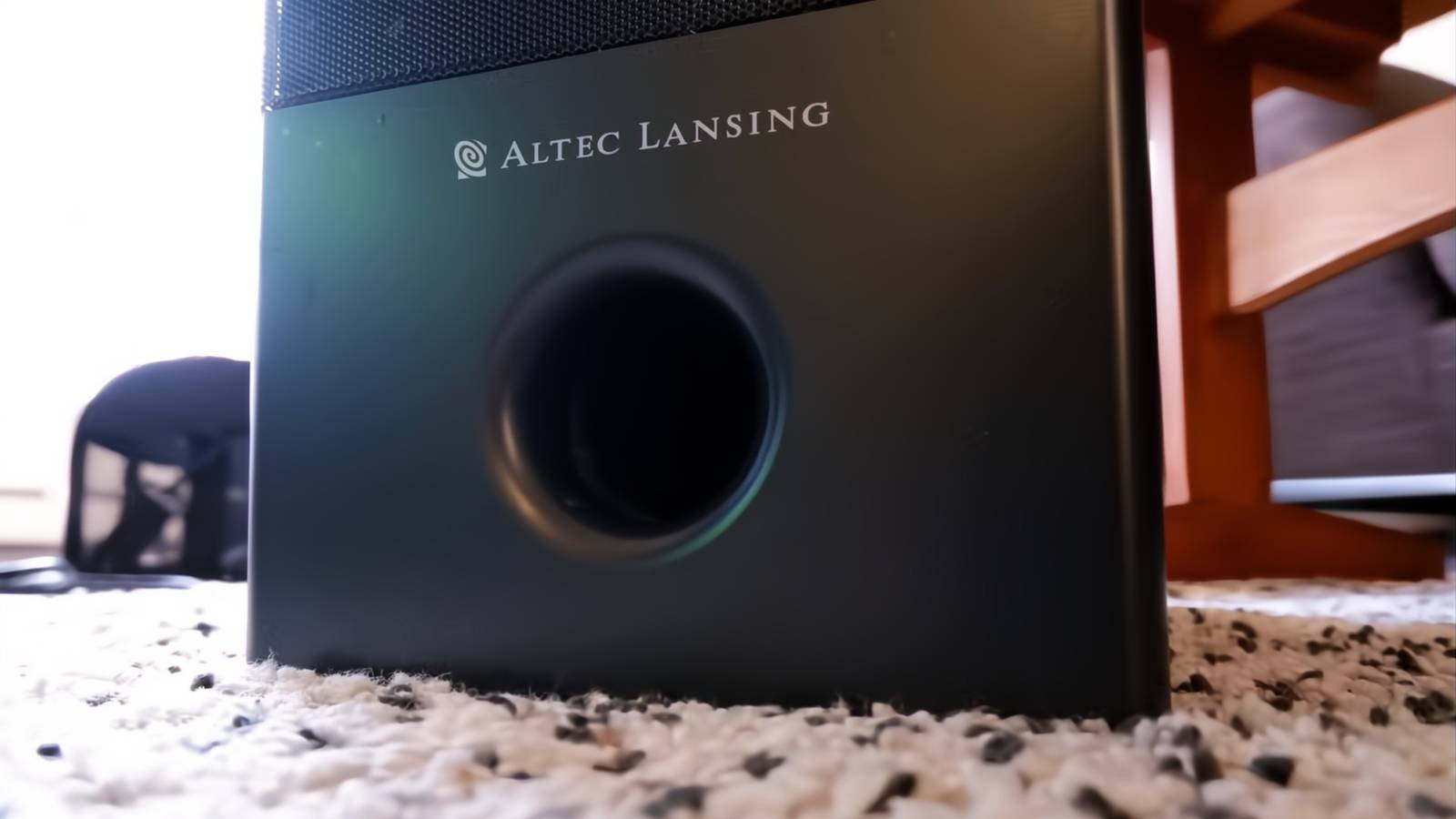
The Subwoofer Is Non-Negotiable The subwoofer is not some extra piece of kit; it is the workhorse for your low end that fixes the undefined sound in your current setup.It's meant to take the heavy bass workload off your main speakers.It handles those deep, bottom octaves that standard speakers just can't hit reliably.
It's also a great idea to get one for your PC.When you force your main drivers to crank out deep bass alongside midrange frequencies, those huge cone movements needed for low notes mess up the highs.That causes a loss of detail called intermodulation distortion.
By routing these tough low frequencies away from your main drivers and sending them to a dedicated sub, you're basically freeing your speakers from a job they weren't really designed to do by themselves.You eliminate that muffled quality because this separation lets your main speakers focus completely on the midrange and treble.The result is a much cleaner, more open soundstage with significantly reduced distortion.
Suddenly, vocals aren't edgy anymore, and instruments get their natural sound back because the amplifier isn't wasting power struggling to reproduce deep bass.Getting this kind of performance means you need to make an investment, though; I can't call them cheap anymore.My first subwoofer in 2017 was $47, and now it's around $74 on a deal.
True high-fidelity subs have huge magnets and stiff drivers so they can handle the immense power needed to start and stop bass transients accurately.That's what justifies the cost if you're a serious listener.A sub gives you that physical impact.
The fantastic rumble that smaller drivers simply can't replicate is a feature I like.A decent subwoofer dips down to 20 Hz or less, the lowest limit of human hearing, to create energy that you feel just as much as you hear.Small Speakers, Big Performance Going with a satellite and subwoofer setup gives you a much stealthier choice, letting you save space without sacrificing quality at all.
I tend not to go for the biggest of anything because it means fewer placement options due to its size.This approach lets you use compact bookshelf or satellite speakers that are super versatile for placement.You can put them on stands, consoles, or shelves, keeping your valuable floor space open.
Since subwoofers handle non-directional bass frequencies below 100 Hz, you can easily tuck them away in corners or out of sight.This keeps your visual aesthetic intact while still maintaining a massive, full-range audio profile as long as you place it in the right place.The benefit of this configuration is how it optimizes the performance of your left and right speakers.
When you add a subwoofer and use digital bass management correctly, you effectively free those satellites from the burden of trying to reproduce deep bass they physically can't handle efficiently.This synergy creates a listening experience that feels like a theater or a massive soundstage, if done right, even though the visible speakers have a modest physical footprint.A properly integrated subwoofer doesn't just add boom; it expands the perceived soundstage, adding a sense of scale that small speakers simply can't make alone.
By accurately reproducing the bottom octaves, a subwoofer reveals ambient cues, like the acoustic space of a concert hall or the subtle rumble of a room, that make the presentation feel real and three-dimensional.To be clear, that is with the smaller subwoofer I've mentioned.A bigger one will likely be better, but you don't have to overspend to get the visceral impact and excitement needed for a home cinema, where you physically feel the sound in a way that mimics a commercial movie theater.
You need to finally ditch that old idea that amazing, full-range sound requires huge main speakers that totally take over the room.When a dedicated component handles the heavy physical lifting of reproducing the absolute lowest frequencies, your main speakers are free to perform significantly better.This teamwork is what makes your sound system better.
So remember that a subwoofer is a vital piece of hardware and a necessary foundation, not just some optional extra.
Read More